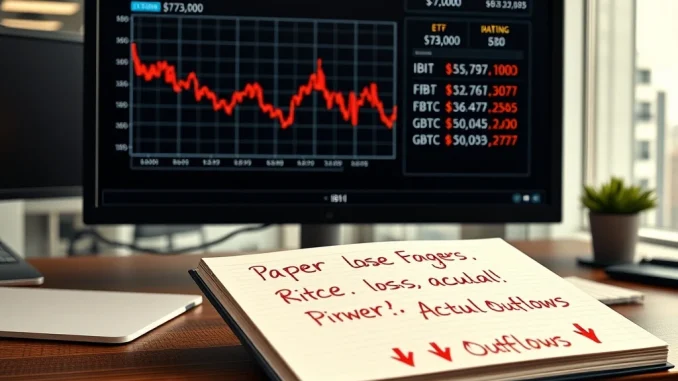
Bitcoin ETFs Face Their Toughest Test Yet as BTC Slides Under $73K: A Deep Dive into Paper Losses and Holder Resolve
New York, May 2025: The United States spot Bitcoin exchange-traded fund (ETF) market is confronting its most significant period of strain since its landmark launch earlier this year. As the price of Bitcoin (BTC) retreats below the $73,000 threshold, these investment vehicles are collectively recording their largest unrealized, or “paper,” losses to date. The emerging narrative, however, is not one of panic-driven selling. Despite the sustained downward pressure on prices over recent weeks, data reveals a market characterized by remarkably limited investor outflows, presenting a complex picture of conviction versus caution.
Bitcoin ETFs Navigate Uncharted Volatility Waters
The introduction of spot Bitcoin ETFs in January 2025 represented a watershed moment for cryptocurrency adoption, granting traditional investors a regulated, familiar vehicle for exposure. Their initial months saw record-breaking inflows, propelling Bitcoin to new all-time highs. The current phase marks a critical stress test for this nascent asset class within conventional finance. A decline in the underlying asset’s price directly impacts the net asset value (NAV) of these funds. When BTC trades below the average purchase price for the ETF’s Bitcoin holdings, it creates a situation where investors see a negative value on their statements—a paper loss. The scale of these unrealized losses has now reached a peak, challenging the thesis that ETF investors might be quicker to exit during downturns compared to long-term Bitcoin holders.
Analyzing the Data: Losses on Paper Versus Money in Motion
Market analytics firms report that the aggregate unrealized loss across the major U.S. spot Bitcoin ETFs has surpassed any previous drawdown since inception. This calculation is based on the difference between the current spot price of Bitcoin and the volume-weighted average price at which these ETFs acquired their BTC holdings. To understand the market dynamic, it’s essential to distinguish between paper losses and realized losses via outflows.
- Paper Losses: These are theoretical losses that exist only on an accounting ledger until an investor sells their ETF shares. They represent a decline in portfolio value but do not constitute an actual cash loss unless the position is closed.
- ETF Outflows: This metric tracks the actual movement of capital out of the fund. When investors redeem shares, the ETF issuer must sell a corresponding amount of Bitcoin, creating sell-side pressure on the market.
The compelling story lies in the divergence between these two metrics. While paper losses have ballooned, daily net outflow figures have remained contained, often fluctuating between minor outflows and occasional inflows. This suggests a cohort of investors is choosing to hold through volatility, perhaps viewing the dip as a consolidation phase rather than a trend reversal.
The Psychology of the Modern ETF Investor
Financial analysts point to several factors that may explain the resilience. First, a significant portion of early ETF capital came from institutional investors and registered investment advisors (RIAs) with longer-term strategic horizons. Their investment mandates often include volatility expectations for an asset like Bitcoin. Second, the very structure of an ETF provides a psychological cushion different from holding Bitcoin directly on an exchange; the interface is familiar, and the action of selling may feel more like rebalancing a traditional portfolio than “exiting crypto.” Finally, the broader macroeconomic context—including monetary policy expectations and geopolitical stability—plays a role in overall risk asset appetite, of which Bitcoin is now a recognized part.
Historical Context and Market Structure Implications
This period invites comparison to previous Bitcoin cycles and the behavior of the Grayscale Bitcoin Trust (GBTC) before its conversion to an ETF. GBTC famously traded at steep premiums and later discounts to NAV during volatile periods, with investors trapped due to its closed-end structure. The modern spot ETF framework, with its creation/redemption mechanism, is designed to prevent such persistent discounts. The current low outflows indicate the mechanism is functioning as intended, with authorized participants able to manage liquidity without forcing large, destabilizing Bitcoin sales. This structural integrity during stress is a positive sign for the long-term viability of these products.
Potential Scenarios and Liquidity Watchpoints
The market’s next phase depends on several variables. If Bitcoin’s price finds a stable support level above key technical and psychological markers, paper losses may begin to shrink, potentially reinforcing holder resolve. Conversely, a further sustained decline could test the patience of ETF investors more severely. Analysts are closely monitoring the options market for clues, observing put/call ratios and the concentration of leverage in the derivatives sector that could exacerbate moves. The true test of the ETF market’s depth will be its ability to handle a scenario where outflows begin to accelerate in tandem with falling prices, a situation not yet seen.
Conclusion
The slide of Bitcoin below $73,000 has indeed initiated the toughest test yet for U.S. spot Bitcoin ETFs, crystallizing massive paper losses for the first time. However, the muted outflow response paints a picture of a maturing market segment. Investors, thus far, are demonstrating a tolerance for volatility that aligns more with strategic asset allocation than speculative trading. This period is less about the failure of the ETF thesis and more about its baptism by fire. The resilience of these capital flows will be a critical data point for regulators, traditional finance institutions, and the cryptocurrency ecosystem at large, ultimately defining the role Bitcoin ETFs will play in future market cycles. The focus keyword, Bitcoin ETFs, remains at the center of a pivotal experiment in financial integration.
FAQs
Q1: What are “paper losses” for a Bitcoin ETF?
A paper loss is an unrealized loss that occurs when the current market price of the ETF’s underlying asset (Bitcoin) falls below the average price the fund paid for it. It reduces the ETF’s net asset value but does not become an actual financial loss for an investor unless they sell their shares.
Q2: Why are outflows from Bitcoin ETFs still limited if losses are so high?
Several factors contribute, including the long-term strategic outlook of many institutional ETF investors, the psychological familiarity of the ETF wrapper compared to direct crypto ownership, and a possible market view that the current price drop is a correction within a longer-term trend.
Q3: How does this ETF volatility compare to holding Bitcoin directly?
The volatility of the Bitcoin price affects both equally. However, the ETF structure adds a layer of traditional market mechanics (like NAV tracking and creation/redemption) and may attract a different investor demographic with potentially different risk tolerance and behavior than a typical crypto exchange user.
Q4: Could large ETF outflows force Bitcoin’s price down further?
Yes, theoretically. Sustained, significant outflows require ETF issuers to sell Bitcoin to meet redemptions, creating additional sell-side pressure on the market. The current low outflow environment has prevented this feedback loop from amplifying the downturn.
Q5: What does this stress test mean for the future of cryptocurrency ETFs?
This period is crucial for establishing the credibility and stability of crypto ETFs within traditional finance. Demonstrating that these products and their investors can weather significant volatility without dysfunctional outflows is key to gaining further acceptance from regulators and a broader set of institutional investors.
Related News
- Spot Ethereum ETF Inflows Surge: $4.7M Net Gain Marks Fifth Consecutive Day of Bullish Momentum
- Clear Street Expands Digital Assets Division: Strategic Push into Institutional Crypto
- NYC Token Rug Pull: Shocking Denial from Former Mayor Adams Amid Conflicting Liquidity Reports
Related: Crypto Market Plunge: 6.38% Wiped Out as Sector Enters 'Extreme Fear' Zone
Related: Essential Logan Update Unveils 8 Critical Cardano Integrations for Ecosystem Growth
Related: Essential Analysis: 5 Cryptocurrencies for a Strategic Long-Term Portfolio (2026 Outlook)