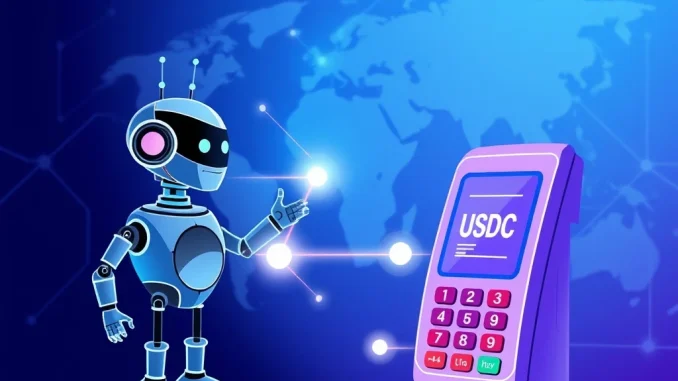
Zurich, Switzerland, March 15, 2025: AEON, a prominent blockchain infrastructure provider, has announced the integration of Starknet-native USDC into its payment network. This strategic move aims to facilitate zero-knowledge (ZK) fast payments to over 50 million merchants worldwide while establishing a scalable settlement layer specifically designed for the burgeoning artificial intelligence economy. The integration represents a significant step toward bridging decentralized finance with real-world commercial applications.
AEON Starknet USDC Integration Creates New Payment Infrastructure
The integration of Starknet-native USDC into AEON’s payment network addresses several critical challenges in blockchain-based commerce. Traditional payment systems often struggle with scalability, high transaction costs, and settlement delays. By leveraging Starknet’s zero-knowledge rollup technology, AEON enables transactions that are both faster and more cost-effective than conventional blockchain payments. This infrastructure supports microtransactions, which are essential for AI-driven services that may require numerous small payments for computational resources or data access.
Starknet, developed by StarkWare, operates as a Layer 2 scaling solution for Ethereum. It uses zero-knowledge proofs to bundle multiple transactions off-chain before submitting a single proof to the Ethereum mainnet. This approach dramatically reduces congestion and gas fees while maintaining the security guarantees of the underlying blockchain. The native USDC integration means the stablecoin exists directly on the Starknet network rather than as a wrapped asset, eliminating bridging risks and simplifying the user experience.
Real-World AI Payments and Economic Implications
The artificial intelligence economy requires payment systems capable of handling automated, high-frequency transactions between AI agents, service providers, and end-users. Traditional financial infrastructure lacks the programmability and interoperability needed for these emerging use cases. AEON’s implementation creates a settlement layer where AI systems can autonomously pay for computational resources, data access, and API calls using a stable digital currency.
Industry analysts note several potential applications for this technology:
- AI Service Marketplaces: Platforms where developers can monetize AI models through pay-per-use transactions
- Decentralized Compute Networks: Systems where users pay for GPU time or specialized processing using automated smart contracts
- Data Economy Platforms: Marketplaces where data providers receive micropayments for verified data contributions
- Autonomous Agent Networks: Ecosystems where AI agents conduct economic activities without human intervention
The table below illustrates the comparative advantages of AEON’s Starknet-native USDC implementation:
| Feature | Traditional Payment Rails | AEON Starknet USDC Solution |
|---|---|---|
| Transaction Speed | 1-3 business days | Seconds to minutes |
| Transaction Cost | 1-3% + fixed fees | Fractional cent fees |
| Settlement Finality | Provisional with chargeback risk | Immediate and irreversible |
| Programmability | Limited through APIs | Native smart contract integration |
| Global Accessibility | Geographic restrictions apply | Borderless by design |
Technical Architecture and Security Considerations
AEON’s implementation utilizes Starknet’s Cairo programming language to create specialized smart contracts that manage USDC transactions. These contracts include features for batch processing, fee optimization, and compliance verification. The system maintains a non-custodial architecture where users retain control of their funds throughout the payment process. Security audits conducted by third-party firms have verified the implementation’s resilience against common vulnerabilities including reentrancy attacks and front-running.
The integration follows a phased rollout approach, beginning with select merchant partners in regions with clear regulatory frameworks for stablecoin usage. Initial testing focuses on e-commerce transactions before expanding to physical point-of-sale systems. Merchant onboarding includes educational resources about blockchain technology and compliance requirements, addressing common adoption barriers in traditional retail environments.
Global Merchant Settlement and Adoption Challenges
AEON’s target of 50 million merchants represents approximately 15% of the global merchant population. Achieving this scale requires addressing several practical challenges. Currency volatility has historically deterred merchants from accepting cryptocurrency payments. USDC’s stable value, pegged 1:1 to the US dollar, eliminates this concern for settlement purposes. However, regulatory compliance varies significantly across jurisdictions, requiring localized implementations for different markets.
The settlement process operates through AEON’s proprietary gateway technology, which converts USDC payments into local fiat currency for merchants who prefer traditional settlement. This hybrid approach allows merchants to benefit from blockchain efficiency while maintaining familiar banking relationships. Settlement occurs daily or weekly based on merchant preferences, with transparent reporting of exchange rates and fees.
Early pilot programs in Southeast Asia and Europe have demonstrated particular success in cross-border e-commerce, where traditional payment methods incur high fees and extended settlement times. Merchants participating in these pilots reported settlement cost reductions of 40-60% compared to conventional international payment processors. The system’s transparency also reduced reconciliation efforts and provided clearer audit trails for accounting purposes.
Industry Context and Competitive Landscape
The convergence of blockchain technology and artificial intelligence represents an emerging sector with several competing approaches. Other projects exploring similar territory include decentralized compute networks like Akash and Render, which focus primarily on resource marketplaces rather than general merchant payments. Established payment processors are experimenting with blockchain integration, though their implementations typically utilize permissioned networks rather than public blockchains like Starknet.
AEON’s differentiation lies in its dual focus on both AI economy payments and traditional merchant settlement. This bifocal approach creates network effects where AI-driven transactions increase utility for merchants, while merchant adoption provides liquidity and stability for AI applications. The use of a widely recognized stablecoin like USDC, rather than a proprietary token, reduces adoption friction and regulatory complexity.
Conclusion
The AEON Starknet USDC integration represents a significant advancement in blockchain-based payment infrastructure. By combining zero-knowledge proof scalability with a widely adopted stablecoin, the system addresses practical barriers to cryptocurrency adoption in both artificial intelligence applications and traditional commerce. The implementation’s phased approach to global merchant onboarding demonstrates understanding of real-world adoption challenges, while its technical architecture provides the foundation for emerging AI economic activities. As blockchain technology continues evolving toward practical utility, integrations like AEON’s Starknet-native USDC implementation bridge the gap between cryptographic innovation and mainstream commercial applications, potentially reshaping how value transfers occur in both digital and physical economies.
FAQs
Q1: What is Starknet-native USDC and how does it differ from regular USDC?
Starknet-native USDC is a version of the USDC stablecoin that exists directly on the Starknet Layer 2 network rather than on Ethereum mainnet. This native implementation eliminates the need for bridging assets between networks, reducing complexity, costs, and potential security risks associated with cross-chain transfers.
Q2: How does this integration benefit traditional merchants who may not understand blockchain technology?
Merchants interact with familiar point-of-sale interfaces and receive settlements in their local currency through AEON’s gateway system. They benefit from faster settlement times and lower transaction costs without needing technical blockchain knowledge. The complexity of the underlying technology remains abstracted from their daily operations.
Q3: What makes this system suitable for AI economy payments compared to traditional payment methods?
AI applications often require numerous microtransactions between autonomous agents, services, and users. Traditional payment systems struggle with high-frequency, low-value transactions due to costs and settlement delays. AEON’s implementation enables programmable, automated payments at fractional costs, making AI-driven economic activities financially viable.
Q4: How does the system ensure regulatory compliance across different jurisdictions?
AEON implements region-specific compliance modules that verify transactions against local regulations. The system includes identity verification where required, transaction monitoring for suspicious activities, and reporting capabilities for tax and audit purposes. Implementation follows a phased approach beginning in regions with clear regulatory frameworks.
Q5: What are the security advantages of using zero-knowledge proofs for payment processing?
Zero-knowledge proofs enable transaction validation without revealing sensitive details about the parties or amounts involved, enhancing privacy while maintaining auditability. The technology also reduces the computational load on the main blockchain, decreasing vulnerability to congestion-based attacks while maintaining the security guarantees of the underlying Ethereum network.