Global, March 2025: In a significant move for the decentralized finance (DeFi) ecosystem, Cache Wallet has announced a strategic partnership with RAX Finance. This collaboration aims to merge Cache Wallet’s pioneering recovery-first security architecture with RAX Finance’s sophisticated suite of cross-chain DeFi tools. The alliance represents a concerted effort to address two persistent challenges in the Web3 space: user security and fragmented liquidity across disparate blockchain networks.
Cache Wallet and RAX Finance Announce Strategic DeFi Partnership
The partnership, formalized this week, is not merely a technical integration but a shared vision for a more accessible and secure decentralized financial future. Cache Wallet, known for its user-centric approach to private key management and asset recovery, will integrate RAX Finance’s aggregation layer directly into its interface. This allows users to access yield farming, lending, borrowing, and swapping opportunities across Ethereum, Solana, Avalanche, and other supported chains without ever compromising the security principles of their non-custodial wallet. Industry analysts view this as a logical convergence, where robust security infrastructure meets advanced financial utility, potentially lowering the entry barrier for millions of users cautious about DeFi’s technical and security risks.
Bridging the Gap Between Wallet Security and DeFi Utility
Historically, DeFi users have faced a difficult trade-off: opt for the convenience of custodial solutions or centralized exchanges, which introduce counterparty risk, or navigate the complex and unforgiving landscape of self-custody with its permanent loss vectors. Cache Wallet’s core innovation lies in its social recovery and multi-factor authentication systems, which provide a safety net without centralizing control. RAX Finance, conversely, has built a reputation for its intelligent routing algorithms that find the best execution prices and yields across dozens of decentralized exchanges (DEXs) and lending protocols.
- Security-First Design: Cache Wallet’s architecture ensures that private keys never leave the user’s device, and recovery mechanisms are decentralized, aligning with the ethos of self-sovereignty.
- Unified Liquidity Access: RAX Finance’s engine scans liquidity pools across multiple layer-1 and layer-2 networks, presenting optimized opportunities in a single dashboard.
- Reduced Complexity: The integration abstracts away the need for users to manually bridge assets or interact with unfamiliar smart contracts on new chains, a common source of user error.
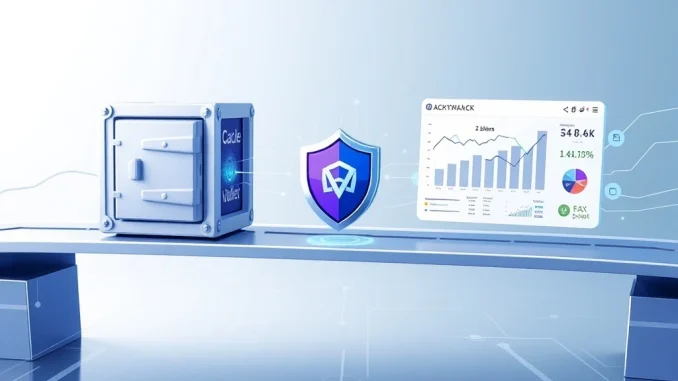
This synergy effectively creates a secure gateway. Users can manage their identity and assets with Cache Wallet’s robust security model while seamlessly tapping into the expansive, multi-chain financial landscape curated by RAX.
The Evolution of Wallet Technology and DeFi Aggregation
The collaboration reflects broader trends in blockchain development. Early wallets like MetaMask provided basic interaction with the Ethereum blockchain. The rise of multi-chain ecosystems necessitated wallets like Phantom (Solana) and Core (Avalanche). Simultaneously, the DeFi explosion of 2020-2021 led to fragmented liquidity, birthing aggregators like 1inch and Yearn Finance. The current phase, as exemplified by this partnership, is one of consolidation and user experience refinement. It moves beyond simple connectivity to offer a cohesive, secure, and intelligent financial interface. This mirrors the evolution of traditional online banking, which integrated security features like two-factor authentication with aggregated financial views from multiple accounts.
Implications for Mainstream DeFi Adoption and Market Structure
The implications of this partnership extend beyond the two companies. By lowering the technical and security barriers, it has the potential to accelerate mainstream adoption of DeFi. Financial institutions and fintech companies exploring blockchain integration often cite security and interoperability as primary hurdles. A proven model combining enterprise-grade security with cross-chain functionality provides a valuable reference point. Furthermore, it could influence market structure by directing more user volume through secure, aggregated pathways, potentially increasing liquidity efficiency and reducing arbitrage gaps across chains. However, the success of such integrations always hinges on rigorous, continuous smart contract audits and transparent communication regarding the risks inherent in any DeFi activity, even when routed through a secure wallet.
Conclusion
The strategic alliance between Cache Wallet and RAX Finance marks a pivotal step towards maturing the decentralized finance landscape. It directly addresses critical friction points for users by combining secure DeFi access with a recovery-focused security model. This partnership underscores a growing industry priority: building seamless, safe, and powerful interfaces that empower users without forcing them to become security experts or full-time liquidity hunters. As the blockchain space continues to evolve, collaborations that bridge foundational infrastructure with application-layer innovation will be crucial in transforming DeFi from a niche technical domain into a broadly accessible component of the global financial system.
FAQs
Q1: What is the primary goal of the Cache Wallet and RAX Finance partnership?
The primary goal is to provide users with a seamless and secure way to access decentralized finance (DeFi) opportunities across multiple blockchain networks. It combines Cache Wallet’s recovery-first security features with RAX Finance’s tools for finding the best yields and swap rates across various chains.
Q2: How does Cache Wallet’s “recovery-first” security work?
Cache Wallet uses mechanisms like social recovery (where trusted contacts can help restore access) or multi-factor authentication instead of a single, easily-lost seed phrase. This design aims to prevent the permanent loss of funds, a common risk in self-custody, while maintaining a non-custodial model where users retain control of their assets.
Q3: Do I need to move my assets to use RAX Finance through Cache Wallet?
No. A key benefit of the integration is that users can interact with DeFi protocols on chains where their assets already reside. RAX Finance’s aggregation layer will locate opportunities based on the assets held in your connected Cache Wallet, minimizing the need for complex and costly cross-chain bridging transactions.
Q4: Does this partnership make DeFi activities completely risk-free?
No. While it significantly enhances security regarding key management and reduces user error, it does not eliminate the inherent risks of DeFi, such as smart contract vulnerabilities, protocol insolvency, or market volatility. Users should always conduct their own research and understand that all DeFi interactions carry financial risk.
Q5: Which blockchain networks will be supported through this integration?
While the initial rollout focuses on major networks like Ethereum, Solana, and Avalanche, the architecture is designed to be chain-agnostic. Both companies have indicated that support will expand over time to include other prominent layer-1 and layer-2 networks based on user demand and liquidity growth.