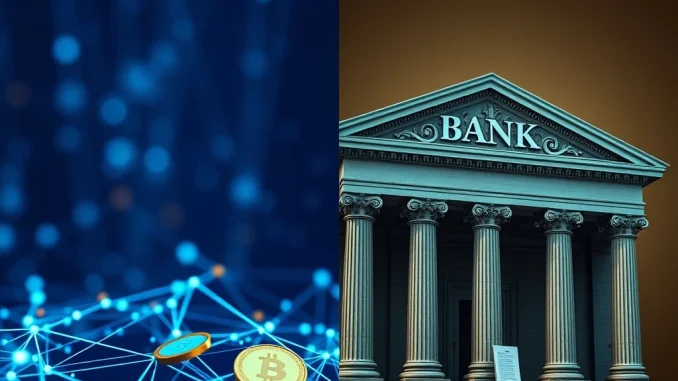
Global Financial System, 2025: A quiet revolution in digital payments is casting a harsh light on the foundational plumbing of global finance. Stablecoins, digital assets pegged to stable reserves like the US dollar, are no longer just a niche crypto tool. Their rapid adoption for payments and settlements is revealing stark, structural limitations in traditional banking systems built on batch processing, daily limits, and intermediary delays. This contrast between the instant, final settlement on blockchain networks and the multi-day clearing cycles of legacy banks is forcing a fundamental reassessment of what modern financial infrastructure should provide.
Stablecoins Challenge the Core Tenets of Traditional Banking
The primary function of any payment system is to transfer value from one party to another with certainty and speed. Traditional banking, developed over centuries, operates on a system of deferred net settlement. When you send a wire transfer or use an Automated Clearing House (ACH) payment, the transaction enters a queue. Banks aggregate these transactions, process them in batches—often at the end of the business day—and settle the net positions between institutions through central bank accounts. This process, while reliable, introduces inherent delays, typically ranging from one to three business days for full settlement and finality.
Stablecoins, operating on public blockchain networks like Ethereum, Solana, or Stellar, function differently. Settlement and transaction finality are nearly instantaneous. When a user sends USDC or another major stablecoin, the transaction is validated by a decentralized network, recorded on an immutable public ledger, and completed in minutes or seconds. The recipient has immediate, verifiable proof of ownership without reliance on a bank’s promise to pay later. This shift from “promise-based” to “proof-based” settlement represents a fundamental architectural divergence.
The Structural Limits of Legacy Financial Rails
The inefficiencies of traditional systems manifest in several concrete ways that directly impact user experience and economic activity. First are operational hours. Most core banking settlement systems do not operate on weekends or holidays, creating artificial pauses in the global flow of capital. Blockchain networks, in contrast, are global and operational 24/7/365.
Second are transfer caps and account freezes. Banks impose daily and monthly transfer limits on accounts for risk management and regulatory compliance purposes. While sometimes necessary, these limits can restrict legitimate business activity and personal financial autonomy. Furthermore, banks can—and do—freeze accounts or delay transactions for compliance reviews, often with limited immediate recourse for the customer. Blockchain transactions, once broadcast, cannot be unilaterally halted by an intermediary.
- Speed: Bank wires: 1-3 days. Stablecoin transfers: Seconds to minutes.
- Finality: Bank settlement: Provisional until net clearing. Blockchain settlement: Cryptographic and immediate.
- Access: Banking: 9-5, weekdays. Blockchain: 24/7, globally.
- Control: Banking: Subject to intermediary rules and freezes. Blockchain: User-controlled with private keys.
The On-Chain Mirror of Traditional Assets
The evolution of tokenized real-world assets (RWAs) deepens this contrast. Today, treasury bills, commercial debt, and even real estate are being digitized and represented as tokens on blockchains. These tokenized assets can be traded, used as collateral in decentralized finance (DeFi) protocols, or settled peer-to-peer with the same speed and programmability as stablecoins. This creates a parallel financial system where traditional asset classes gain the liquidity and transactional efficiency of the digital realm, a feature absent in their conventional, paper-based or book-entry forms held in custodial accounts.
Financial analysts note that this isn’t merely a technical upgrade but a shift in financial paradigm. “The legacy system is built on a foundation of managed delay and controlled risk through time,” explains a fintech strategist at a major consultancy. “Blockchain, and by extension stablecoins, compresses that timeline to near-zero. It doesn’t just make things faster; it changes the very nature of liquidity, credit, and risk modeling. The structural limits of the old system weren’t apparent until a viable alternative demonstrated what was possible.”
Regulatory and Institutional Responses to the Disruption
The rise of stablecoins has not gone unnoticed by regulators and traditional financial institutions. Central banks worldwide are accelerating research into Central Bank Digital Currencies (CBDCs), partly in response to the capabilities demonstrated by stablecoins. Major banks are exploring private permissioned blockchains for interbank settlement to capture some of the efficiency gains. Regulatory frameworks, such as the EU’s MiCA (Markets in Crypto-Assets) regulation and evolving guidance in the United States, aim to bring stablecoin issuers under similar oversight to money transmitters and payment institutions, addressing concerns about consumer protection and financial stability.
This regulatory engagement itself validates the disruptive potential. The conversation has moved from whether blockchain-based payments are viable to how they should be integrated and governed within the broader financial ecosystem. The competition is now focused on which model—permissioned bank-led blockchains, public decentralized networks, or a hybrid—will define the future of value transfer.
Conclusion: A Catalyst for Modernization
The emergence and maturation of stablecoins serve as a powerful catalyst, exposing structural limits in traditional banking that many users had simply accepted as unavoidable. The clear contrast in transaction finality, operational hours, and user autonomy highlights that many “features” of the old system are, in fact, limitations born of legacy technology and centralized control. While traditional banks offer critical services like insured deposits and complex lending that stablecoins do not replace, the pressure on their payment and settlement infrastructure is now undeniable. The ongoing dialogue between innovators and regulators will shape the hybrid financial system of the future, but one outcome is certain: the benchmark for speed, accessibility, and finality in payments has been permanently raised.
FAQs
Q1: What is the main structural difference between a stablecoin transfer and a bank wire?
The core difference is finality. A stablecoin transfer on a blockchain is cryptographically settled and immutable within minutes. A bank wire is an instruction that enters a multi-day clearing and net settlement process between banks before funds are finally available.
Q2: Why do banks have daily transfer limits if stablecoins don’t?
Banks impose limits primarily for fraud prevention and regulatory compliance (like anti-money laundering controls). Their centralized model makes them liable for transactions, so they control flow. Stablecoin transactions are user-initiated and peer-to-peer, with compliance often pushed to the endpoints (exchanges) rather than the network itself.
Q3: Are stablecoin transactions truly irreversible?
On the blockchain level, yes. Once validated and added to the ledger, a transaction cannot be reversed. This is why user security (protecting private keys) is paramount. It eliminates intermediary risk but increases user responsibility. Some services built on top may offer fraud protection, but the base layer settlement is final.
Q4: How do tokenized real-world assets (RWAs) relate to this banking discussion?
Tokenized RWAs bring traditional assets like bonds or commodities onto blockchains. This allows them to be traded and settled with the same speed and 24/7 availability as stablecoins, bypassing the slower, paper-based settlement systems of traditional capital markets and highlighting their inefficiencies.
Q5: Is the traditional banking system becoming obsolete because of this?
Not obsolete, but pressured to evolve. Banks still provide essential services like secure custody (with insurance), credit creation, and complex financial products. However, their monopoly over basic payment rails and settlement is being challenged. The likely future is a hybrid model where banks integrate faster blockchain-based settlement for certain functions while maintaining their other roles.