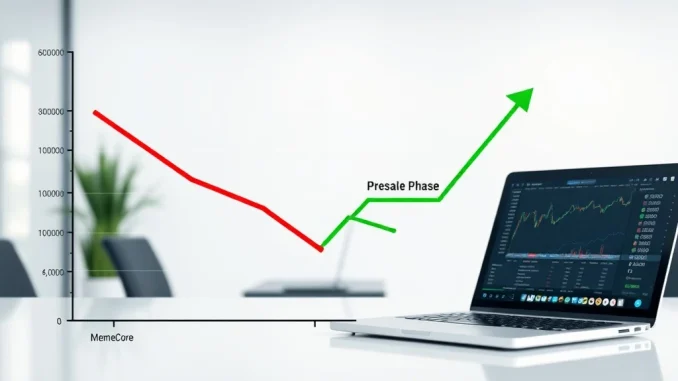
Global Cryptocurrency Markets, May 2025: The cryptocurrency market witnessed a notable correction this week as MemeCore, a prominent meme-inspired digital asset, recorded a 12.55% decline in its market value. This movement has prompted a broader discussion among market participants regarding volatility, project fundamentals, and alternative investment avenues, particularly those structured around fixed-price presale events and underlying technological utility, such as the DOGEBALL project’s approach.
Analyzing the MemeCore Market Correction
Market data from several major exchanges confirms MemeCore’s price dropped significantly over a 48-hour period. Analysts point to a combination of factors that commonly influence altcoin markets. Broader profit-taking across the meme coin sector contributed to the downward pressure. Furthermore, shifts in trading volume and liquidity often exacerbate price movements for tokens with high retail investor concentration. Historical context is important; similar corrections have occurred throughout crypto history, such as during the 2018 downturn and various mini-cycles, where assets lacking immediate utility or burning mechanisms experienced steeper declines. The immediate consequence is a reevaluation of risk exposure by holders, while the broader implication reinforces the market’s ongoing differentiation between pure speculation and projects with defined roadmaps.
The Investor Pivot Towards Structured Presale Events
In response to such volatility, a segment of investors consistently seeks avenues with perceived lower entry risk. Fixed-price presale events represent one such model. These events allow participants to acquire tokens at a set price before a public listing, theoretically insulating them from short-term market swings during the sale period. The DOGEBALL project, as referenced in market discussions, employs this model. It is crucial to understand the mechanics: a presale typically involves selling a portion of the total token supply to early backers to fund development. This method contrasts with fair launch models or immediate exchange listings, which are subject to market pricing from inception. Investors weigh factors like vesting schedules, use of funds, and the project’s technical whitepaper when assessing such opportunities.
- Price Stability: A fixed purchase price during the sale period.
- Funding Clarity: Presale funds are often earmarked for specific development milestones.
- Risk Factors: Presale investments carry development risk, as the project’s mainnet or product may not yet be live.
The Role of Layer-2 Scaling and Gaming Utility
Beyond the funding mechanism, the underlying technology of a project forms a core part of the investment thesis. The integration of a custom Ethereum Layer-2 (L2) solution, as proposed by projects like DOGEBALL, addresses two critical industry challenges: transaction cost and speed. Ethereum’s mainnet, while secure, can suffer from high gas fees during congestion. L2 solutions, such as Optimistic Rollups or ZK-Rollups, batch transactions off-chain before settling on Ethereum, drastically reducing costs and increasing throughput. For a gaming-focused token, this is not merely a technical detail but a fundamental requirement for user adoption, as players require fast and inexpensive transactions for in-game activities. The utility derived from integrating a token within a game’s economy—for items, rewards, or access—aims to create inherent demand beyond speculative trading.
Historical Context and the 2026 Investment Landscape
Looking toward 2026 requires an understanding of crypto market cycles and development timelines. Major gains in the past have often been associated with the maturation of a foundational technology, such as the rise of decentralized finance (DeFi) in 2020 following the development of robust smart contract platforms. The current cycle emphasizes scalability and real-world application. Projects initiating development now, with presales in 2025, target a launch and growth phase coinciding with the next anticipated period of broader market expansion, historically projected around 2026. However, it is vital to frame this not as a guarantee but as a strategic window based on typical software development cycles (18-24 months) and historical inter-cycle periods. The potential for significant valuation increases always exists alongside the potential for project failure, making due diligence paramount.
Conclusion
The 12.55% decline in MemeCore’s value serves as a timely case study in cryptocurrency market dynamics, highlighting the inherent volatility of the asset class. This event has concurrently drawn investor attention to alternative models like fixed-price presales and projects emphasizing tangible utility through Layer-2 scaling and gaming integration. As the market evolves towards 2026, the differentiation between assets based on speculative sentiment and those backed by technological execution and clear use cases is likely to intensify. A disciplined investment strategy in this space must account for both the high-reward potential and the substantial risks, with a focus on verifiable development progress and sustainable economic models.
FAQs
Q1: What does a 12.55% drop mean for a cryptocurrency like MemeCore?
Such a decline represents a significant short-term loss in market capitalization and investor portfolio value. It often triggers analysis of trading volume, liquidity depth, and community sentiment to determine if it’s an isolated correction or part of a larger trend.
Q2: How does a fixed-price presale work?
A fixed-price presale is a fundraising event where a crypto project sells a portion of its tokens to early investors at a predetermined price before the tokens are listed on public exchanges. This price remains stable throughout the sale period.
Q3: What is an Ethereum Layer-2 (L2) solution?
An Ethereum L2 is a secondary framework or protocol built on top of the Ethereum blockchain. Its primary purpose is to improve scalability by handling transactions off the main Ethereum chain (Layer-1), thereby reducing fees and increasing transaction speed, while still leveraging Ethereum’s security.
Q4: Why is gaming utility considered important for a cryptocurrency’s value?
Gaming utility can create consistent, organic demand for a token. If a token is required to purchase in-game items, access features, or earn rewards, its demand is tied to platform usage rather than purely speculative trading, which can contribute to a more stable valuation model.
Q5: What should investors research before considering a 2026-focused crypto project?
Key research areas include the project’s whitepaper and technical roadmap, the experience and transparency of the development team, the tokenomics (supply, distribution, vesting), the problem the project aims to solve, its competitive landscape, and the progress on its stated milestones, such as testnet or mainnet launches.