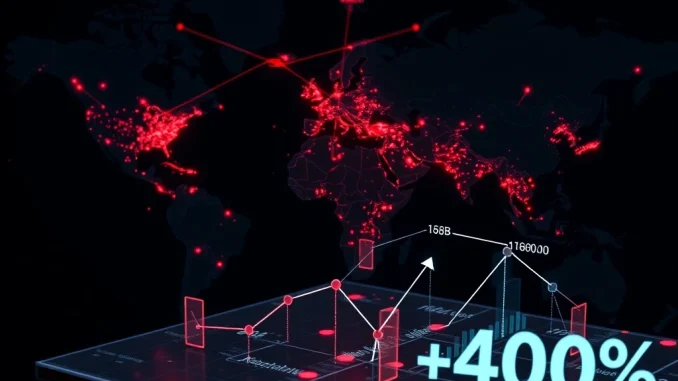
Global, April 2025: Cryptocurrency-related crime linked to Russian networks has surged to its highest level in five years, according to a landmark report from blockchain intelligence firm TRM Labs. The data reveals a staggering $158 billion flowed into illicit cryptocurrency wallets in 2025, driven by sophisticated sanctions evasion tactics, including a more than 400 percent increase in the use of the obscure A7A5 stablecoin. This unprecedented peak marks a critical escalation in the use of digital assets for illicit finance, presenting a formidable challenge to global regulatory and law enforcement agencies.
Russia Crypto Crime Networks Fuel Record $158 Billion Illicit Flow
TRM Labs’ 2025 Illicit Crypto Economy Report provides the most comprehensive analysis to date of the scale and sophistication of Russian-affiliated cryptocurrency crime. The $158 billion figure represents the total value received by wallets identified as facilitating illicit activities, including sanctions evasion, ransomware payments, darknet market sales, and fraud. This sum eclipses previous annual totals and indicates a maturation and professionalization of criminal crypto operations. Analysts note that while global illicit crypto transaction volume has fluctuated, the subset connected to Russian actors has shown consistent, aggressive growth since 2022, correlating directly with the expansion of international sanctions. The networks involved are not monolithic; they comprise a complex ecosystem of state-affiliated groups, cybercriminal gangs, and oligarch-linked financial operatives, all leveraging blockchain’s pseudo-anonymity.
The A7A5 Stablecoin and the 400% Surge in Sanctions Evasion
A central finding of the report is the explosive adoption of the A7A5 stablecoin as a primary tool for circumventing financial sanctions. Unlike mainstream stablecoins like USDT or USDC, A7A5 operates on a permissioned blockchain with validators primarily located in jurisdictions outside the reach of Western regulators. Its value is ostensibly pegged to a basket of currencies and commodities, but its opaque governance and lack of regular audits make it an ideal vehicle for moving value across borders unseen.
- Mechanism of Evasion: Entities under sanctions convert assets into A7A5 through over-the-counter (OTC) desks or compliant exchanges in friendly nations. The stablecoin is then transferred to private wallets or used to pay for critical imports like semiconductors, dual-use technology, and manufacturing equipment.
- Network Effect: The report details how the use of A7A5 created a network effect within sanctioned economies. As more merchants and counterparties accepted it, its utility and liquidity increased, fueling the 400% year-over-year growth in its use for illicit transactions.
- Regulatory Blind Spot: “A7A5 represents a deliberate design to exploit gaps in the global regulatory framework,” the TRM Labs report states. “Its architecture is built not for efficiency, but for obfuscation and jurisdictional arbitrage.”
Historical Context: The Evolution of Crypto-Enabled Sanctions Evasion
The current peak did not emerge in a vacuum. Following the initial sanctions imposed in 2014 after the annexation of Crimea, Russian entities began experimenting with cryptocurrencies. The period from 2017 to 2021 saw a rise in the use of Bitcoin and Monero for lower-value transactions. The comprehensive sanctions of 2022 acted as a catalyst, forcing a rapid scaling and innovation in evasion techniques. This timeline shifted the focus from privacy coins to stablecoins, which offer price stability crucial for large-scale trade financing. The pivot to A7A5 around late 2023 marked the third phase: the adoption of a purpose-built, geopolitically aligned digital asset designed explicitly to counter Western financial pressure.
Operational Impact and Global Law Enforcement Challenges
The sheer volume of illicit flows has tangible consequences. It undermines the efficacy of sanctions, allowing targeted regimes to sustain military and geopolitical operations. It also floods the global crypto ecosystem with tainted funds, increasing compliance costs for legitimate businesses and risking the integrity of decentralized finance (DeFi) protocols that may be unwittingly used for laundering. For law enforcement, the challenges are multifaceted. The cross-jurisdictional nature of blockchain transactions requires unprecedented international cooperation, which is often slow and politically fraught. Furthermore, the criminals are adept at using mixers, cross-chain bridges, and “chain-hopping”—quickly moving funds between different blockchains—to complicate tracing efforts.
The Technical Arms Race in Blockchain Intelligence
In response, firms like TRM Labs, Chainalysis, and Elliptic are engaged in a continuous technical arms race. They develop heuristic algorithms to identify patterns associated with sanctioned entities, cluster wallets controlled by the same actor, and track funds across multiple blockchains. Their 2025 reports show improved success in attributing complex transactions, but they acknowledge that the scale and speed of the illicit activity often outpace the reactive nature of enforcement. “We are mapping the network in near real-time,” a TRM Labs analyst explained, “but taking down the network requires coordinated legal action across dozens of countries, which takes months or years.”
Conclusion: A Critical Juncture for Crypto Regulation and Security
The TRM Labs data on Russia crypto crime reaching a five-year peak in 2025 serves as a stark indicator that digital assets have become a central battlefield in modern financial warfare and cybercrime. The $158 billion in illicit flows and the 400% explosion in A7A5 stablecoin use for sanctions evasion demonstrate both the vulnerability and the misuse of blockchain technology. This report underscores an urgent need for a cohesive, global regulatory strategy that addresses not just exchanges, but also the issuers of stablecoins, the developers of privacy tools, and the validators of decentralized networks. The integrity of the global financial system and the enforceability of international law may depend on the response to this escalating threat.
FAQs
Q1: What is the main source of the data on Russia crypto crime?
The primary source is the 2025 Illicit Crypto Economy Report published by TRM Labs, a leading blockchain intelligence and compliance company. Their data is derived from analyzing billions of on-chain transactions and cross-referencing them with known illicit addresses and entities.
Q2: What is the A7A5 stablecoin and why is it used for sanctions evasion?
A7A5 is a stablecoin operating on a permissioned blockchain with validators in jurisdictions less cooperative with Western sanctions. Its opaque governance, lack of regular audits, and design make it difficult for regulators to freeze or track, making it an attractive tool for moving value internationally while evading traditional financial controls.
Q3: Does the $158 billion represent money stolen or laundered?
The $158 billion figure represents the total value received by wallets involved in illicit activities. This includes the proceeds of crimes like ransomware and fraud, as well as funds being actively laundered or moved to evade sanctions. It is a measure of the scale of illicit financial flows, not a single theft.
Q4: How do blockchain analysts track these illicit funds?
Analysts use a combination of techniques: clustering wallets based on common ownership heuristics, tracing transaction graphs, labeling addresses associated with known criminal entities or sanctions lists, and using pattern recognition to identify behaviors typical of mixing services or sanctions evasion.
Q5: What can be done to counter this trend in crypto crime?
Countermeasures require a multi-pronged approach: enhanced international regulatory cooperation, stricter compliance requirements for all crypto service providers (including stablecoin issuers), continued development of blockchain intelligence tools, and potentially, targeted sanctions against the developers and validators of networks designed primarily for evasion.