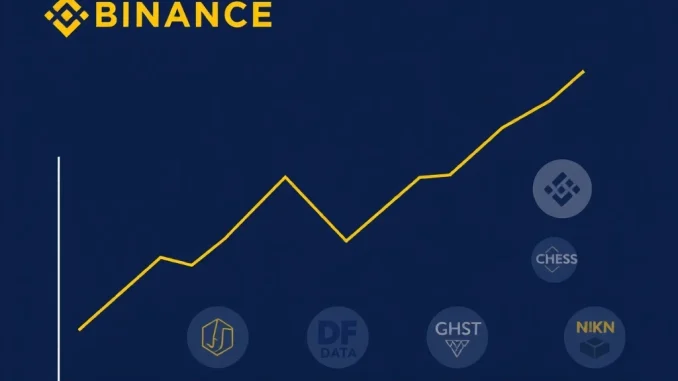
Global, February 2025: In a significant market update, the world’s largest cryptocurrency exchange, Binance, has announced it will delist six specific spot trading pairs. The move, scheduled for 3:00 a.m. UTC on February 13, will remove trading for ACA/BTC, CHESS/BTC, DATA/BTC, DF/BTC, GHST/BTC, and NKN/BTC. This decision underscores the exchange’s ongoing commitment to maintaining a robust and compliant trading environment, directly impacting liquidity and access for these specific digital assets.
Binance Delists Six Spot Trading Pairs: A Detailed Breakdown
Binance’s announcement follows a standard review process where the exchange evaluates all listed tokens against a stringent set of criteria. The primary factors typically include trading volume and liquidity, commitment of the project’s development team, quality and level of public communication, network stability and security, and responsiveness to the exchange’s due diligence inquiries. When a digital asset no longer meets these standards or the industry landscape changes, delisting becomes a necessary action to protect users. The exchange has provided a clear timeline for the cessation of trading. Spot trading for the six pairs will halt precisely at the designated time. Subsequently, Binance will execute a cancellation of all pending orders and delist the pairs. Users are strongly advised to manage their trades and any open orders well before the deadline to avoid automatic cancellation.
Understanding the Delisted Cryptocurrencies and Their Projects
Each of the six tokens represents a distinct blockchain project with unique use cases. Their removal from Binance’s spot market, while significant, does not inherently reflect on the underlying technology but rather on their current market performance and compliance with the exchange’s listing standards.
- ACA (Acala): Acala is a decentralized finance hub and stablecoin platform built for the Polkadot ecosystem, aiming to offer a suite of financial primitives.
- CHESS (Tranchess): CHESS is the governance token for Tranchess, a tokenized asset management and derivatives protocol primarily focused on tracking Bitcoin and Ethereum.
- DATA (Streamr): Streamr’s DATAcoin is designed to power a decentralized real-time data economy, allowing users to monetize data streams.
- DF (dForce): dForce is a decentralized finance protocol network offering a suite of integrated financial services including lending, trading, and stablecoins.
- GHST (Aavegotchi): GHST is the utility and governance token for Aavegotchi, a DeFi-enabled NFT gaming platform where users collect and interact with pixelated ghosts.
- NKN (New Kind of Network): NKN is a project focused on decentralizing network connectivity and bandwidth sharing using blockchain technology.
The common thread for these delistings is their pairing exclusively with Bitcoin (BTC). This suggests lower relative trading volume and liquidity on these specific BTC markets compared to other pairings like USDT or BUSD, which often see higher activity.
The Standard Exchange Review and Compliance Process
Major exchanges like Binance conduct periodic reviews of all listed assets. This process is not unique to Binance; it is a standard operational practice across regulated financial and crypto markets to ensure market integrity. The review assesses multiple, non-negotiable factors. Sustained low trading volume and liquidity are primary concerns, as they can lead to excessive price volatility and market manipulation risks. Furthermore, exchanges monitor the development activity and business viability of the underlying project. A lack of progress or failure to maintain robust, secure networks can trigger a review. The decision to delist is never taken lightly, as it directly affects the exchange’s users and the project’s community. The announcement always provides a grace period, allowing users sufficient time to adjust their positions.
Immediate and Long-Term Consequences for Traders and Holders
The immediate consequence for traders is the loss of a major liquidity venue for converting these specific tokens into Bitcoin on Binance. After delisting, users will not be able to create new spot orders for these pairs. However, it is crucial to note that delisting a trading pair is not synonymous with removing the token from the platform entirely. Users can still hold these assets in their Binance Spot Wallets. They retain the ability to deposit and withdraw the tokens, provided the respective blockchain networks remain operational. For those wishing to trade, they must seek alternative exchanges that still list the assets or utilize decentralized exchanges (DEXs) that support the tokens. The long-term impact varies. For some projects, losing a major exchange listing can reduce visibility and accessibility, potentially affecting price. For others, it may refocus community efforts on other platforms or direct peer-to-peer trading mechanisms.
Historical Context: Binance’s Evolving Market Strategy
This action is part of a consistent pattern observed since Binance’s inception. The exchange has periodically delisted tokens to streamline its offerings and uphold quality standards. For instance, in late 2023 and throughout 2024, Binance executed similar rounds of delistings, often involving dozens of trading pairs. These moves frequently correlate with broader industry shifts towards increased regulatory compliance and a focus on assets with demonstrable utility and sustainable ecosystems. By pruning lower-volume pairs, Binance optimizes its platform’s performance, reduces operational complexity, and aligns with global regulatory expectations that emphasize investor protection and market stability. This historical pattern indicates that such announcements are a normal part of the exchange’s lifecycle management rather than an anomalous event.
Conclusion: Navigating Exchange Delistings as a Crypto Participant
Binance’s decision to delist the ACA, CHESS, DATA, DF, GHST, and NKN spot trading pairs is a procedural market adjustment reflective of standard exchange operations. For users, the key takeaways are proactive management of existing orders before the February 13 deadline and an understanding that asset custody remains unaffected. This event highlights the importance of diversification across trading venues and a fundamental understanding of the projects in one’s portfolio. As the cryptocurrency industry matures, such regulatory and operational refinements by leading exchanges like Binance are expected to continue, reinforcing the need for informed and adaptable market participation.
FAQs
Q1: What happens to my coins after the Binance delisting?
Your coins remain safely in your Binance Spot Wallet. You cannot trade the delisted pairs on Binance, but you can still withdraw them to another wallet or exchange that supports them.
Q2: Will Binance support deposits and withdrawals for these tokens after delisting?
Yes, Binance typically continues to support deposits and withdrawals for the tokens themselves unless a separate announcement is made regarding the token’s status. Always check the official announcement for specific details.
Q3: Why does Binance delist trading pairs?
Binance delists pairs due to factors like consistently low trading volume and liquidity, concerns about network stability or security, or if a project fails to meet the exchange’s evolving listing standards during periodic reviews.
Q4: Is the token ‘dead’ if it gets delisted from Binance?
Not necessarily. Delisting from one exchange, even a major one, does not mean the underlying project has ceased operation. The token may still trade on other centralized exchanges or decentralized platforms.
Q5: What should I do if I have an open order for one of these pairs?
You must cancel any open orders before the delisting time (3:00 a.m. UTC, Feb 13). Binance will cancel all remaining pending orders automatically when trading ceases, but it is best practice to manage this yourself to avoid any unintended issues.