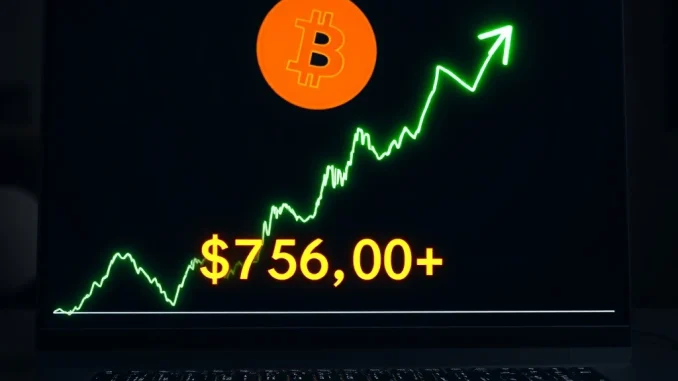
Global, April 2025: The cryptocurrency market witnessed a landmark event as Bitcoin (BTC), the world’s premier digital asset, decisively broke through the $76,000 threshold. According to real-time data from CoinPulseHQ, Bitcoin is currently trading at $76,053.38 on the Binance USDT market, cementing a new chapter in its volatile yet ascendant history. This price point represents not just a numerical milestone but a significant psychological and financial barrier for the asset class, drawing intense scrutiny from investors, regulators, and financial institutions worldwide.
Bitcoin Price Reaches Unprecedented High
The climb to $76,000 marks a continuation of a bullish trend that has characterized Bitcoin’s performance in recent months. This movement is underpinned by a confluence of macroeconomic factors and industry-specific developments. Analysts point to several key drivers. First, increased institutional adoption has provided a more stable foundation of capital. Major asset managers now offer Bitcoin exchange-traded funds (ETFs), granting traditional investors regulated exposure. Second, ongoing geopolitical uncertainties continue to bolster Bitcoin’s perceived role as a digital store of value, akin to digital gold. Finally, the upcoming Bitcoin halving event, a programmed reduction in the block reward for miners, historically creates supply-side scarcity that has preceded major price rallies.
Market depth and liquidity at this new level appear robust. Trading volumes across major exchanges like Binance, Coinbase, and Kraken have spiked significantly, indicating strong buyer interest and participation. The move past $76,000 was not a fleeting spike but a sustained push, with the price consolidating above this level for several hours, suggesting a foundation of support. This price action contrasts with previous bull runs, which were often marked by sharper, more speculative volatility. The current trajectory suggests a market that is maturing, though it remains inherently prone to swift corrections.
Analyzing the Cryptocurrency Market Rally
Bitcoin’s surge has a pronounced ripple effect across the entire digital asset ecosystem. This phenomenon, often called ‘the Bitcoin dominance effect,’ sees altcoins frequently follow BTC’s lead. However, the current cycle shows nuanced behavior. While many major altcoins like Ethereum (ETH) and Solana (SOL) have posted gains, their performance relative to Bitcoin varies, indicating that investors are making more discerning choices based on individual project fundamentals, not just broad market sentiment.
- Institutional Inflows: Data from fund flow reports shows consecutive weeks of substantial capital moving into spot Bitcoin ETFs.
- Macroeconomic Backdrop: Persistent inflation concerns and a shifting interest rate environment in traditional finance have driven some capital towards alternative assets.
- Network Fundamentals: Bitcoin’s hash rate, a measure of network security and miner commitment, remains at an all-time high, signaling strong underlying health.
- Regulatory Clarity: In key jurisdictions, evolving regulatory frameworks, while stringent, are providing a clearer operating environment for large-scale participants.
The table below illustrates Bitcoin’s key price milestones over the past two years, providing context for the current achievement:
| Date | Price Milestone | Key Contextual Event |
|---|---|---|
| Q2 2023 | ~$30,000 | Post-FTX collapse recovery, banking crisis. |
| January 2024 | ~$45,000 | Approval of first U.S. spot Bitcoin ETFs. |
| March 2024 | ~$73,000 (Previous ATH) | Peak following ETF launch enthusiasm. |
| April 2025 | $76,053 | Sustained institutional demand, pre-halving anticipation. |
Historical Context and Market Cycles
Understanding Bitcoin’s journey to $76,000 requires a view of its historical market cycles. Each major bull run has been driven by a different primary narrative. The 2017 surge was largely retail-driven and fueled by initial coin offering (ICO) mania. The 2021 peak correlated with expansive fiscal policy during the global pandemic and the rise of decentralized finance (DeFi). The current phase appears distinct, characterized by formal integration into the traditional financial system. This institutionalization could potentially reduce the amplitude of boom-bust cycles, leading to a more gradual, stepped appreciation over time, though volatility will remain a defining feature.
The psychological impact of surpassing its previous all-time high (around $73,000 in 2024) cannot be understated. It invalidates the bearish narrative of a prolonged downturn and confirms a renewed bullish trend from a technical analysis perspective. This often triggers algorithmic trading models and renews media attention, bringing in a new wave of market participants. However, seasoned analysts caution that such milestones are also typical areas for profit-taking, which can lead to increased short-term volatility and pullbacks.
Implications for Investors and the Digital Economy
The breach of $76,000 has immediate and long-term implications. For retail investors, it reinforces the high-risk, high-reward profile of cryptocurrency. Financial advisors increasingly stress the importance of position sizing and viewing Bitcoin as a speculative portion of a diversified portfolio, not a core holding. For institutions, the higher price validates earlier strategic entries and may accelerate plans for further integration, such as offering crypto custody services or developing blockchain-based payment solutions.
On a macroeconomic scale, Bitcoin’s growing market capitalization strengthens its argument as a legitimate asset class. It forces central banks and policymakers to more seriously consider the implications of digital currencies, both private like Bitcoin and public like Central Bank Digital Currencies (CBDCs). Furthermore, the energy consumption debate around Bitcoin mining is reignited at each price peak, pushing the mining industry to further innovate with renewable energy sources and more efficient hardware to improve its environmental, social, and governance (ESG) profile.
Conclusion
Bitcoin’s ascent above $76,000 is a significant event that underscores the digital asset’s evolving role in the global financial landscape. This Bitcoin price movement is supported by a more mature market structure involving institutional players, clearer regulations, and robust network fundamentals. While the future trajectory remains uncertain and subject to volatility, regulatory shifts, and macroeconomic forces, this milestone represents a clear vote of confidence from a broadening investor base. The journey to this price point reflects Bitcoin’s continued resilience and its persistent capture of value in the digital age, making it a critical asset for observers of finance and technology to monitor closely.
FAQs
Q1: What does Bitcoin trading at $76,000 mean?
It signifies Bitcoin has reached a new nominal high, reflecting strong current demand and a major milestone in its market history. It suggests growing acceptance but does not guarantee future performance.
Q2: What typically happens after Bitcoin hits a new all-time high?
Markets often experience increased volatility. While it can fuel further bullish sentiment and buying, it also frequently leads to short-term corrections as some investors take profits.
Q3: How does Bitcoin’s price affect other cryptocurrencies?
Bitcoin often sets the trend for the broader crypto market. A strong Bitcoin surge usually boosts overall sentiment and capital inflow, but individual altcoin performance increasingly depends on their own technological and use-case developments.
Q4: Is $76,000 a good price to buy Bitcoin?
Investment decisions should be based on personal financial goals, risk tolerance, and research, not solely on price levels. Dollar-cost averaging is a common strategy to mitigate timing risk in volatile markets.
Q5: What are the main risks to Bitcoin’s price at this level?
Key risks include unexpected stringent regulatory actions globally, a major security flaw or hack, a sharp shift in traditional monetary policy, a broader macroeconomic recession, or a technological failure.