London, February 2, 2025: The spot gold price experienced a dramatic and rapid decline in early trading, briefly breaking below the critical $4,500 per ounce level. This sharp move represents a significant correction from the record highs seen just days prior, sending ripples through global commodity and financial markets. The sudden drop highlights the volatile nature of precious metals trading and prompts a closer examination of the underlying market forces at play.
Spot Gold Price Plummets in Early Trading
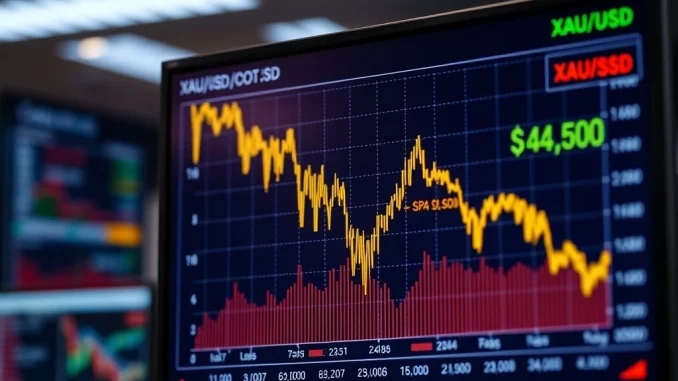
At approximately 5:50 a.m. UTC on February 2, the spot gold price broke through the $4,500 support level, trading as low as $4,498. This marked a pivotal moment for traders and analysts who had been monitoring the metal’s parabolic rise. The current spot gold price sits at $4,558.140, reflecting a steep single-day decline of 6.97%. This swift downturn follows an extraordinary rally that saw gold reach an intraday high of $5,598.750 on January 29. In the span of just three active trading sessions, the spot gold price has shed nearly $1,100 in value, one of the most rapid and substantial corrections in recent commodity market history.
Analyzing the Rapid Gold Market Correction
The velocity of the decline in the spot gold price points to a potent combination of technical selling and shifting macroeconomic sentiment. Several key factors contributed to this abrupt reversal.
- Profit-Taking Pressure: The unprecedented rally to above $5,500 created immense paper profits for long-term holders and speculative traders. The move below key technical levels likely triggered automated sell orders and a wave of profit-taking, accelerating the downward momentum.
- Shifts in Central Bank Policy Expectations: Market interpretations of statements from major central banks, particularly the Federal Reserve and the European Central Bank, regarding future interest rate paths can have an immediate and powerful impact on non-yielding assets like gold. Any perceived hawkish tilt can strengthen the US Dollar and increase the opportunity cost of holding gold.
- Technical Breakdown: Chart analysts note that the failure to hold above the $5,000 psychological level earlier in the week was an early warning sign. The subsequent breach of several Fibonacci retracement levels and moving averages created a cascade of selling pressure.
- Liquidity and Leverage: The gold market, while large, can experience moments of thin liquidity, especially in off-hours trading. Combined with high leverage used by some institutional and retail traders, this can magnify price moves in both directions.
Historical Context for Gold Price Volatility
While the scale of this three-day drop is notable, the gold market has a long history of sharp corrections following parabolic advances. For instance, after hitting a then-record high above $1,900 in 2011, gold entered a multi-year bear market, losing over 40% of its value by 2015. Similarly, the rapid surge during the early stages of the COVID-19 pandemic in 2020 was followed by a significant pullback as markets stabilized. These historical precedents remind investors that even in strong long-term bull markets, precious metals are not immune to severe short-term volatility. The current spot gold price action, while extreme, fits within a known pattern of market behavior where overheated rallies are often met with swift and deep corrections.
Implications for Investors and the Broader Market
The dramatic fall in the spot gold price carries implications beyond the commodity pits. It serves as a barometer for broader market risk sentiment and inflation expectations.
- For Portfolio Managers: Gold is traditionally viewed as a hedge against inflation and currency devaluation. A sharp decline may lead some to reassess the near-term inflation outlook or the strength of the US Dollar. It also impacts the performance of gold ETFs, mining stocks, and other gold-linked securities.
- For Currency Markets: Gold is predominantly priced in US Dollars. A falling gold price often coincides with a strengthening Dollar, as the two frequently exhibit an inverse relationship. Traders will watch for confirmation of this dynamic in major forex pairs.
- For Retail Investors: The volatility underscores the importance of position sizing and risk management. It also presents a potential entry point for long-term believers in gold’s store-of-value thesis, though timing such a volatile market remains highly challenging.
The following table illustrates the scale of the recent price movement:
| Date | Key Price Event | Change from Previous Key Level |
|---|---|---|
| Jan 29, 2025 | Intraday High: $5,598.750 | N/A |
| Feb 2, 2025 (Pre-Market) | Breaks below $4,500 | Approx. -$1,100 / -19.6% |
| Feb 2, 2025 (Current) | Trading at $4,558.140 | -6.97% from prior close |
Conclusion
The spot gold price has demonstrated its capacity for extreme volatility, plunging below the $4,500 level in a stunning reversal from recent record highs. This move, driven by a confluence of profit-taking, technical selling, and evolving macroeconomic expectations, serves as a stark reminder of the risks inherent in all asset classes, even traditional safe havens. While the long-term fundamentals for gold—including geopolitical uncertainty and its role as a monetary metal—may remain intact, the current correction emphasizes that price discovery in the short term can be a turbulent process. Market participants will now closely watch to see if the spot gold price finds stable support or if further downside exploration lies ahead.
FAQs
Q1: What exactly is the “spot gold price”?
The spot gold price refers to the current market price at which gold can be bought or sold for immediate delivery and payment. It is the benchmark price for physical gold and gold derivatives, constantly fluctuating based on global supply and demand.
Q2: Why did the spot gold price fall so quickly?
The rapid decline was likely triggered by a combination of heavy profit-taking after a historic rally, shifts in market expectations around interest rates and the US Dollar, and the triggering of automated technical sell orders as key price levels were breached.
Q3: Is gold still a good hedge against inflation?
Historically, gold has been considered a long-term store of value and a hedge against currency devaluation and inflation. However, as this event shows, its short-term price can be highly volatile and may not always move in perfect correlation with near-term inflation prints.
Q4: How does this drop compare to past gold corrections?
The speed and magnitude of this drop are significant but not unprecedented. Gold has experienced several sharp corrections after major rallies throughout history, such as the declines following the 2011 peak and the 2020 pandemic surge.
Q5: What should an investor do when the spot gold price is this volatile?
During periods of high volatility, investors are generally advised to avoid making impulsive decisions, ensure their portfolio allocation to gold aligns with their long-term risk tolerance and investment goals, and consider that sharp moves can present both risk and opportunity.