Global, May 2025: Bitcoin perpetual futures markets across major cryptocurrency exchanges show a subtle but significant shift in trader positioning, with short positions now slightly outnumbering long positions for the first time in several weeks. This development in BTC perpetual futures trading provides a window into the evolving sentiment among sophisticated market participants, offering clues about potential price direction and market psychology.
Bitcoin perpetual futures show shifting market sentiment
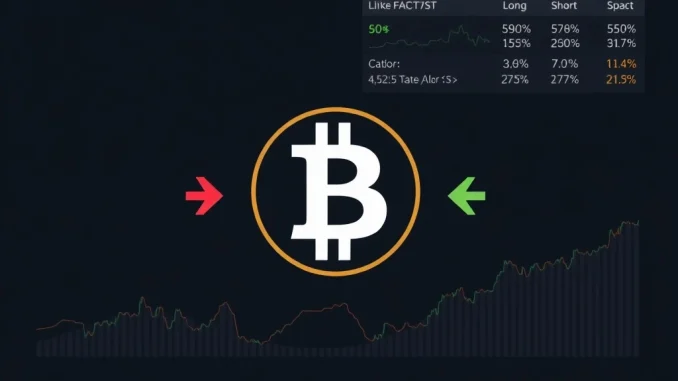
Over the last 24 hours, aggregate data from the top three exchanges by open interest reveals that short positions hold a 51.42% majority against 48.58% long positions. This represents a notable change from the predominantly bullish positioning that characterized much of the previous month. The data comes from exchanges that collectively handle billions of dollars in daily Bitcoin derivatives volume, making their positioning metrics particularly relevant for understanding institutional and professional trader sentiment.
Perpetual futures, unlike traditional futures contracts, do not have an expiration date. Traders use them to speculate on Bitcoin’s price direction while paying or receiving funding rates that help keep the contract price aligned with the spot market. When short positions dominate, it typically indicates that more traders are betting on price declines, though the relationship isn’t always straightforward. Market makers and arbitrageurs often take offsetting positions that can complicate simple interpretations of the data.
Exchange-by-exchange analysis reveals consistent pattern
The short positioning appears consistent across major platforms, though with slight variations in magnitude. Binance, the world’s largest cryptocurrency exchange by trading volume, shows the most pronounced short bias at 52% short versus 48% long. OKX follows closely with 51.21% short positions against 48.79% long. Bybit displays the narrowest gap, with shorts holding just a 50.88% majority against 49.12% long positions.
This consistency across exchanges suggests the sentiment shift isn’t isolated to a single platform or regional trading pattern. Instead, it appears to reflect broader market dynamics affecting Bitcoin traders globally. The data becomes particularly meaningful when considered alongside other market indicators, including funding rates, open interest changes, and spot market volume patterns.
Understanding the mechanics of perpetual futures positioning
Perpetual futures positioning data represents the aggregate of all trader positions on a given exchange. When more traders hold short positions than long positions, it doesn’t necessarily mean the majority expects immediate price declines. Sophisticated traders often use futures for hedging existing spot positions or for complex arbitrage strategies. Market makers, who provide liquidity by taking both sides of trades, can also influence these metrics significantly.
The funding rate mechanism in perpetual futures creates additional complexity. When shorts dominate, funding rates typically turn negative, meaning short positions pay funding to long positions. This creates economic incentives that can encourage position rebalancing over time. Current funding rates across major exchanges remain relatively neutral, suggesting the positioning shift hasn’t yet created extreme market conditions that would trigger significant funding rate adjustments.
Historical context and market implications
Historically, extreme positioning in either direction has often preceded market reversals. When long positions become excessively crowded, it can signal over-optimism and potential for correction. Conversely, when short positions dominate significantly, it may indicate excessive pessimism that could precede a rally. The current positioning sits in a moderate range, suggesting neither extreme optimism nor extreme pessimism dominates the market.
Several factors might explain the shift toward short positioning:
- Increased regulatory uncertainty in key markets
- Technical resistance levels that Bitcoin has struggled to break
- Macroeconomic factors affecting risk assets generally
- Seasonal patterns in cryptocurrency markets
- Institutional rebalancing ahead of quarter-end
It’s important to note that derivatives positioning represents just one piece of the market puzzle. Spot market flows, on-chain metrics, and macroeconomic developments all contribute to Bitcoin’s price trajectory. The derivatives data becomes most meaningful when analyzed alongside these other indicators rather than in isolation.
Professional trader perspectives on the data
Experienced derivatives traders approach positioning data with nuanced understanding. “The shift toward net short positioning doesn’t necessarily predict immediate price declines,” explains a veteran cryptocurrency derivatives trader who requested anonymity due to firm policies. “What it does indicate is changing risk appetite and hedging behavior. Many institutional players use shorts to hedge spot exposure, particularly when they anticipate increased volatility.”
Another factor professionals consider is the composition of the positioning. Large, concentrated positions from a few entities can skew the data differently than numerous small positions from retail traders. Exchange data typically doesn’t distinguish between these, though some platforms provide additional breakdowns by account size or trader category that can offer deeper insights.
Comparing current data with previous market cycles
The current positioning shift occurs against the backdrop of Bitcoin’s historical market cycles. During previous bull markets, temporary periods of net short positioning often occurred during consolidation phases before the next upward leg. In bear markets, sustained net short positioning typically accompanied extended downtrends. The current environment presents unique characteristics, including increased institutional participation and evolving regulatory landscapes that weren’t present in earlier cycles.
When examining positioning data historically, several patterns emerge:
| Market Phase | Typical Positioning | Current Comparison |
|---|---|---|
| Bull Market Acceleration | Strong Net Long | Not Present |
| Consolidation/Correction | Moderate Net Short | Similar Pattern |
| Bear Market | Sustained Net Short | Not Present |
| Market Bottom | Extreme Net Short | Not Present |
The table illustrates how current positioning aligns most closely with consolidation or correction phases rather than extreme bull or bear market conditions. This suggests traders may be positioning for range-bound trading or modest corrections rather than anticipating major trend reversals in either direction.
Technical factors influencing derivatives positioning
Several technical market developments likely contributed to the positioning shift. Bitcoin’s failure to break key resistance levels around previous all-time highs may have encouraged some traders to establish short positions. Additionally, changes in market structure, including the growth of options trading and more sophisticated hedging strategies, have altered how traders use perpetual futures.
Liquidity conditions also play a crucial role. When liquidity is abundant, positioning shifts can occur smoothly without significant price impact. During periods of reduced liquidity, similar positioning changes can trigger more pronounced price movements. Current market conditions show adequate but not excessive liquidity, suggesting the positioning shift reflects genuine sentiment changes rather than technical market structure issues.
Risk management considerations for traders
For traders monitoring positioning data, several risk management principles apply. First, positioning represents a lagging indicator—it shows what has already happened rather than predicting what will happen. Second, extreme positioning often precedes reversals, but timing those reversals remains challenging. Third, different timeframes may show conflicting positioning data, with short-term traders taking different views than longer-term investors.
Professional risk managers emphasize that positioning data should inform rather than dictate trading decisions. “We consider derivatives positioning as one input among dozens in our models,” notes the head of risk at a cryptocurrency trading firm. “It provides context about market sentiment and potential crowding, but it doesn’t replace fundamental analysis or risk management discipline.”
Conclusion
The slight shift toward net short positioning in Bitcoin perpetual futures across major exchanges signals changing market dynamics and trader sentiment. While the positioning change remains moderate rather than extreme, its consistency across platforms makes it noteworthy for market observers. This development in BTC perpetual futures trading reflects the ongoing evolution of cryptocurrency markets as they mature and attract more sophisticated participants. As always, derivatives positioning represents just one piece of the complex puzzle that determines cryptocurrency market movements, requiring careful interpretation alongside other fundamental and technical indicators.
FAQs
Q1: What are Bitcoin perpetual futures?
Bitcoin perpetual futures are derivative contracts that allow traders to speculate on Bitcoin’s price without an expiration date. Unlike traditional futures, they use a funding rate mechanism to keep their price aligned with the spot market.
Q2: Why does short positioning matter in futures markets?
Short positioning indicates that more traders are betting on price declines. While not a perfect predictor, extreme positioning in either direction can signal potential market reversals or changing sentiment among sophisticated traders.
Q3: How reliable is exchange positioning data?
Exchange positioning data provides valuable insights but has limitations. It doesn’t distinguish between hedging and speculative positions, nor between large institutional positions and numerous small retail positions. It’s best used alongside other market indicators.
Q4: What typically happens when shorts dominate futures markets?
When short positions significantly outnumber longs, funding rates typically turn negative, meaning short positions pay funding to long positions. This creates economic incentives that can encourage position rebalancing over time.
Q5: How do professional traders use positioning data?
Professional traders use positioning data to gauge market sentiment, identify crowded trades, and assess potential reversal points. They typically combine it with other analysis rather than relying on it exclusively for trading decisions.
Q6: Can retail traders access the same positioning data?
Yes, most major exchanges provide some form of positioning or sentiment data publicly. The depth and frequency of this data varies by platform, with some offering real-time updates and others providing periodic summaries.