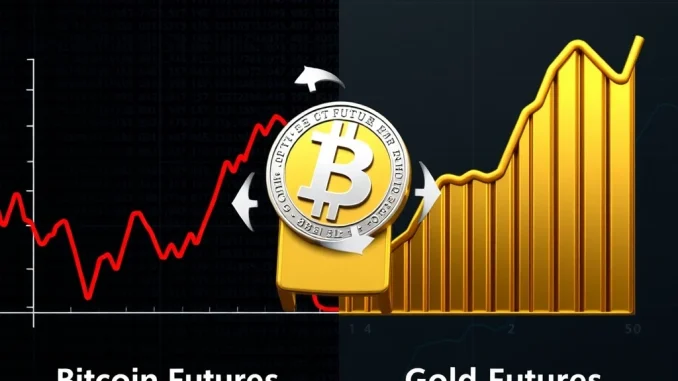
New York, January 2026: A stark divergence in investor sentiment is reshaping global markets, according to a recent analysis from JPMorgan. The bank’s research indicates Bitcoin futures have entered oversold territory following persistent selling pressure, while traditional safe-havens gold and silver have surged into overbought conditions. This pivot suggests a profound and potentially lasting rotation of capital from cryptocurrencies to precious metals, with JPMorgan maintaining a notably bullish long-term outlook that sees gold prices potentially climbing to the $8,000–$8,500 range.
JPMorgan’s Analysis Reveals a Fundamental Rotation
Analysts at JPMorgan, led by managing director Nikolaos Panigirtzoglou, have identified a clear behavioral shift among both retail and institutional investors. For much of 2025, the dominant “debasement trade”—a hedge against currency devaluation and inflation—saw funds flow simultaneously into Bitcoin and gold exchange-traded funds (ETFs). However, momentum began to fracture around August. Bitcoin ETF inflows plateaued and turned negative in the fourth quarter, while gold ETFs maintained steady demand, culminating in approximately $60 billion in net inflows for the year. Silver ETFs also captured significant investment in the final months, precisely when Bitcoin products experienced withdrawals.
This pattern points to a growing preference for the perceived stability and historical hedging characteristics of precious metals over the volatility of digital assets. The shift is not merely a short-term correction but appears rooted in a broader reassessment of risk and store-of-value assets amid evolving macroeconomic uncertainties.
Retail and Institutional Investors Move in Unison
The rotation is remarkably consistent across investor classes. Retail investors, who drove much of the 2024-2025 crypto ETF boom, have demonstrably reduced their exposure to Bitcoin. JPMorgan’s data shows this cohort continues to seek inflation hedges but is increasingly allocating to gold and silver ETFs, viewing them as less volatile alternatives in a changing market landscape.
Institutional activity, measured through changes in CME Group futures open interest, tells a parallel story. The analysis reveals:
- Silver Futures: Experienced a significant build-up in long positions, heavily driven by hedge fund activity in Q4 2025 and early 2026.
- Gold Futures: Saw sustained growth in institutional positioning over the same period.
- Bitcoin Futures: Failed to attract comparable institutional long interest, resulting in a notable divergence.
This institutional behavior is reflected in momentum indicators. Silver futures are currently in extremely overbought territory, gold futures are overbought, and Bitcoin futures remain oversold. Such extremes often precede market corrections, as seen in late January when gold fell roughly 9% and silver plummeted about 26% in 24 hours—with silver experiencing its largest single-session drop ever.
Liquidity Dynamics and Market Sensitivity
Beyond sentiment, JPMorgan examined the underlying liquidity structure of these markets using the Hui-Heubel ratio, which measures how much price movement occurs per unit of trading volume. The findings highlight critical differences in market depth and stability:
| Asset | Hui-Heubel Ratio Implication | Market Characteristic |
|---|---|---|
| Gold | Lowest Ratio | Strong liquidity, deep market, absorbs large trades with minimal price disruption. |
| Silver | Higher Ratio | More limited liquidity, prone to larger price swings on significant volume. |
| Bitcoin | Highest Ratio | Most sensitive to trading activity; smaller trades can have an outsized price impact. |
This liquidity profile explains why gold’s recent pullback was relatively orderly compared to silver’s violent correction. It also underscores Bitcoin’s inherent volatility, which may be contributing to the current investor caution.
The Bullish Case for Gold and the $8,500 Forecast
Despite short-term volatility, JPMorgan’s long-term thesis for precious metals remains firmly bullish. The analysts cite two sustained, structural demand drivers:
- Central Bank Accumulation: Global central banks continue to be net buyers of gold, diversifying reserves away from the US dollar.
- Private Portfolio Reallocation: Individual investors currently hold a small percentage of their assets in gold. JPMorgan posits that if investors shift even a modest portion of long-term bond holdings into gold as an equity risk hedge, private allocations could rise from just over 3% to around 4.6%.
This incremental increase in portfolio allocation, multiplied across the vast global pool of private wealth, represents a massive potential source of demand. It is this fundamental reallocation scenario, coupled with ongoing central bank buying, that underpins the bank’s projection for gold to reach $8,000–$8,500 per ounce.
A Counterpoint: Is a Rotation Back to Crypto Imminent?
Some market observers note that the recent sharp declines in precious metals contrast with Bitcoin’s relative stability during the same sell-off. Prominent crypto analyst Michaël van de Poppe highlighted that while gold fell 15–20% and silver dropped 30% in a day, Bitcoin declined only about 1%. This resilience, he suggests, could signal that the rotation has overextended and may soon reverse, drawing capital back into cryptocurrencies.
The immediate catalyst for market direction may be macroeconomic. With the U.S. government entering a partial shutdown, investors are seeking clarity on fiscal policy and debt management. The next few days will be critical in determining whether the flight to precious metals resumes or if cryptocurrency markets stage a demand rebound.
Conclusion: A Market at an Inflection Point
JPMorgan’s research paints a picture of a financial landscape in transition. The simultaneous oversold condition of Bitcoin futures and overbought state of gold and silver futures is a rare signal of extreme capital rotation. While short-term profit-taking has triggered a correction in precious metals, the fundamental drivers for gold—central bank demand and portfolio reallocation—appear intact, supporting the long-term $8,500 price forecast. Investors are now navigating a delicate balance between the established safe-haven status of gold and the high-growth, high-volatility proposition of Bitcoin, with market sentiment likely to swing on the next major macroeconomic development.
FAQs
Q1: What does it mean that Bitcoin futures are “oversold”?
An “oversold” condition is a technical analysis term indicating that an asset’s price has fallen sharply and may be due for a rebound. It suggests selling pressure has been excessive relative to the asset’s fundamentals, often identified using indicators like the Relative Strength Index (RSI).
Q2: Why is JPMorgan so bullish on gold specifically?
JPMorgan’s bullish outlook is based on two concurrent demand trends: sustained buying by global central banks seeking reserve diversification and the potential for private investors to increase their gold allocations from roughly 3% to nearly 5% of portfolios as a hedge against equity and inflation risk.
Q3: Did the recent crash in silver and gold prices invalidate this analysis?
Not necessarily. Sharp corrections are common in overbought markets and can be driven by short-term profit-taking. JPMorgan’s forecast is a long-term structural view based on allocation trends, not short-term price movements. The bank even warned that overbought conditions could lead to a pullback.
Q4: How does the Hui-Heubel ratio affect my investment?
The Hui-Heubel ratio measures liquidity. A high ratio, like Bitcoin’s, means the market is thin and prices can swing wildly on relatively small trades. A low ratio, like gold’s, indicates a deep, liquid market where large orders can be filled with less price impact, generally implying greater stability.
Q5: Should I sell my Bitcoin and buy gold based on this report?
JPMorgan’s analysis is observational research, not personal investment advice. It highlights a current market trend but does not predict the future with certainty. Any investment decision should be based on your individual financial goals, risk tolerance, and consultation with a qualified financial advisor.