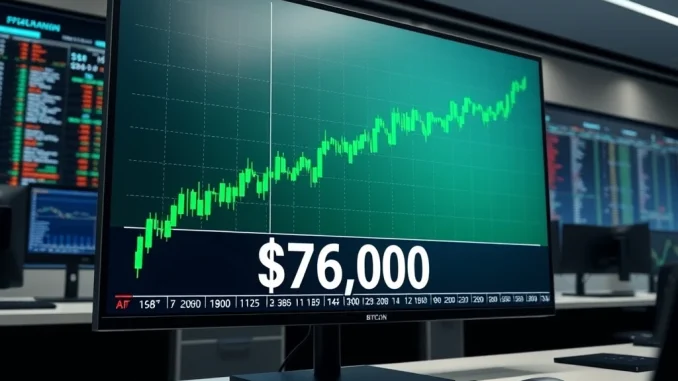
Global, March 2025: The cryptocurrency market witnessed a significant milestone as Bitcoin (BTC), the world’s leading digital asset, surged above the $79,000 threshold. According to real-time data from CoinPulseHQ market monitoring, BTC was trading at $79,010.77 on the Binance USDT perpetual futures market. This price movement represents a pivotal moment, pushing the asset into uncharted valuation territory and reigniting discussions about its long-term trajectory and role in the global financial system.
Bitcoin Price Breaks Through $79,000 Barrier
The ascent past $79,000 marks a continuation of a strong bullish trend observed throughout the early months of 2025. This price point is not merely a psychological barrier but a technical confirmation of sustained buying pressure. Market analysts point to several concurrent factors driving this rally. Institutional adoption continues to expand, with new regulatory frameworks in major economies providing clearer pathways for investment. Furthermore, macroeconomic conditions, including currency devaluation concerns in several regions and shifting monetary policy expectations, have renewed interest in Bitcoin as a potential store of value. The trading volume accompanying this breakout on platforms like Binance indicates broad-based participation, not just speculative retail trading.
Analyzing the Cryptocurrency Market Drivers
Understanding the context behind Bitcoin’s rise requires examining the broader cryptocurrency ecosystem. The market does not operate in a vacuum. Several key drivers have converged to create favorable conditions.
- Institutional Inflows: Data from on-chain analytics firms shows consistent accumulation by large-scale investors and publicly traded companies adding BTC to their treasury reserves.
- Network Fundamentals: Bitcoin’s underlying network health remains robust. The hash rate, a measure of computational power securing the network, continues to hit all-time highs, signaling strong miner commitment and security.
- Macroeconomic Hedge: In an era of persistent inflation concerns and geopolitical uncertainty, a portion of the capital flow into Bitcoin is attributed to its perceived properties as a non-sovereign, hard-capped asset.
- Technological Developments: While Bitcoin’s core protocol is stable, advancements in its secondary layers, like the Lightning Network for payments, enhance its utility narrative.
Historical Context and Price Cycle Comparisons
Historically, Bitcoin has experienced multi-year cycles characterized by explosive bull markets followed by prolonged consolidation periods. The breach of $79,000 places the current price action in a unique historical position, far surpassing the previous all-time high set in the 2021 cycle. Analysts are careful to draw direct parallels, however, as the market’s maturity, investor profile, and regulatory landscape are fundamentally different today. The reduced volatility relative to previous cycles, while still significant, suggests a growing market depth and resilience. This price level also brings the topic of Bitcoin’s total market capitalization into focus, as it approaches and surpasses the valuation of some of the world’s largest traditional assets.
Implications for Traders and Long-Term Holders
The psychological impact of a new, high price plateau influences different market participants in distinct ways. For active traders on spot and derivatives exchanges like Binance, key technical levels around $79,000 become crucial for managing risk and identifying potential support or resistance zones. For long-term holders, often referred to as “HODLers,” this price action validates a patient investment thesis but also introduces considerations about portfolio rebalancing. The market’s structure, including the funding rates in perpetual swap markets, is being closely watched for signs of excessive leverage or euphoria, which can precede corrections.
| Price Milestone | Approximate Date | Key Catalysts Noted |
|---|---|---|
| $60,000 | Q4 2024 | Spot ETF approval momentum, institutional interest |
| $70,000 | Q1 2025 | Sustained ETF inflows, macro uncertainty |
| $79,000+ | March 2025 | Broader financial market integration, supply shock narrative |
The Role of Major Exchanges Like Binance
Major cryptocurrency exchanges serve as the primary liquidity venues for price discovery. The reported price of $79,010.77 from the Binance USDT pair is a critical benchmark. Binance, as one of the largest global exchanges by volume, aggregates liquidity from millions of users. Discrepancies between exchanges are typically minimal due to arbitrage trading, making its quoted price a reliable industry standard. The stability and depth of order books on such platforms during volatile moves are essential for healthy market function and were tested during this rapid ascent.
Conclusion
Bitcoin’s rise above $79,000 is a landmark event that underscores its evolving role from a niche digital experiment to a mainstream financial asset. This Bitcoin price movement, verified on major platforms like Binance, is supported by a confluence of institutional adoption, strong network fundamentals, and a unique macroeconomic backdrop. While market cycles persist and volatility remains an inherent feature, crossing this threshold demonstrates significant maturation. The focus now shifts to how the market consolidates at these levels and what it signifies for the next phase of cryptocurrency integration into the global economic fabric.
FAQs
Q1: What does Bitcoin trading at $79,010.77 mean?
It means that at the time of reporting, one Bitcoin could be exchanged for approximately 79,010.77 USDT (Tether) on the Binance exchange. This represents its current market valuation based on supply and demand.
Q2: Why is the price on Binance considered important?
Binance is one of the world’s largest cryptocurrency exchanges by trading volume. Its prices are widely cited because they reflect a massive pool of global liquidity, making them a reliable benchmark for the asset’s market value.
Q3: What are common factors that cause Bitcoin’s price to rise?
Major price increases are often driven by a combination of increased institutional investment, positive regulatory developments, broader macroeconomic uncertainty favoring alternative assets, technological advancements, and reductions in the new supply rate (halving events).
Q4: Is Bitcoin’s volatility a concern at this price level?
Volatility is a well-known characteristic of Bitcoin, even at higher market capitalizations. While it has decreased relative to its early years, significant price swings both upward and downward can still occur rapidly based on market sentiment and news.
Q5: How does breaking a price milestone like $79,000 affect the market?
Breaking a major psychological and technical resistance level can fuel further bullish sentiment, attract media attention, and potentially draw in new investors. It also forces market analysts and participants to re-evaluate their long-term price models and assumptions.