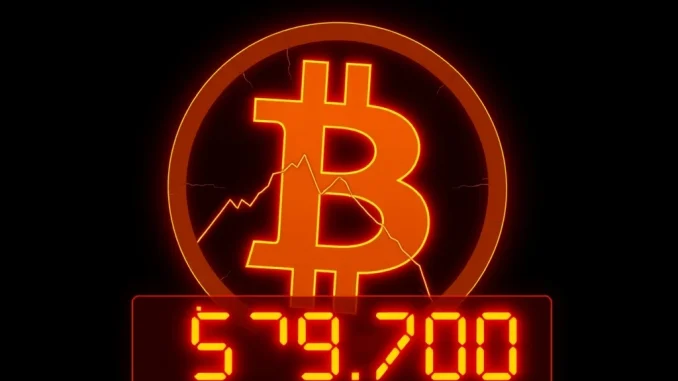
Global, April 2025: The cryptocurrency market witnessed a significant shift today as Bitcoin, the world’s leading digital asset, fell below the psychologically important $80,000 mark. According to data from CoinPulseHQ market monitoring, BTC is currently trading at approximately $79,700 on the Binance exchange’s USDT trading pair. This move represents a notable pullback from recent highs and has captured the attention of traders and analysts worldwide. The breach of this key level prompts a deeper examination of market dynamics, historical precedent, and the underlying factors driving cryptocurrency volatility.
Bitcoin Price Dips Below Key Threshold
The descent of Bitcoin below $80,000 marks a pivotal moment in the current market cycle. Price levels ending in round numbers, like $80,000, often act as significant psychological support and resistance zones. Traders and algorithms watch these levels closely. The move below $79,700, as reported on Binance, suggests a shift in short-term market sentiment. This price action follows a period of consolidation and testing near the $82,000 to $84,000 range. Market depth data often shows increased selling pressure and reduced buy-side liquidity when such levels break. This event is not occurring in isolation. It reflects the interplay of global macroeconomic signals, institutional flows, and on-chain metrics that collectively influence Bitcoin’s valuation.
Analyzing the Cryptocurrency Market Context
To understand the significance of Bitcoin’s drop, one must consider the broader market environment. Cryptocurrency markets are inherently volatile, with price corrections being a standard feature of their growth trajectory. Several concurrent factors may be contributing to the current pressure.
- Macroeconomic Headwinds: Shifts in traditional finance, such as changes in interest rate expectations or strength in the US Dollar Index (DXY), can impact risk assets like Bitcoin.
- Profit-Taking Activity: After a sustained rally, it is common for investors to realize gains, creating natural sell-side pressure.
- Leverage Flush: Derivatives markets often see excessive leverage build up during rallies. A slight downturn can trigger cascading liquidations, amplifying the price move.
- On-Chain Metrics: Analysts examine data like exchange inflows (suggesting selling intent) versus outflows (suggesting holding), the behavior of long-term holders, and miner selling activity.
Historical data shows that corrections of 20-30% are common within bull markets. The current pullback’s depth and duration will be key to determining if it is a healthy consolidation or the start of a larger trend reversal.
Historical Volatility and Support Levels
Bitcoin’s history is defined by cycles of explosive growth and sharp corrections. Each cycle matures, with institutional participation potentially dampening extreme volatility over the very long term, though significant swings remain. The $80,000 level had previously acted as a launchpad for pushes to new highs. Now, as support, its failure opens the door for a test of lower support zones. Technical analysts will now watch previous resistance-turned-support levels, such as the $75,000 or $70,000 areas, and key moving averages like the 50-day or 200-day. The market’s reaction at these levels will provide critical clues about underlying strength. Furthermore, the performance of major altcoins often correlates with, and sometimes exaggerates, Bitcoin’s movements, making the entire digital asset market sensitive to BTC’s price discovery.
Implications for Investors and the Crypto Ecosystem
A move below a key level like $80,000 has tangible consequences for different market participants. For retail investors, it may test conviction and risk management strategies. For institutional entities, such as ETF issuers and corporate treasuries, it may influence the timing of allocation decisions or public commentary. The mining industry feels a direct impact, as revenue in fiat terms decreases, potentially pressuring miners with higher operational costs. Network security, funded by block rewards, remains robust due to the value of rewards in BTC terms, but fiat-denominated income declines. This price action also serves as a real-world stress test for the growing infrastructure of cryptocurrency, including exchanges, custody solutions, and payment networks, which must handle increased volatility and user activity smoothly.
Conclusion
Bitcoin’s fall below the $80,000 support level is a significant event that underscores the dynamic and volatile nature of the cryptocurrency market. While the current Bitcoin price of $79,700 represents a pullback, it is essential to view this movement within the context of historical cycles, broader financial markets, and ongoing technological adoption. Such corrections are a standard part of asset price discovery, especially in a nascent and globally traded market like digital assets. Market participants will now closely monitor whether this is a short-term liquidation event or the beginning of a deeper corrective phase. The fundamental long-term thesis for Bitcoin—as a decentralized store of value and hedge against monetary inflation—remains unchanged for its proponents, but price volatility continues to be the market’s most consistent feature.
FAQs
Q1: Why is the $80,000 level important for Bitcoin?
A1: Round-number price levels like $80,000 often act as psychological barriers in trading. They can concentrate buy and sell orders, making them key support or resistance zones that traders watch closely for signals about market direction.
Q2: What typically causes a sharp drop in Bitcoin’s price?
A2: Sharp drops can be triggered by a combination of factors including large-scale profit-taking, negative macroeconomic news, regulatory concerns, cascading liquidations in leveraged derivatives markets, or shifts in institutional investor sentiment.
Q3: How does Bitcoin’s current volatility compare to its history?
A3: While still volatile, Bitcoin’s price swings have generally decreased in magnitude on a percentage basis as its market capitalization has grown and institutional participation has increased. However, significant multi-thousand dollar moves remain common.
Q4: Should investors be worried about a drop below $80,000?
A4: Price corrections are a normal part of any financial market, especially cryptocurrencies. Investors should base their strategy on long-term goals, risk tolerance, and fundamental research rather than reacting to any single price movement.
Q5: Where can I find reliable, real-time data on Bitcoin’s price?
A5: Reputable data aggregators like CoinMarketCap, CoinGecko, and TradingView provide real-time price feeds from multiple exchanges. For specific exchange prices, like the Binance USDT pair referenced, visiting the exchange’s official website or app provides the most direct data.