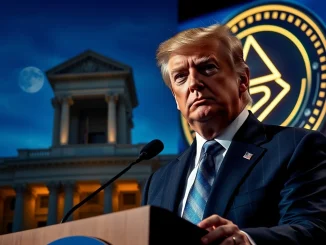
Washington, D.C., January 30, 2026: Former President Donald Trump has formally announced his intention to nominate Kevin Warsh as the next Chair of the Federal Reserve, a decision that could reshape American monetary policy for years to come. The confirmation, made via Trump’s Truth Social platform, immediately sent ripples through global financial markets and cryptocurrency sectors, as analysts began assessing the potential implications of installing a former Fed governor known for his critical stance on the central bank’s recent policy direction.
Kevin Warsh Fed Nomination: A Return to Conservative Monetary Principles
The nomination of Kevin Warsh represents a significant departure from the Federal Reserve’s current leadership under Jerome Powell, whose term concludes in May. Warsh, who served as a Fed governor from 2006 to 2011, brings a reputation for monetary conservatism and skepticism toward the unconventional policies that have characterized the post-2008 financial era. His professional background includes executive roles at Morgan Stanley and advisory positions within Republican administrations, giving him a unique perspective that bridges Wall Street experience with central banking insight.
Trump’s announcement stated, “I have no doubt he will go down in history as one of the GREAT Fed chairmen, maybe the best.” This endorsement highlights the political significance of the nomination, which comes amid ongoing debates about the Federal Reserve’s independence and its role in managing economic stability. Warsh’s previous tenure at the Fed coincided with the global financial crisis, during which he frequently advocated for more restrained intervention compared to his colleagues.
Monetary Policy Shift and Financial Market Implications
Financial markets reacted swiftly to the nomination news, with analysts revising their expectations for future interest rate trajectories and quantitative easing policies. Warsh has been a consistent critic of prolonged low interest rates, which he has described as “risky in the long term” for financial stability. His academic writings and public statements have called for a “regime change” in monetary policy conduct, advocating for rules-based approaches that would reduce discretionary intervention.
The potential policy shift carries several implications:
- Interest Rate Trajectory: Markets anticipate a potentially faster normalization of interest rates under Warsh’s leadership
- Balance Sheet Management: Previous criticisms suggest he may advocate for more aggressive reduction of the Fed’s expanded balance sheet
- Inflation Framework: His approach may involve revising the Fed’s current average inflation targeting strategy
- Financial Regulation: Warsh’s Wall Street background suggests potential changes to banking supervision and stress testing protocols
Historical Context and Confirmation Challenges
Kevin Warsh’s nomination arrives at a complex moment in Federal Reserve history. The central bank has maintained an expanded balance sheet exceeding $7 trillion while navigating persistent inflation concerns and geopolitical uncertainties. Warsh’s confirmation process before the Senate Banking Committee promises to be contentious, with lawmakers likely to scrutinize his past positions on financial regulation, his relationships with major banking institutions, and his vision for the Fed’s role in a digital economy.
Historical precedent suggests Fed chair nominations often face rigorous examination. The Senate confirmed Jerome Powell by an 84-13 vote in 2018, while Ben Bernanke faced a 70-30 confirmation vote in 2010. Warsh’s confirmation hearings will probably focus on several key areas:
- His criticism of quantitative easing programs implemented during and after the 2008 crisis
- Views on the Fed’s emergency lending authorities and transparency requirements
- Position on digital currency development and cryptocurrency regulation
- Approach to balancing maximum employment and price stability mandates
Cryptocurrency Market Response to Warsh’s Nomination
Unlike current Fed Chair Jerome Powell, who has maintained cautious neutrality toward cryptocurrencies, Kevin Warsh has expressed notably different views. During a July discussion at the Hoover Institution, Warsh suggested that Bitcoin and similar digital assets could serve as tools for “market discipline,” potentially offering alternatives to traditional monetary systems. This perspective represents a substantial departure from the Fed’s generally wary stance toward decentralized digital currencies.
Market analysts observed immediate reactions across cryptocurrency exchanges following the nomination announcement. Bitcoin and major altcoins experienced increased volatility as traders assessed the implications of potentially more favorable regulatory attitudes from the Federal Reserve. The nomination comes as several states, including Texas and Arizona, have implemented cryptocurrency-friendly legislation, creating a patchwork regulatory environment that the Fed may need to address.
Warsh’s previous statements indicate he views cryptocurrency innovation through a different lens than many traditional central bankers. In various forums, he has discussed how digital assets might influence monetary policy transmission mechanisms and potentially constrain central bank actions through market-based discipline. This theoretical framework suggests his leadership might bring more nuanced understanding to cryptocurrency regulation debates.
Global Central Banking Context
The Warsh nomination occurs amid broader transformations in global central banking. Major economies continue grappling with post-pandemic economic adjustments, supply chain realignments, and technological disruptions to traditional financial systems. Other central banks, including the European Central Bank and Bank of England, have been gradually normalizing policies after extended periods of accommodation.
International observers will monitor how a potential Warsh-led Fed might coordinate with other major central banks on issues ranging from currency swap lines to coordinated responses to financial stability threats. His experience during the 2008 crisis, when he participated in international central bank communications and crisis management, provides relevant background for these global coordination challenges.
Economic Theory and Practical Implementation
Kevin Warsh’s academic writings and policy speeches reveal a consistent intellectual framework emphasizing several core principles. He frequently references the importance of rules-based monetary policy, drawing from monetarist traditions while acknowledging practical implementation challenges. His criticism of discretionary policy interventions stems from concerns about unintended consequences and long-term financial stability risks.
Practical implementation of his theoretical views would likely involve:
- Greater emphasis on forward guidance tied to specific economic indicators rather than calendar-based projections
- Potential revisions to the Fed’s Statement on Longer-Run Goals and Monetary Policy Strategy
- Increased transparency about policy reaction functions and decision-making processes
- Possible restructuring of Federal Open Market Committee communication practices
These changes would represent significant operational shifts from current practices established during the Bernanke, Yellen, and Powell chairships. Market participants would need to adjust their analytical frameworks for predicting Fed actions, potentially reducing certain types of policy uncertainty while introducing new forms of complexity.
Conclusion: A Potential Turning Point for Monetary Policy
The nomination of Kevin Warsh as Federal Reserve Chair represents a potential inflection point in American monetary policy. His confirmation would signal a shift toward more conservative, rules-based approaches after years of unconventional interventions. Financial markets, cryptocurrency sectors, and international observers will closely monitor the Senate confirmation process and subsequent policy developments. The ultimate impact will depend not only on Warsh’s leadership but also on economic conditions, political dynamics, and the evolving global financial landscape. As Jerome Powell’s term concludes, the Federal Reserve stands at a crossroads between continuity and change, with Kevin Warsh’s nomination offering a clear path toward the latter.
FAQs
Q1: Who is Kevin Warsh and why is his Fed nomination significant?
Kevin Warsh is a former Federal Reserve governor (2006-2011) and Morgan Stanley executive nominated by Donald Trump to chair the Federal Reserve. His nomination is significant because he represents a more conservative, rules-based approach to monetary policy compared to recent Fed leadership.
Q2: How might Kevin Warsh’s nomination affect cryptocurrency markets?
Warsh has expressed relatively favorable views toward Bitcoin as a potential tool for “market discipline,” contrasting with the Fed’s typically cautious stance. This could signal more open regulatory attitudes, though practical policy changes would require broader consensus within the Federal Reserve System.
Q3: What are the main challenges to Kevin Warsh’s Senate confirmation?
Confirmation challenges include scrutiny of his Wall Street background, past criticisms of Fed policies, views on financial regulation, and potential concerns about Federal Reserve independence. The Senate Banking Committee will examine these issues during confirmation hearings.
Q4: How does Kevin Warsh’s monetary policy approach differ from Jerome Powell’s?
Warsh has consistently advocated for more rules-based, less discretionary monetary policy, criticized prolonged low interest rates as risky for financial stability, and called for earlier normalization of the Fed’s balance sheet compared to Powell’s more gradual approach.
Q5: When would Kevin Warsh potentially assume the Fed Chair position if confirmed?
If confirmed by the Senate, Warsh would assume the Chair position when Jerome Powell’s term concludes in May, though the exact transition timing would depend on confirmation process completion and administrative procedures.