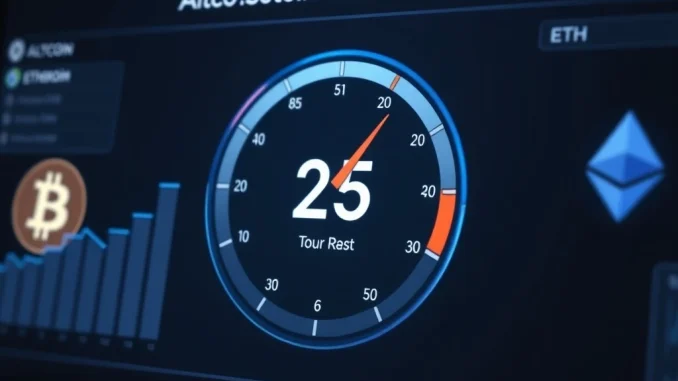
Global, May 2025: A key metric for cryptocurrency traders has signaled a significant cooling in market sentiment. CoinMarketCap’s Altcoin Season Index has fallen to 25, a notable seven-point drop from the previous day. This decline suggests a rapid shift away from the conditions that typically favor alternative cryptocurrencies, or altcoins, over Bitcoin. The index serves as a crucial barometer, measuring whether the broader crypto market is experiencing a period where most major altcoins outperform the original cryptocurrency.
Understanding the Altcoin Season Index and Its Critical 25 Reading
The Altcoin Season Index is a quantitative tool designed to cut through market noise. It provides a clear, data-driven answer to a fundamental question: is it an altcoin season? The index specifically analyzes the performance of the top 100 cryptocurrencies, excluding stablecoins and wrapped tokens, over a rolling 90-day period. It then calculates what percentage of these assets have outperformed Bitcoin. A score of 100 would mean every single one beat Bitcoin, while a score of 0 means none did. The threshold for declaring a formal “altcoin season” is set at 75. Therefore, a reading of 25 is not just low; it indicates the market is far from such a season, with Bitcoin dominance strongly reasserting itself.
This seven-point single-day drop is itself noteworthy. While crypto markets are volatile, such a sharp move in a 90-day rolling metric points to a pronounced and recent trend of capital rotation or risk aversion. It reflects a period where investors are likely favoring the perceived safety and liquidity of Bitcoin over the higher-risk, higher-potential-reward profiles of smaller altcoins. This behavior often correlates with broader macroeconomic uncertainty or a cooling of speculative fervor in the crypto sector.
Historical Context and Market Cycle Implications
To understand the significance of a score of 25, one must look at historical patterns. The index has fluctuated dramatically since its inception. During the bull market peaks of 2021, the index repeatedly breached the 75 threshold, entering official “altcoin season” territory for extended periods. These phases were characterized by explosive growth in decentralized finance (DeFi) tokens, non-fungible token (NFT) projects, and new layer-1 blockchains.
Conversely, during bear markets and periods of consolidation, the index often languishes below 50, as it has now. A sustained reading below 30, however, often precedes or coincides with what analysts call a “Bitcoin dominance” phase. This is when Bitcoin’s market capitalization grows as a percentage of the total crypto market cap. Current data from other trackers shows Bitcoin’s dominance hovering around 55%, reinforcing the narrative suggested by the low Altcoin Season Index. This dynamic is a classic feature of crypto market cycles, where capital tends to flow into Bitcoin first during a recovery, before eventually “trickling down” to altcoins in a risk-on move.
The Mechanics Behind the Metric: More Than Just Price
The index’s design reveals sophisticated market logic. By excluding stablecoins, it removes assets designed for stability, not growth. Excluding wrapped tokens (like WBTC) prevents double-counting Bitcoin’s performance. The 90-day window is long enough to smooth out short-term volatility and identify sustained trends, yet responsive enough to capture shifting phases. A drop to 25 means that, on a 90-day basis, only about a quarter of the top altcoins have managed to outpace Bitcoin. For traders and long-term holders, this data point is more reliable than anecdotal evidence or social media hype, providing a structural view of market health.
Analyzing the Potential Drivers of the Decline
Several interrelated factors could be contributing to the index’s fall. First, macroeconomic headwinds, such as interest rate decisions or inflationary data, often impact risk assets disproportionately. Altcoins, as higher-beta assets, typically feel this pressure first and most severely. Second, regulatory developments targeting specific altcoin sectors (e.g., DeFi or token classification) can create sector-wide sell-offs. Third, market sentiment itself becomes a feedback loop; as the index falls, it can discourage new capital from entering the altcoin space, reinforcing Bitcoin’s lead.
Furthermore, the current state of blockchain innovation and adoption plays a role. Periods of intense altcoin season activity are often fueled by narratives around new technological breakthroughs or massive user adoption for a particular chain or application. A lull in such groundbreaking narratives can lead to capital consolidation in Bitcoin as the market awaits the next catalyst.
- Macroeconomic Pressure: Rising rates or recession fears drive investors toward crypto’s most established asset.
- Regulatory Clarity (or Lack Thereof): Uncertainty can cause a flight to the relative safety of Bitcoin.
- Narrative Exhaustion: Previous cycles driven by DeFi, NFTs, or memecoins may need time before a new dominant narrative emerges.
- Liquidity Preference: In volatile or declining markets, Bitcoin’s superior liquidity makes it a preferred holding.
What a Low Altcoin Season Index Means for Different Market Participants
The implications of this data vary depending on one’s role in the ecosystem. For short-term traders, a low index suggests that momentum strategies focused on altcoin pumps may be less effective, and attention should shift to Bitcoin-centric trades or stablecoin yields. For long-term investors, or “HODLers,” a period of low altcoin performance can represent a strategic accumulation phase, where fundamentally strong projects can be acquired at lower prices relative to Bitcoin.
For project developers and foundations, a prolonged low index reading underscores the importance of building through market cycles and focusing on real utility and adoption, rather than relying on favorable market winds. It separates projects with sustainable models from those dependent purely on speculation.
Expert Perspective on Market Structure
Seasoned analysts often view the Altcoin Season Index as a gauge of market risk appetite. A high reading indicates a “risk-on” environment where investors are comfortable chasing higher returns in less proven assets. A low reading, like 25, indicates a “risk-off” or cautious environment. This shift isn’t necessarily negative for the overall health of the crypto market; it can represent a necessary consolidation, washing out excess leverage and speculation, and building a stronger foundation for the next growth phase. It reaffirms Bitcoin’s role as the market’s bedrock and reserve asset.
Conclusion: A Data Point for Prudent Strategy
The fall of CoinMarketCap’s Altcoin Season Index to 25 is a clear, quantifiable signal of changing market dynamics. It marks a decisive move away from the conditions that fuel broad-based altcoin rallies and toward a phase of Bitcoin strength and relative altcoin weakness. This single data point, rooted in a 90-day performance analysis, provides critical context for anyone navigating the cryptocurrency markets. It emphasizes that market cycles are still a dominant force, and that tools like the Altcoin Season Index are essential for moving beyond sentiment and basing decisions on verifiable, structural trends. While not predictive of immediate price movements, this low reading underscores the importance of patience, fundamental analysis, and a clear understanding of where the market currently sits within its perpetual cycle of rotation between Bitcoin and altcoin dominance.
FAQs
Q1: What does an Altcoin Season Index of 25 mean?
An index score of 25 means that only about 25% of the top 100 cryptocurrencies (excluding stablecoins) have outperformed Bitcoin over the past 90 days. It indicates a market strongly favoring Bitcoin over altcoins.
Q2: How is CoinMarketCap’s Altcoin Season Index calculated?
The index calculates the percentage of the top 100 cryptocurrencies (excluding stablecoins and wrapped tokens) that have outperformed Bitcoin in terms of price over a rolling 90-day period. That percentage is the index score.
Q3: What triggers an official “altcoin season”?
According to the index’s common interpretation, an official altcoin season is declared when the index sustains a reading above 75. This means at least 75% of major altcoins are beating Bitcoin’s performance.
Q4: Does a low Altcoin Season Index mean altcoins are a bad investment?
Not necessarily. A low index indicates current underperformance relative to Bitcoin, often during risk-off periods. For long-term investors, this can sometimes present accumulation opportunities in fundamentally sound projects at lower prices.
Q5: How often does the Altcoin Season Index update?
The index updates daily, reflecting the latest 90-day rolling performance data. Sharp daily moves, like the seven-point drop reported here, highlight significant recent shifts in market momentum.