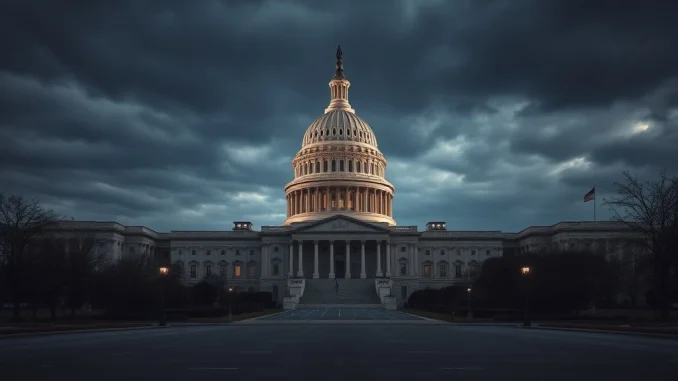
Washington D.C., February 1, 2025: The United States government has entered a partial shutdown, a disruptive event triggered by a critical delay in the final House vote on the federal budget. While the Senate passed the necessary funding legislation, the shutdown became unavoidable as the House of Representatives adjourned without taking action, with members not scheduled to return until February 2. This lapse in appropriations immediately places the nation in a familiar yet disruptive pattern, forcing numerous federal agencies to cease non-essential operations and furlough hundreds of thousands of workers.
Anatomy of a Partial Government Shutdown
A partial government shutdown occurs when Congress fails to enact the required appropriations bills or a continuing resolution before a funding deadline. The Antideficiency Act prohibits federal agencies from obligating funds without congressional approval. Consequently, agencies must execute contingency plans, distinguishing between “excepted” and “non-excepted” activities. Excepted activities, which continue, involve the protection of human life and property, such as national security, air traffic control, and border protection. Non-excepted activities halt, and employees performing those duties are furloughed.
This specific shutdown stems from a procedural breakdown. The Senate, following protracted negotiations, managed to pass a consolidated appropriations package to fund the government through the remainder of the fiscal year. However, the bill’s journey stalled in the House. Leadership could not secure unanimous consent for an expedited vote, and with a significant number of representatives already departed for a scheduled district work period, the chamber lacked the quorum necessary to conduct business. The delay past the midnight deadline triggered the funding lapse.
Immediate Impacts and Consequences
The effects of a partial shutdown are immediate and wide-ranging, touching millions of Americans and the broader economy. The scope depends entirely on which agencies’ funding has lapsed. Based on historical precedents and current contingency plans, the following impacts are expected:
- Federal Workforce: An estimated 750,000 federal employees across affected agencies will be furloughed. Another 1.3 million “essential” employees are required to work without immediate pay, receiving backpay only after funding is restored.
- Public Services: National parks and museums may close or operate with minimal staff. Processing of passports and visas slows dramatically. IRS taxpayer assistance centers close, though automated systems remain operational.
- Economic Ripple: The Congressional Budget Office estimates that the 2018-2019 shutdown reduced GDP by approximately $11 billion. A prolonged event disrupts government contracting, small business loan processing, and economic data releases from the Bureau of Labor Statistics and Commerce Department.
- Social Safety Nets: Programs like Social Security and Medicare, funded by permanent appropriations, continue. However, administrative support can degrade. The Supplemental Nutrition Assistance Program (SNAP) and certain housing benefits face uncertainty if the shutdown extends beyond a few weeks.
Historical Context and Political Dynamics
Since the modern budgeting process began in 1976, the U.S. has experienced over 20 funding gaps, with 10 causing partial shutdowns of varying lengths. The most significant in recent history was the 35-day shutdown from December 2018 to January 2019, centered on disputes over border wall funding. These events typically result from a fundamental disagreement between Congress and the White House, or, as in this case, intra-party or procedural disputes within a single chamber of Congress.
Analysts point to several factors complicating the current impasse. The narrow partisan margins in both the House and Senate grant significant leverage to small factions within each party. Furthermore, the use of short-term continuing resolutions (CRs) to extend deadlines has become commonplace, creating a cycle of brinkmanship that erodes regular order in the appropriations process. This shutdown highlights the fragility of governing under such conditions, where the absence of a handful of lawmakers can precipitate a national disruption.
Path to Resolution and Lingering Effects
The most direct path to ending the shutdown is for the House to reconvene, secure a quorum, and hold a vote on the Senate-passed bill. House leadership is reportedly working to recall members, but logistical challenges and political calculations can delay this process. Alternative, narrower funding measures are sometimes proposed but often lack the consensus needed for passage.
Even after funding is restored, the effects linger. The morale and financial stability of the federal workforce suffer. Contractors, who typically do not receive backpay, face direct financial losses. Public trust in governmental institutions often declines. Furthermore, the repeated use of shutdowns as a political tactic risks normalizing what was once considered a failure of governance, potentially making future budgetary standoffs more likely.
| Year | Duration | Primary Cause | Estimated Cost |
|---|---|---|---|
| 2013 | 16 days | Affordable Care Act dispute | $24 billion |
| 2018-2019 | 35 days | Border security funding | $11 billion (GDP) |
| 2025 | Ongoing | House procedural delay | TBD |
Conclusion
The current partial government shutdown serves as a stark reminder of the operational and political vulnerabilities within the U.S. federal budgeting system. While the immediate trigger is a procedural delay in the House vote, the underlying causes are rooted in deep-seated partisan divisions and a breakdown of traditional legislative processes. The consequences are real and immediate, affecting federal employees, public services, and economic stability. As the nation watches for the House to reconvene and break the impasse, this event underscores the critical importance of timely, functional governance and the high cost of its failure.
FAQs
Q1: What is the difference between a partial and a full government shutdown?
A partial shutdown occurs when Congress fails to pass some, but not all, of the annual appropriations bills. Agencies without funding must close. A full shutdown, which is extremely rare, would happen if none of the bills were passed, affecting virtually all discretionary spending.
Q2: Do all federal employees stop working during a partial shutdown?
No. Employees deemed “essential” for the protection of life and property continue to work, though they will not be paid until after the shutdown ends. “Non-essential” employees are furloughed and cannot work.
Q3: Will I still get my Social Security check?
Yes. Social Security benefits are funded by permanent appropriations and are not subject to annual congressional approval. Checks will continue to be mailed. However, field office services may be limited, and new benefit verification requests may be delayed.
Q4: How long can a partial government shutdown last?
There is no legal time limit. A shutdown lasts until Congress passes and the President signs the necessary appropriations legislation. The longest on record was 35 days in 2018-2019.
Q5: What happens to national parks during a shutdown?
Management varies. Parks may remain accessible but with all staffed services (restrooms, visitor centers, trash collection, maintenance) suspended, leading to potential safety and environmental issues. Some may be closed entirely based on contingency plans.