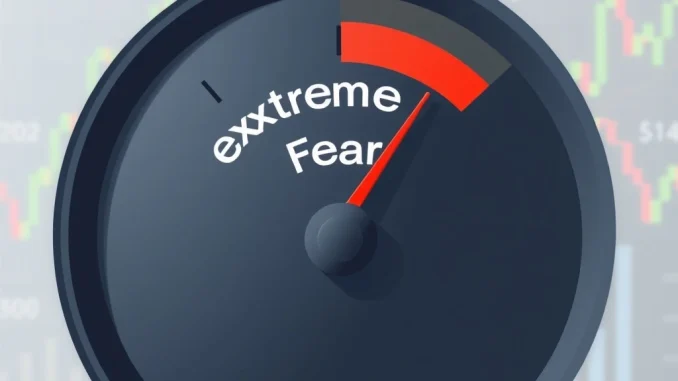
Global, April 2025: A key barometer of cryptocurrency market psychology has registered a subtle but notable shift. The Crypto Fear & Greed Index, a widely followed sentiment indicator compiled by data provider Alternative, has risen four points from the previous day to a reading of 20. This crucial move signals a tentative recovery in investor mood, yet the index remains firmly entrenched in the “Extreme Fear” category, highlighting the persistent anxiety and caution that continue to define the current market landscape. The index, which measures market sentiment on a scale from 0 (extreme fear) to 100 (extreme greed), serves as a vital pulse check for traders and analysts navigating the volatile digital asset space.
Crypto Fear & Greed Index Climbs: Decoding the Four-Point Rise
The movement from 16 to 20 on the Crypto Fear & Greed Index represents more than just a numerical tick. It reflects a measurable, albeit fragile, improvement in the collective emotional state of the market. Historically, readings below 25 are classified as “Extreme Fear,” a zone often associated with potential market bottoms, widespread capitulation, and heightened risk aversion among investors. The four-point gain, therefore, suggests a marginal reduction in panic selling and a slight increase in risk tolerance, possibly driven by short-term price stabilization or positive developments in broader financial markets. Analysts monitor these intra-category movements closely, as they can precede more significant sentiment shifts. It is essential to understand that the index is a composite measure, not a predictor of price direction. A rise from extreme fear does not guarantee a bull market; it simply indicates that the previous peak of negative sentiment has eased. The calculation methodology, which we will explore, ensures this is a data-driven observation, not a speculative guess.
Understanding the Mechanics of Market Sentiment
The Crypto Fear & Greed Index derives its authority from a transparent and multi-faceted calculation model. It synthesizes data from six distinct sources to avoid over-reliance on any single metric. This methodology provides a robust, 360-degree view of market psychology. The factors and their respective weightings are:
- Volatility (25%): Current price swings of Bitcoin and other major cryptocurrencies are compared to historical averages. Elevated volatility typically correlates with fear, as it indicates uncertainty and rapid price changes.
- Market Momentum/Volume (25%): This component analyzes trading volume and recent price momentum. Sustained high volume on upward price moves can indicate greed, while high volume on downtrends often signals fear.
- Social Media (15%): The index scans platforms like Twitter and Reddit for the volume and sentiment of cryptocurrency-related discussions. A surge in positive mentions can lift the score, while negative buzz can depress it.
- Surveys (15%): Periodic polls of the cryptocurrency community provide direct insight into investor expectations and mood, adding a qualitative layer to the quantitative data.
- Dominance (10%): Bitcoin’s share of the total cryptocurrency market cap is tracked. Rising dominance can sometimes indicate a “flight to safety” during fearful periods, as investors move capital into the most established asset.
- Trends (10%): Google search volume for cryptocurrency-related terms is analyzed. Spikes in search interest, particularly for negative terms, are factored into the fear assessment.
This diversified approach ensures the index reflects genuine market dynamics rather than noise from one specific area.
Historical Context: The Index as a Contrarian Compass
The true value of the Crypto Fear & Greed Index often emerges in hindsight. Market historians frequently point to its extremes as potential contrarian indicators. For instance, during the bull market peak in late 2021, the index sustained readings above 90 (Extreme Greed) for extended periods, coinciding with a market top. Conversely, following major sell-offs like those in 2018 and 2022, the index plunged into single-digit “Extreme Fear” territory, which later aligned with longer-term accumulation phases. The current reading of 20 sits well above the absolute lows seen in those severe bear markets but is far from the neutral zone around 50-55. This historical perspective is crucial. It tells us that while sentiment has improved from its recent worst levels, the market remains in a state of trauma recovery. Investors are not yet confident, but the intense panic may be subsiding. This phase can be characterized by sideways price action and low conviction, as the market searches for a new fundamental catalyst to drive a sustained sentiment recovery.
Implications for Traders and Long-Term Investors
The rise to 20 carries different meanings for various market participants. For active traders, especially those employing mean-reversion strategies, an “Extreme Fear” reading can signal a potential buying opportunity, under the assumption that sentiment cannot remain depressed indefinitely. However, the key lesson from past cycles is that fear can persist, and prices can remain low, for much longer than anticipated. The index is a tool for context, not a timing signal. For long-term, dollar-cost-averaging investors, periods of extreme fear are often framed as windows to accumulate assets at lower price points, aligning with the philosophy of being “greedy when others are fearful.” The slight recovery to 20 might suggest that the period of maximum fear-driven selling pressure could be moderating. It is also vital to consider external macro factors. The index’s recent movement may be reacting to or being suppressed by concerns about global interest rates, inflation data, or geopolitical tensions, reminding us that cryptocurrency markets do not operate in a vacuum. The sentiment recovery, while slight, must be validated by improvements in on-chain fundamentals, such as network activity and developer engagement, for it to translate into a durable market advance.
Conclusion: A Market in Transition, Not Transformation
The Crypto Fear & Greed Index’s climb to 20 is a meaningful data point in the ongoing narrative of the cryptocurrency market. It confirms a slight thaw in the deep freeze of investor sentiment, moving the needle away from the depths of despair. However, the persistent “Extreme Fear” classification is an equally important reminder that confidence remains fragile. The market appears to be in a transitional state, recovering from a shock but not yet ready to embrace optimism. For observers, this creates a landscape defined by caution rather than conviction. Monitoring whether future movements can break the index out of the extreme fear zone and into “Fear” or “Neutral” territory will be critical for assessing the market’s next major phase. The Crypto Fear & Greed Index, therefore, remains an essential tool for cutting through the noise and quantifying the powerful, often irrational, force of human emotion in the digital asset economy.
FAQs
Q1: What does a Crypto Fear & Greed Index reading of 20 mean?
A reading of 20 means the overall market sentiment is in the “Extreme Fear” category, but it has improved slightly from a lower level. It indicates that while fear is still the dominant emotion, its intensity has lessened compared to the previous measurement period.
Q2: Who creates the Crypto Fear & Greed Index and how often is it updated?
The index is compiled and published by the data provider Alternative.me. It is typically updated once per day, providing a daily snapshot of market sentiment based on the previous 24 hours of data.
Q3: Is the Crypto Fear & Greed Index a reliable buy or sell signal?
No, the index is not a direct trading signal. It is a sentiment indicator. While extreme readings have historically coincided with market turning points, it should not be used in isolation. It is best utilized as one tool among many for understanding market psychology and context.
Q4: Why does the index focus so heavily on Bitcoin (through volatility and dominance)?
Bitcoin is the largest and most influential cryptocurrency by market capitalization, liquidity, and mainstream recognition. Its price action and market share significantly impact the entire digital asset ecosystem, making it a critical component for any broad market sentiment gauge.
Q5: Has the index ever been wrong?
As a sentiment indicator, it accurately reflects the emotion present at the time. However, sentiment can remain “extreme” for prolonged periods. A reading of “Extreme Fear” does not guarantee an immediate price rebound; markets can stay fearful and prices can continue to drift before a recovery begins. It measures the present mood, not the future price.