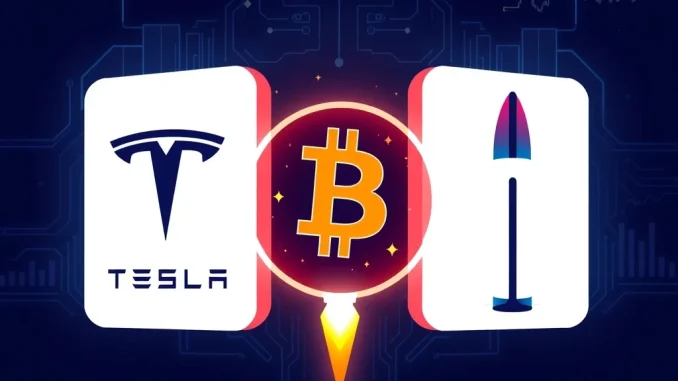
Global, May 2025: A potential corporate merger between Elon Musk’s two flagship companies, Tesla and SpaceX, could have a profound and unexpected consequence in the cryptocurrency world. According to a recent analysis, the combined entity would instantly become one of the largest publicly traded corporate holders of Bitcoin globally, fundamentally altering the landscape of institutional cryptocurrency adoption.
Tesla-SpaceX Merger Could Create a New Bitcoin Powerhouse
The prospect of a merger between Tesla Inc. and Space Exploration Technologies Corp. (SpaceX) has moved from speculative chatter to serious financial analysis. Reports from major news outlets like Reuters and Bloomberg have indicated that SpaceX is evaluating strategic options, including a potential merger with Tesla or Musk’s artificial intelligence venture, xAI, ahead of a planned initial public offering. While the primary motivations for such a consolidation would revolve around technological synergies, capital structure, and Musk’s overarching vision, a significant side effect involves their substantial Bitcoin treasuries. A detailed report from CoinDesk highlights that a combined Tesla-SpaceX would hold nearly 20,000 Bitcoin, positioning it as the seventh-largest corporate holder of the cryptocurrency in the world. This development underscores the growing intersection of traditional corporate strategy and digital asset management.
Analyzing the Combined Bitcoin Holdings
The scale of the potential combined Bitcoin treasury is not trivial. According to publicly available data and corporate disclosures analyzed by CoinDesk, the individual holdings of each company are already significant. Tesla’s corporate treasury currently holds approximately 11,509 Bitcoin, valued at roughly $1 billion based on recent market prices. SpaceX, a privately held company, is reported to hold about 8,285 Bitcoin, worth approximately $690 million. The simple arithmetic of a merger creates a formidable digital asset portfolio.
- Combined Total: ~19,794 Bitcoin
- Approximate Value: ~$1.69 billion (subject to market volatility)
- Global Ranking: 7th largest publicly traded corporate holder
This would place the hypothetical merged company ahead of other notable corporate holders and just behind giants like MicroStrategy, which has made Bitcoin acquisition a core part of its treasury strategy. The table below illustrates a snapshot of the top corporate holders for context.
| Company | Bitcoin Holdings (Approx.) | Status |
|---|---|---|
| MicroStrategy | ~226,000 BTC | Public |
| Marathon Digital | ~17,600 BTC | Public |
| Coinbase (Corporate) | ~10,000 BTC | Public |
| Potential Tesla-SpaceX | ~19,800 BTC | Would be Public |
| Square (Block, Inc.) | ~8,027 BTC | Public |
The Strategic Context of Corporate Bitcoin Adoption
The potential merger brings into sharp focus the evolving rationale for corporations holding Bitcoin. Initially viewed as a highly speculative move, corporate Bitcoin adoption has matured into a discussed treasury management strategy. Proponents argue it serves as a hedge against inflation, a diversifier away from traditional cash holdings, and a bet on the long-term value of a new digital asset class. Tesla’s initial $1.5 billion purchase in early 2021, followed by subsequent sales and holds, sparked intense debate and set a precedent for other technology-forward companies. SpaceX’s acquisition, though less publicized, signaled a similar strategic alignment within Musk’s ecosystem. A merger would consolidate these bets into a single, massive balance sheet position, making the new entity’s financial health more correlated to Bitcoin’s price movements than perhaps any other non-crypto native corporation of its size.
Implications for Markets and Cryptocurrency Legitimacy
The creation of such a large, single corporate Bitcoin holder carries several immediate and long-term implications. First, it would represent one of the most significant validations of Bitcoin as a legitimate reserve asset from within the traditional industrial and technological sector. The sheer size of the holding would be difficult for institutional investors and market analysts to ignore, potentially forcing a broader reassessment of Bitcoin’s role in corporate finance. Second, market dynamics could be affected. While 20,000 BTC is a fraction of the total circulating supply, its concentration on a single public company’s balance sheet could influence perceptions of liquidity and holder behavior. The market would closely watch the new entity’s treasury policy—whether it would hold, accumulate further, or strategically sell portions of its cache. Finally, regulatory scrutiny would likely intensify. A publicly traded company of that stature holding billions in a volatile asset would face questions from shareholders and regulators about risk management, disclosure practices, and accounting treatment.
Historical Precedents and Future Trajectories
The discussion around a Tesla-SpaceX merger and its Bitcoin implications does not exist in a vacuum. It follows a multi-year trend of institutional adoption that began with hedge funds and asset managers and moved into public and private corporations. The journey has been marked by volatility, both in price and in corporate sentiment. Some early adopters have maintained their positions through market cycles, while others have reduced exposure. A successful merger creating a top-ten holder would be a landmark event in this narrative, suggesting that digital asset integration is becoming a permanent feature of future-facing corporate strategy, not just a fleeting trend. It also raises questions about whether other conglomerates or merging entities might consider similar consolidated digital asset strategies in the future.
Conclusion
The potential merger between Tesla and SpaceX is primarily a story about aerospace, automotive, and artificial intelligence ambition. However, a critical subplot involves the creation of a new titan in the world of corporate Bitcoin holdings. With a combined treasury nearing 20,000 BTC, the entity would immediately rank as the seventh-largest publicly traded corporate holder globally. This fact highlights the deepening integration of cryptocurrency into mainstream corporate finance and serves as a powerful indicator of Bitcoin’s enduring appeal as a strategic treasury asset for innovative companies. The market will watch closely, as the fate of this significant Bitcoin cache becomes intertwined with the success of one of the world’s most watched entrepreneurs and his visionary companies.
FAQs
Q1: How much Bitcoin do Tesla and SpaceX currently hold individually?
Tesla holds approximately 11,509 Bitcoin. SpaceX holds approximately 8,285 Bitcoin, according to analysis from CoinDesk based on available information.
Q2: Why would a merger make them a major Bitcoin holder?
A merger would combine their separate Bitcoin treasuries into a single corporate entity. The sum of their holdings, nearly 20,000 BTC, would be larger than most other publicly traded companies that hold Bitcoin, instantly granting the new company a top-ten ranking.
Q3: What is the main reason companies like Tesla and SpaceX buy Bitcoin?
While official strategies may vary, common reasons cited by corporations include diversifying cash reserves, hedging against potential inflation and currency devaluation, and gaining exposure to a growing digital asset class they believe has long-term value.
Q4: Has Tesla sold any of its Bitcoin?
Yes. Tesla’s initial $1.5 billion purchase in 2021 was followed by sales of portions of its holdings in subsequent quarters. Its current holding of ~11,500 BTC represents what remains of its strategic position after those transactions.
Q5: How would this affect the Bitcoin market?
A single large holder can influence market sentiment. The consolidation of such a large amount on one balance sheet could be seen as a sign of strong, long-term conviction (bullish), but it also concentrates liquidity. The market would monitor the new company’s future Bitcoin-related treasury decisions closely.