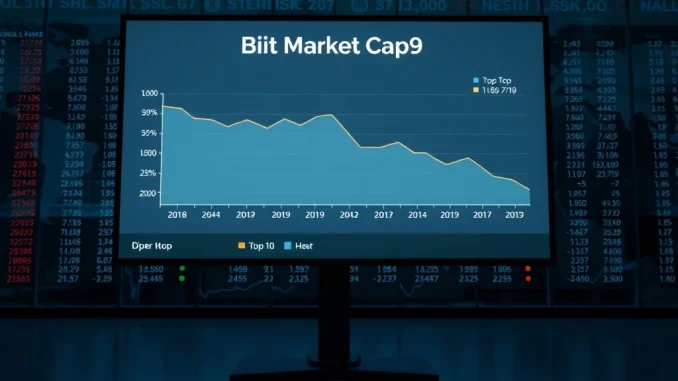
Global, May 2025: Bitcoin’s market capitalization has experienced a significant shift, falling three positions to 12th place among the world’s largest assets. According to data from 8marketcap, the premier cryptocurrency now holds a valuation of approximately $1.64 trillion, marking a notable retreat from its recent standing within the top 10. This movement underscores the inherent volatility of digital assets and prompts a deeper analysis of Bitcoin’s role within the global financial hierarchy.
Bitcoin Market Cap Exits the Top 10 Global Assets
The descent from the top 10 represents a pivotal moment for Bitcoin, which has enjoyed a prominent position among traditional financial giants like Apple, Microsoft, and gold for extended periods. Data aggregator 8marketcap, which tracks the market capitalization of publicly traded companies, commodities, and cryptocurrencies, confirmed the repositioning. Financial media outlet Cointelegraph reported that a large-scale sell-off in the crypto markets precipitated the drop. This event illustrates a core characteristic of the cryptocurrency sector: its capacity for rapid and substantial price swings, which can dramatically alter its standing relative to more established, less volatile asset classes.
Market capitalization, calculated by multiplying the current price by the total circulating supply, serves as a key metric for comparing the relative size of different assets. Bitcoin’s fall to 12th place places it behind several mega-cap technology stocks, major government bonds, and precious metals. Analysts observe that such volatility is not unprecedented for Bitcoin but highlights the ongoing maturation process of the entire digital asset ecosystem. The market’s reaction often reflects a complex interplay of macroeconomic factors, regulatory news, investor sentiment, and technical trading patterns.
Understanding the Data and Recent Cryptocurrency Volatility
The data from 8marketcap provides a clear, quantitative snapshot of Bitcoin’s changing fortune. To contextualize this shift, it is essential to examine the recent price action and trading volumes that led to the erosion of its market cap. Over the past several months, the cryptocurrency market has navigated a challenging landscape characterized by:
- Macroeconomic Headwinds: Rising interest rates and tightening monetary policy from central banks worldwide have pressured risk assets, including technology stocks and cryptocurrencies.
- Regulatory Scrutiny: Ongoing discussions and actions by financial regulators in major economies continue to create uncertainty for institutional and retail investors.
- Market Sentiment Shifts: The “fear and greed” cycle, a well-documented phenomenon in crypto markets, appears to have entered a cautious phase, leading to profit-taking and capital preservation.
- Liquidity Dynamics: Large sell orders from major holders, often referred to as “whales,” can trigger cascading liquidations in leveraged trading positions, exacerbating downward price movements.
This period of volatility serves as a reminder that while Bitcoin has demonstrated remarkable long-term growth, its journey is punctuated by significant corrections. These cycles often test the conviction of long-term holders and reshape the composition of the investor base.
Historical Context: Bitcoin’s Journey in the Global Rankings
Bitcoin’s position among global assets has never been static. Its first notable entry into these comparisons came after the bull run of 2017, though it remained far outside the top 50. The paradigm shift occurred following the institutional adoption wave of 2020-2021, propelled by corporate treasury allocations, the launch of Bitcoin ETFs in several countries, and increasing recognition as a potential digital store of value. This propelled Bitcoin into the top 10, at times surpassing the market cap of legacy corporations and even challenging silver.
This historical perspective is crucial. Previous exits from the top 10 have been followed by periods of consolidation and subsequent re-entries. The asset’s ranking is a direct function of its USD-denominated price, making it exceptionally sensitive to market sentiment. Comparing Bitcoin to traditional companies also presents an analytical challenge, as their fundamental drivers—network adoption and monetary policy versus revenue and profits—are fundamentally different. Nonetheless, the market cap ranking remains a popular and easily understood benchmark for mainstream financial audiences.
Implications for Investors and the Crypto Ecosystem
The drop in ranking carries several implications for different market participants. For traditional investors observing from the sidelines, it may reinforce perceptions of cryptocurrency as a highly speculative and unstable asset class. For crypto-native investors and analysts, however, the focus often shifts to on-chain metrics, hash rate, network activity, and long-term adoption trends, which they argue provide a more robust fundamental picture than short-term price fluctuations.
The event also has consequences for the broader digital asset ecosystem. Bitcoin’s market cap dominance—its share of the total cryptocurrency market—often influences altcoin markets. A declining Bitcoin price and market cap can lead to reduced capital flowing into smaller cryptocurrencies. Furthermore, the public narrative around Bitcoin’s “size” relative to traditional finance can impact its appeal as a potential hedge against inflation or currency devaluation in the eyes of institutional allocators.
Conclusion
Bitcoin’s market cap falling to 12th place in the global asset rankings is a significant data point that captures a moment of pronounced market stress. The decline to a $1.64 trillion valuation, as tracked by 8marketcap, highlights the cryptocurrency’s acute sensitivity to sell-offs and broader risk-off sentiment in financial markets. While this volatility presents challenges, it also forms an intrinsic part of Bitcoin’s historical market profile. The event underscores the ongoing evolution of Bitcoin from a niche digital experiment to an asset that is periodically measured against the largest companies and commodities on earth, a comparison that itself signifies its profound impact on modern finance. The focus for observers now shifts to whether this represents a temporary setback or the beginning of a more prolonged period of consolidation outside the top tier of global assets.
FAQs
Q1: What does “market capitalization” mean for Bitcoin?
Market capitalization for Bitcoin is calculated by multiplying the current market price of one bitcoin by the total number of bitcoins in circulation. It represents the total theoretical USD value of all existing bitcoin and is the standard metric used to compare its size to other assets like stocks or gold.
Q2: What was Bitcoin’s market cap when it fell to 12th place?
According to data from 8marketcap, Bitcoin’s market capitalization was approximately $1.64 trillion at the time it fell three places to 12th in the global asset rankings.
Q3: Why is Bitcoin’s market ranking so volatile?
Bitcoin’s price, and therefore its market cap, is highly sensitive to changes in supply and demand, investor sentiment, macroeconomic news, and regulatory developments. Unlike a company whose value is partly based on steady revenue, Bitcoin’s value is more purely driven by market perception and adoption, leading to larger percentage swings.
Q4: What assets are currently ranked above Bitcoin?
While rankings fluctuate, assets typically above Bitcoin include mega-cap technology stocks (e.g., Apple, Microsoft, NVIDIA, Google), major exchange-traded funds (ETFs) tracking broad indices, gold, and the sovereign debt of large nations like the United States.
Q5: Has Bitcoin fallen out of the top 10 before?
Yes. Bitcoin’s position in the global rankings has changed multiple times throughout its history. It has entered and exited the top 10 on several occasions, usually following major bull runs and subsequent market corrections. Its current position reflects the cyclical nature of its market cycles.