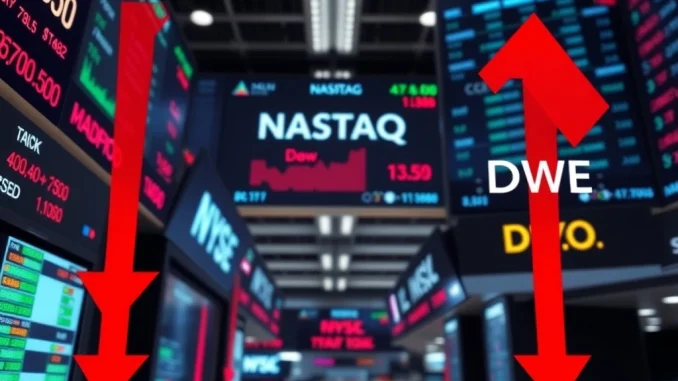
New York, NY, April 10, 2025: The three major US stock indices opened Thursday’s trading session in negative territory, signaling a cautious start for Wall Street. The S&P 500 fell 0.24%, the technology-heavy Nasdaq Composite dropped 0.32%, and the Dow Jones Industrial Average declined 0.24% at the opening bell. This synchronized downward move follows a mixed overnight session in global markets and comes ahead of key economic data releases later in the week.
Analyzing the Opening Bell Decline for Major US Stock Indices
Traders and analysts immediately scrutinized the tape as the opening prints confirmed a broad-based retreat. The simultaneous decline across all three major US stock indices often points to macroeconomic concerns rather than sector-specific issues. Market participants digested several potential catalysts during the pre-market hours, including movements in Treasury yields and comments from Federal Reserve officials. The opening dip extended slight losses from the previous session’s close, suggesting persistent investor hesitation. Volume was reported as average for the first fifteen minutes, indicating orderly selling rather than panic-driven liquidation. This type of opening often sets the tone for morning trading as institutional investors execute their initial orders.
Sector Performance and Market Breadth at the Open
Early sector data revealed which areas of the market faced the most pressure. A preliminary breakdown showed:
- Technology: Led the declines, weighing heavily on the Nasdaq.
- Consumer Discretionary: Showed weakness amid concerns over retail spending.
- Financials: Traded slightly lower alongside a flattening yield curve.
- Defensive Sectors: Utilities and Consumer Staples showed relative stability, a typical pattern during risk-off opens.
Market breadth, a measure of advancing versus declining stocks, was negative. For every stock that opened higher, approximately two opened lower on the New York Stock Exchange. This negative breadth confirmed the decline was widespread, not driven by a handful of large-cap stocks. The CBOE Volatility Index (VIX), often called the market’s “fear gauge,” ticked higher in early trading, reflecting increased demand for options protection.
Historical Context for Early Session Declines
Opening declines of this magnitude are not uncommon. Historical data from the last decade shows that the S&P 500 opens lower roughly 40% of all trading days. However, the direction at the open is a poor predictor of the session’s final outcome. On average, about one-third of days that start lower finish higher, a phenomenon traders call a “morning dip buy.” The current decline of around a quarter of a percent falls well within the range of normal market volatility. It does not, by itself, signal a change in the prevailing market trend without confirmation from subsequent price action and volume throughout the day.
The Role of Economic Data and Federal Reserve Policy
The market’s cautious open occurred within a specific economic calendar context. Investors are awaiting the Producer Price Index (PPI) report and weekly jobless claims data scheduled for release tomorrow. These reports provide critical insights into inflation and labor market health, two primary factors influencing Federal Reserve policy. Recent commentary from Fed officials has emphasized a data-dependent approach, making each economic release a potential market mover. The modest pullback at the open may reflect positioning ahead of this data, as some investors reduce risk exposure. Furthermore, the yield on the benchmark 10-year Treasury note was relatively stable in early trading, suggesting bond markets were not driving the equity sell-off.
Global Market Influence on US Equities
US markets do not trade in a vacuum. Overnight, major Asian indices closed with modest losses, while European markets traded mixed at the time of the US open. Often, weakness in foreign markets can spill over to US futures, setting a negative tone. Currency markets also played a role, with the US Dollar Index holding steady. A stronger dollar can pressure multinational companies by making their overseas earnings less valuable when converted back to USD. The interconnectedness of global capital markets means that the opening move for major US stock indices frequently reflects a synthesis of overnight developments from around the world.
Technical Analysis of Key Index Levels
From a technical perspective, chart analysts monitor specific price levels for the indices. The early decline tested near-term support levels.
| Index | Key Support Level | Key Resistance Level | Status at Open |
|---|---|---|---|
| S&P 500 | 5,200 | 5,250 | Testing support |
| Nasdaq Composite | 16,300 | 16,500 | Below 50-day MA |
| Dow Jones | 39,000 | 39,500 | Holding above support |
A sustained break below these support zones could trigger further algorithmic selling. Conversely, a rebound from these levels would be seen as a sign of underlying strength. The opening thirty minutes are crucial for technicians to assess the validity of the initial move.
Conclusion: Interpreting the Market’s Opening Message
The lower open for the major US stock indices presented a clear, if modest, signal of investor caution at the start of Thursday’s session. The declines in the S&P 500, Nasdaq, and Dow Jones reflected a combination of global market sentiment, pre-economic data positioning, and normal intraday volatility. For long-term investors, such opening moves are typically noise within a broader trend. For active traders, they represent the first data point in constructing the day’s narrative. The subsequent hours will determine whether this opening dip was a fleeting moment of hesitation or the beginning of a more meaningful pullback. Market participants will now watch for sector rotation, leadership changes, and volume patterns to gauge the session’s true direction.
FAQs
Q1: What does it mean when all three major US stock indices open lower?
It typically indicates broad-based selling pressure across the market at the session’s start, often driven by macroeconomic news, global market trends, or investor sentiment ahead of key events. It suggests a risk-off tone among traders executing their opening orders.
Q2: How significant is a 0.24% decline at the open for the S&P 500?
A decline of this size is considered normal market volatility and is not unusual. It falls within the average daily trading range. The significance depends on whether the loss accelerates or reverses as the trading day progresses.
Q3: Does the market’s direction at the open predict the close?
Not reliably. Historical data shows markets often reverse direction from the open. The first hour’s price action and volume provide more clues about intraday sentiment than the opening tick alone.
Q4: What immediate factors most influence the stock market open?
The open is heavily influenced by pre-market trading in futures, overnight news, earnings reports released before the bell, economic data, and the performance of Asian and European markets while US markets are closed.
Q5: Should individual investors react to a lower market open?
Most financial advisors caution against reactive trading based solely on the open. For long-term investors following a strategy, daily opening volatility is usually irrelevant. The focus should remain on fundamental research and asset allocation rather than intraday moves.