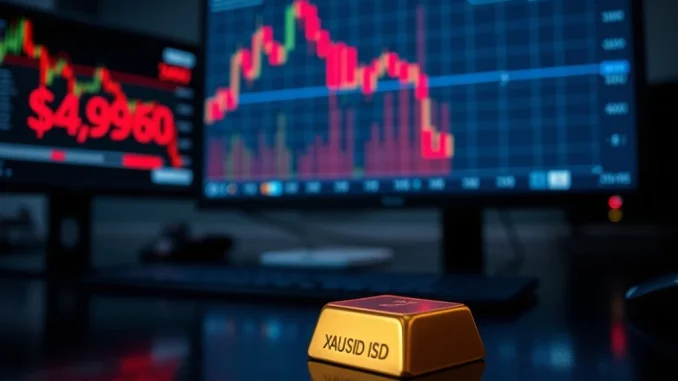
Global Markets, January 31, 2025: In a stunning reversal, spot gold has tumbled below the critical $5,000 per ounce threshold, currently trading at $4,988.600. This represents a sharp 7.08% decline from the previous session and a dramatic pullback from its recent peak of $5,598.750 set just two days prior on January 29. The sell-off has engulfed the broader precious metals complex, with spot silver experiencing an even more severe correction, falling over 15% to trade at $98.697. This volatility marks one of the most significant two-day drops for gold in recent years, prompting intense scrutiny from investors and analysts worldwide.
Spot Gold Price Plunge: Analyzing the Immediate Data
The velocity of the decline in the gold price is particularly noteworthy. A drop of over $600 from peak to trough in a 48-hour window is an extreme move for an asset traditionally viewed as a stable store of value. The following table breaks down the key price action:
| Asset | Price on Jan 29 (Peak) | Current Price (Jan 31) | Dollar Change | Percentage Change |
|---|---|---|---|---|
| Spot Gold (XAU/USD) | $5,598.750 | $4,988.600 | -$610.150 | -10.90% (from peak) |
| Spot Silver (XAG/USD) | ~$116.40 (est.) | $98.697 | ~-$17.70 | > -15.00% |
This correction follows an extended, multi-year bull run for precious metals, driven by a confluence of factors including geopolitical tensions, expansive global fiscal policies, and concerns over currency debasement. The sudden downturn suggests a rapid reassessment of market conditions or a significant technical breakdown after gold failed to sustain momentum above the $5,500 level.
Contextual Drivers Behind the Precious Metals Sell-Off
To understand this plunge, one must examine the shifting macroeconomic landscape. Several interrelated factors are contributing to the current market volatility.
- Shifting Central Bank Rhetoric: Recent communications from major central banks, particularly the Federal Reserve and the European Central Bank, have hinted at a more hawkish stance than markets anticipated. Strong economic data has increased the perceived risk of interest rates remaining higher for longer. Since gold offers no yield, rising real interest rates increase the opportunity cost of holding it.
- US Dollar Strength: A broad-based rally in the US Dollar Index (DXY) has placed downward pressure on dollar-denominated commodities like gold and silver. A stronger dollar makes gold more expensive for holders of other currencies, dampening international demand.
- Profit-Taking and Technical Factors: After such a prolonged ascent, the market was vulnerable to a sharp correction. The failure to hold above $5,500 likely triggered automated sell orders and profit-taking from institutional investors and momentum traders, exacerbating the downward move.
- Risk-On Sentiment Resurgence: A temporary rally in global equity markets, fueled by positive corporate earnings or sector-specific optimism, can draw capital away from defensive assets like gold.
Historical Parallels and Market Psychology
Sharp corrections within long-term bull markets are not uncommon. Analysts often reference the 2008 financial crisis or the 2011-2013 period following gold’s all-time high (at that time). In both instances, gold experienced violent downdrafts exceeding 20% before eventually resuming its primary trend or entering a consolidation phase. The current spot gold drop, while severe, remains within the realm of a correction rather than a confirmed trend reversal. Market psychology plays a crucial role; the fear of missing out (FOMO) that drove prices to recent extremes can quickly turn into fear, uncertainty, and doubt (FUD), leading to rapid liquidation.
The Ripple Effect: Silver, Miners, and Related Assets
The carnage has not been isolated to gold. Silver price action, often more volatile due to its smaller market and dual role as both a monetary and industrial metal, has been hit harder. A 15% decline underscores its sensitivity to shifts in risk appetite and industrial demand expectations. The sell-off has created a cascading effect across related financial instruments.
- Mining Stocks: Publicly traded gold and silver mining companies typically exhibit leverage to the underlying metal prices. Their shares have likely fallen significantly more than the 7% drop in bullion, reflecting amplified equity risk.
- Exchange-Traded Funds (ETFs): Major physically-backed gold ETFs like GLD and IAU will see net outflows as investors redeem shares, potentially forcing the fund managers to sell physical gold holdings to meet redemptions, creating a feedback loop.
- Futures and Options Markets: Elevated volatility will be reflected in the derivatives markets, with margin calls potentially forcing further liquidations from leveraged speculators.
Implications for Investors and the Global Economy
This event serves as a stark reminder of the inherent volatility in all asset classes, even those considered “safe havens.” For investors, the drop presents both a warning and a potential opportunity.
- Portfolio Rebalancing: Investors who saw their precious metals allocation balloon during the bull run may now be rebalancing back to target weights, selling gold to buy other depressed assets.
- Test of Conviction: Long-term holders of gold as a hedge against systemic risk must decide whether the fundamental reasons for their investment have changed or if this is merely a short-term liquidity event.
- Economic Signal: Some analysts interpret a falling gold price as a signal of returning confidence in fiat currencies and central bank management. However, others caution it may simply reflect temporary liquidity shifts and technical trading.
The Path Forward: Key Levels to Watch
Market technicians are now closely monitoring several key price zones for spot gold. The $4,800-$4,900 area represents a critical medium-term support level, a consolidation zone from late 2024. A sustained break below this could open the door to a deeper correction toward $4,500. On the upside, any recovery will need to reconquer the $5,100-$5,200 area to stabilize sentiment. For silver, the $95 level is now a pivotal battleground.
Conclusion
The dramatic fall of spot gold below $5,000 per ounce is a significant market event that underscores the dynamic and often unpredictable nature of global finance. While the immediate drivers appear to be a combination of dollar strength, shifting rate expectations, and technical selling, the long-term trajectory for precious metals will depend on the evolving narrative around inflation, geopolitical stability, and monetary policy. This correction washes out speculative excess and provides a clearer picture of underlying demand. Whether this marks a healthy reset within a ongoing bull market or the beginning of a more profound shift will be one of the defining financial stories of early 2025. Investors are advised to focus on fundamentals, maintain disciplined risk management, and avoid reactionary decisions based solely on short-term market volatility.
FAQs
Q1: Why did spot gold fall so sharply?
The drop is attributed to a combination of a stronger US dollar, hawkish shifts in central bank policy expectations, widespread profit-taking after a long rally, and triggered technical sell orders after gold failed to hold above $5,500.
Q2: Is this the end of the bull market for gold?
It is too early to declare the bull market over. Sharp corrections are common within long-term uptrends. The fundamental drivers for gold—such as geopolitical risk, fiscal deficits, and its role as a non-sovereign asset—need to be reassessed to determine if a lasting trend change has occurred.
Q3: Why did silver fall more than gold?
Silver is a smaller, less liquid market than gold and is more sensitive to changes in global economic growth expectations due to its significant industrial use. This often leads to higher volatility in both directions.
Q4: What does this mean for my gold investments (ETFs, stocks, physical)?
Review your investment thesis. If you hold gold as a long-term hedge, short-term volatility is expected. If your position was based on short-term momentum, the landscape has changed. Consult with a financial advisor to assess your specific portfolio and risk tolerance.
Q5: Where could the gold price go from here?
Technicians are watching the $4,800-$4,900 support zone. A hold above could lead to consolidation and a potential rebound. A break below could see a test of lower supports near $4,500. The $5,100-$5,200 area is now initial resistance for any recovery attempt.
Q6: How does this affect other markets like cryptocurrencies or stocks?
Historically, gold and cryptocurrencies have had a mixed correlation. Sometimes they move together as “alternative” assets, other times they diverge. A sharp drop in gold can sometimes signal a “risk-on” shift benefiting stocks, but the relationship is not perfectly inverse and depends heavily on the specific cause of the move.