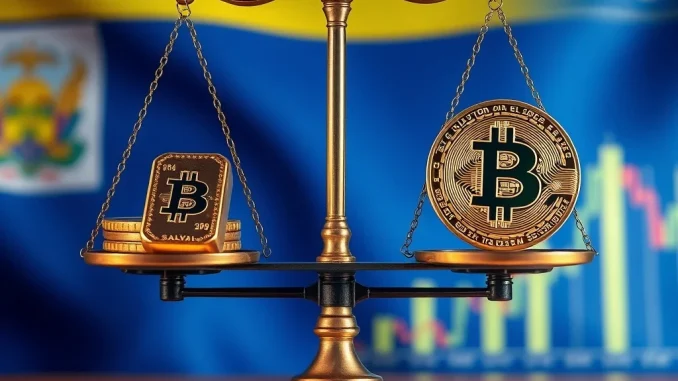
San Salvador, March 2025: In a world of economic uncertainty, El Salvador is executing a distinctive financial strategy that merges millennia-old tradition with digital-age innovation. The nation is systematically aligning its gold and bitcoin reserves to secure its economic future, a move that positions it uniquely on the global stage. This dual-asset approach aims to build monetary independence and resilience against external financial pressures.
El Salvador’s Strategic Accumulation of Gold Reserves
El Salvador’s Central Reserve Bank (BCR) recently announced a significant purchase of 9,298 troy ounces of gold, valued at approximately $50 million. This transaction elevates the nation’s total gold holdings to 67,403 ounces, with an estimated market value of $360 million. The bank stated this acquisition strengthens the country’s long-term national wealth and maintains a prudent balance within its international reserves composition. This policy reflects a global trend where central banks are increasing their gold holdings. According to the World Gold Council, central banks worldwide purchased 863 tons of gold in 2025, with nations like Poland, China, and Turkey leading the acquisitions. For a small, dollarized economy like El Salvador, building reserves in a tangible, historically stable asset like gold sends a clear signal of intent to bolster financial autonomy and credibility.
The Parallel Bitcoin Accumulation Strategy
Concurrently, El Salvador continues its unwavering commitment to bitcoin. Faithful to its “1 BTC per day” accumulation policy, the government’s treasury now holds 7,547 bitcoins. At current valuations, this digital reserve is worth approximately $635 million. This strategy, initiated with the country’s groundbreaking adoption of bitcoin as legal tender in 2021, is framed by President Nayib Bukele’s administration as a tool for economic sovereignty. The approach seeks to reduce reliance on the US dollar and position the nation at the forefront of a potential decentralized financial future. President Bukele has publicly characterized market downturns as buying opportunities, famously commenting on social media, “We just bought this other dip,” underscoring a long-term, conviction-driven investment philosophy.
Navigating Market Perceptions and Volatility
The dual strategy operates within a complex financial landscape. While gold prices have surged, gaining about 95% in a year to surpass $5,400 per ounce, bitcoin has experienced significant volatility, declining nearly 19% over the same period. This contrast highlights the differing risk profiles of the two assets. Financial analysts like John Glover, Chief Investment Officer at Leden, note that during periods of market instability, capital typically flows toward traditional safe havens like gold and stable currencies. Bitcoin, they argue, often still correlates with risk-on assets like stocks. El Salvador’s economic model actively challenges this conventional wisdom by treating bitcoin not merely as a speculative asset but as a foundational component of its national reserve strategy.
The Rationale Behind a Hybrid Reserve Model
El Salvador’s economic policy is not about choosing between old and new but about strategic complementarity. The government views gold as the bedrock of stability—a universally recognized store of value that provides security during geopolitical and economic crises. Bitcoin, conversely, represents a transformative bet on financial technology and decentralization. This hybrid model aims to create a balanced portfolio: gold anchors the nation’s wealth in physical reality, while bitcoin offers exposure to digital scarcity and potential long-term appreciation in a digitizing global economy. The strategy is a direct response to a world where traditional fiat currencies face inflationary pressures and where the monetary policies of major central banks, like the U.S. Federal Reserve, exert outsized influence on smaller economies.
Implications for Economic Sovereignty and Global Finance
El Salvador’s experiment is being closely watched by economists, investors, and other nations. By diversifying its reserves beyond traditional foreign currency holdings and into both physical gold and digital bitcoin, the country is attempting to carve a path toward greater monetary independence. This move has practical implications for its balance of payments, creditworthiness, and ability to engage in international trade. Furthermore, it positions El Salvador as a living laboratory for alternative financial systems. The success or failure of this policy will provide valuable data on the viability of cryptocurrency as a state-level reserve asset and on the practicalities of managing a bifurcated treasury in a volatile global market.
Conclusion
El Salvador’s alignment of gold and bitcoin reserves constitutes a bold and unconventional strategy to secure its economic future. By combining the timeless safe-haven appeal of gold with the innovative potential of bitcoin, President Nayib Bukele’s administration is pursuing a clear goal: reduced dependency on external monetary systems and the cultivation of national financial resilience. While the path is fraught with volatility and scrutiny, El Salvador’s commitment to this dual-asset framework underscores a profound long-term vision. The world now observes whether this blend of ancient value and digital promise can forge a viable model for economic sovereignty in the 21st century.
FAQs
Q1: Why is El Salvador buying both gold and bitcoin?
El Salvador is diversifying its national reserves to enhance economic sovereignty and reduce reliance on the US dollar. Gold provides traditional stability, while bitcoin represents a strategic bet on future digital finance and decentralization.
Q2: How much gold and bitcoin does El Salvador currently hold?
As of recent reports, El Salvador holds approximately 67,403 ounces of gold (worth ~$360 million) and 7,547 bitcoins (worth ~$635 million), following its latest purchase of 9,298 gold ounces.
Q3: What has been the market performance of these assets?
In the past year, gold’s price has increased significantly (up ~95%), while bitcoin’s price has been volatile and declined nearly 19%. This highlights the different risk and stability profiles of the two assets.
Q4: How do financial experts view this strategy?
Opinions are divided. Some analysts view bitcoin as too volatile for national reserves and note its correlation with risk assets. The Salvadoran government views it as a long-term investment in financial innovation and independence.
Q5: Is any other country adopting a similar approach?
While other nations, like China and Russia, have increased gold reserves, and some have explored central bank digital currencies (CBDCs), El Salvador remains unique in its direct, state-level accumulation of bitcoin as a reserve asset alongside gold.