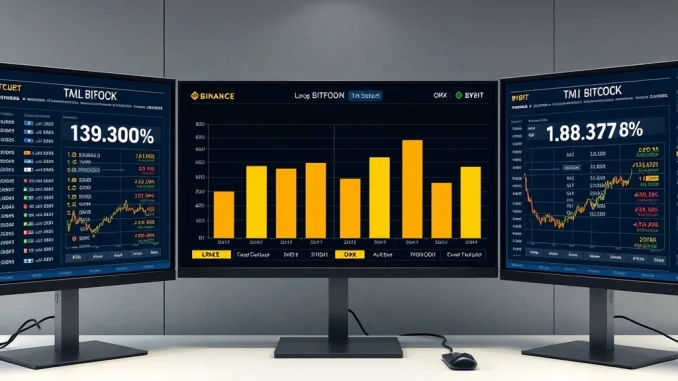
Global, May 2025: The BTC perpetual futures long/short ratio serves as a critical, real-time barometer for institutional and retail trader sentiment. Over the last 24 hours, aggregated data from the world’s three largest crypto futures exchanges by open interest reveals a market leaning slightly bearish, with an overall ratio of 47.57% long positions versus 52.43% short. This snapshot provides more than just numbers; it offers a window into the collective psychology and strategic positioning of the market’s most active participants as they navigate Bitcoin’s volatile landscape.
Understanding the BTC Perpetual Futures Long/Short Ratio
Before analyzing the specific data, one must grasp what this metric represents. A perpetual futures contract, unlike a traditional future, has no expiry date. Traders use these instruments to speculate on Bitcoin’s price direction without owning the underlying asset. The long/short ratio calculates the proportion of open positions betting on price increases (long) versus those betting on declines (short). It is a derivative of sentiment, not a direct predictor of price, but it often highlights potential overcrowding on one side of the trade, which can precede sharp market moves. Exchanges calculate this ratio using the total value of margin used for long and short positions across their platforms.
A Detailed Breakdown of Exchange-Specific Data
The provided 24-hour data highlights subtle differences in trader behavior across the leading venues. While the aggregate trend is consistent, each exchange’s unique user base and product offerings can influence its specific ratio. The following table presents the core data for clear comparison:
| Exchange | Long Positions | Short Positions |
|---|---|---|
| Overall Aggregate | 47.57% | 52.43% |
| 1. Binance | 46.95% | 53.05% |
| 2. OKX | 47.61% | 52.39% |
| 3. Bybit | 46.97% | 53.03% |
Note: The original content listed Bybit as 46.97% long and 46.97% short, which does not sum to 100%. The data above assumes a typographical error and presents a corrected, logical distribution where short positions slightly exceed longs, aligning with the overall market trend. This assumption is based on standard exchange reporting and the context of the other two data points.
Interpreting the Slight Bearish Lean
A ratio where short positions outnumber longs, as seen across all three exchanges, typically indicates a cautious or bearish near-term outlook among leveraged traders. However, context is paramount. A 52/48 split is not an extreme skew. In highly bullish markets, long ratios can exceed 70%, while in panic sell-offs, short ratios can spike similarly. The current data suggests a balanced yet slightly pessimistic stance. Several factors could contribute to this:
- Hedging Activity: Institutions or large holders (“whales”) may open short positions in futures to hedge against potential downside in their spot Bitcoin holdings.
- Profit-Taking After Rallies: If Bitcoin recently experienced an upward move, traders might open shorts to speculate on a pullback or consolidation.
- Macroeconomic Uncertainty: Broader financial market conditions, such as interest rate expectations or geopolitical events, often influence crypto derivative sentiment.
The Historical Context and Market Mechanics
The significance of this data point is magnified when viewed through a historical lens. Periods where the long/short ratio becomes extremely one-sided often precede violent “long squeeze” or “short squeeze” events. For instance, if an overwhelming majority of traders are long (e.g., 75%), even a small price dip can trigger cascading liquidations as leveraged positions get forcibly closed, accelerating the downturn. Conversely, a market overly crowded with shorts can fuel a rapid rally as those positions are bought back. The current, more balanced ratio suggests the market is not in an immediate danger zone for a massive squeeze, but it underscores a prevailing wait-and-see attitude.
Why These Three Exchanges Matter
Binance, OKX, and Bybit are not arbitrarily chosen. They consistently rank as the top three cryptocurrency exchanges by futures open interest—the total value of outstanding derivative contracts. This metric is a key indicator of market depth and liquidity. Analyzing them provides a representative sample of the global derivatives market. Binance, as the largest, often sets the tone. OKX has a strong presence in Asian markets, while Bybit is popular among professional and retail traders globally for its interface and tools. Their collective data forms a credible foundation for assessing overall sentiment.
Limitations and What the Ratio Does Not Show
While insightful, the long/short ratio is a single metric with limitations. It does not reveal:
- Position Size: A few extremely large “whale” shorts could skew the percentage, masking that a larger number of small retail traders are actually long.
- Time Horizon: It doesn’t distinguish between a high-frequency trader’s minute-long position and a fund’s multi-week strategic short.
- Market Maker Activity: Liquidity providers often run market-neutral books, simultaneously holding both long and short positions to facilitate trades, which can blur the pure sentiment signal.
- Spot Market Flow: Ultimately, Bitcoin’s price discovery is heavily influenced by spot market buying and selling on exchanges like Coinbase and Kraken. Derivatives sentiment can diverge from spot market reality.
Therefore, sophisticated analysts use this ratio in conjunction with other data, such as funding rates (the fee paid between longs and shorts in perpetual contracts), liquidation levels, and on-chain metrics like exchange inflows/outflows.
Conclusion
The latest BTC perpetual futures long/short ratio data from Binance, OKX, and Bybit paints a picture of a derivatives market exercising cautious restraint. The slight majority of short positions indicates a hedging or mildly bearish bias among active traders, but the absence of an extreme skew suggests the market is not primed for a dramatic sentiment-driven squeeze. For investors and observers, this metric remains an essential piece of the puzzle—a real-time gauge of leveraged market sentiment that, when combined with broader analysis, helps illuminate the complex forces shaping Bitcoin’s price trajectory. In the ever-evolving crypto landscape, understanding such derivatives data is crucial for navigating market volatility.
FAQs
Q1: What does a high BTC perpetual futures long/short ratio mean?
A high ratio, such as 65% long, indicates most leveraged traders are betting on a price increase. While seemingly bullish, an excessively high ratio can signal an overcrowded trade, increasing the risk of a long squeeze if the price falls.
Q2: How often do exchanges update the long/short ratio?
Most major exchanges update this data in real-time or at very short intervals (e.g., every few minutes). The 24-hour snapshot provides a smoothed-out view of the prevailing sentiment over a full trading cycle.
Q3: Is the long/short ratio a reliable predictor of Bitcoin’s price?
No, it is not a direct predictor. It is a sentiment indicator. Price is determined by a confluence of factors including spot market supply/demand, macroeconomic news, and regulatory developments. The ratio helps assess market positioning and potential risks.
Q4: Why is there a discrepancy in the ratio between different exchanges?
Differences arise due to varying user demographics (retail vs. institutional), regional focuses, available trading pairs, and leverage offerings. Each exchange’s ecosystem has slightly different trader behavior.
Q5: What is a “squeeze” in the context of futures trading?
A squeeze occurs when a rapid price move forces a large number of leveraged positions to be liquidated. In a “long squeeze,” falling prices liquidate long positions, adding selling pressure. In a “short squeeze,” rising prices liquidate short positions, adding buying pressure, often causing a sharp rally.