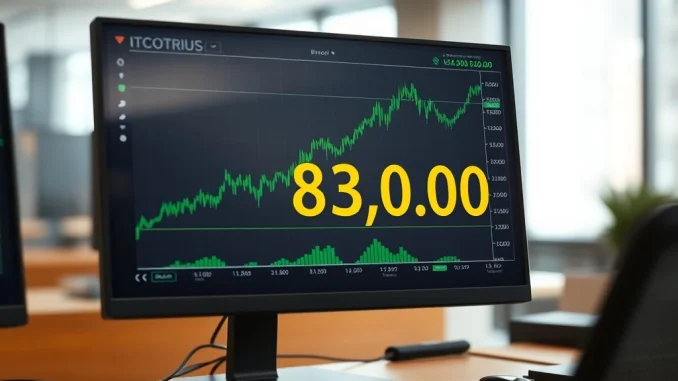
Global, April 2025: The cryptocurrency market witnessed a significant milestone as the Bitcoin price surged above the $83,000 threshold. According to real-time data from CoinPulseHQ market monitoring, BTC is trading at $83,011.84 on the Binance USDT perpetual futures market. This movement represents a notable acceleration in the digital asset’s valuation, capturing the attention of investors and analysts worldwide.
Bitcoin Price Reaches a New Valuation Plateau
The breach of the $83,000 level marks a critical point in Bitcoin’s ongoing market cycle. This price action is not an isolated event but part of a broader trend observed across major trading platforms. Market depth charts show substantial buy-side liquidity supporting the move, indicating strong institutional and retail demand. The rally follows a period of consolidation, where Bitcoin established a firm support base above the $75,000 level. Analysts point to several concurrent factors, including macroeconomic sentiment shifts and sustained inflows into spot Bitcoin exchange-traded funds (ETFs), as contributing to the bullish momentum. The trading volume accompanying this breakout has been significantly higher than the 30-day average, suggesting conviction behind the move.
Analyzing the Cryptocurrency Market Context
To understand the significance of Bitcoin trading above $83,000, one must examine the wider market landscape. Bitcoin’s performance often sets the tone for the entire digital asset sector.
- Dominance Metric: Bitcoin’s market dominance, its share of the total cryptocurrency market capitalization, has held steady or increased during this move, signaling that capital is flowing into the flagship asset rather than dispersing into altcoins.
- Macroeconomic Backdrop: The move occurs within a specific global financial context, including central bank policy expectations and currency market fluctuations, which have historically influenced digital asset valuations.
- On-Chain Data: Key on-chain metrics, such as the number of addresses holding non-zero balances and the mean coin age, provide a fundamental view of investor behavior and network health supporting the price.
The following table compares key Bitcoin price milestones from the past year, illustrating the pace of appreciation:
| Price Milestone | Approximate Date Reached | Time Since Previous $10k Milestone |
|---|---|---|
| $73,000 | Early March 2025 | ~3 weeks |
| $83,000 | Mid-April 2025 | ~6 weeks |
Historical Precedents and Cycle Analysis
Examining previous Bitcoin cycles provides crucial context. Each major bull market has been characterized by parabolic advances followed by periods of correction and consolidation. The move from $73,000 to above $83,000 shares technical similarities with past breakout patterns observed after prolonged accumulation phases. Historically, new all-time highs have been tested multiple times before establishing a firm foothold for the next leg up. The current price discovery phase above previous peaks is a critical watchpoint for long-term trend confirmation. Market technicians are observing key Fibonacci extension levels and moving averages to gauge potential resistance and support zones ahead.
Implications for Investors and the Digital Asset Ecosystem
A sustained Bitcoin price above $83,000 carries several implications. For investors, it reinforces the asset’s store-of-value narrative, particularly in portfolios seeking non-correlated returns. For the ecosystem, it validates the underlying network’s security and the utility of its settlement layer. Miners benefit from increased revenue in dollar terms, which can fund network infrastructure expansion and technological upgrades. Furthermore, this price level enhances the viability of Bitcoin as collateral in decentralized finance (DeFi) protocols and traditional finance (TradFi) lending facilities, increasing its financial utility. Regulatory observers note that higher valuations often bring increased scrutiny, making transparent reporting and compliance more important than ever for service providers in the space.
Conclusion
The Bitcoin price achieving a sustained level above $83,000 is a definitive moment for the cryptocurrency market. It reflects a complex interplay of market sentiment, institutional adoption, and macroeconomic factors. While price movements are inherent to volatile asset classes, this milestone underscores Bitcoin’s continued evolution from a niche digital experiment to a mainstream financial asset. Monitoring the market’s ability to hold this new ground will be essential for understanding the next phase of the cycle. The focus now shifts to whether this breakthrough can consolidate and serve as a launchpad for further valuation discovery or if it will invite profit-taking and a period of retracement.
FAQs
Q1: What does Bitcoin trading above $83,000 mean?
It signifies Bitcoin has reached a new valuation plateau in its current market cycle, often interpreted as a sign of strong buying pressure and bullish sentiment. It represents a breakthrough from previous resistance levels.
Q2: What typically causes a sharp Bitcoin price increase?
Sharp increases are usually driven by a combination of factors, including significant institutional investment inflows (like into ETFs), positive macroeconomic developments, technological upgrades, reduced selling pressure from miners or long-term holders, and overall positive market sentiment.
Q3: How does Bitcoin’s price affect other cryptocurrencies?
Bitcoin is considered the market leader. A strong, sustained rise in Bitcoin’s price often improves overall market sentiment, leading to capital flows into the broader cryptocurrency sector. However, during sharp Bitcoin-specific rallies, its market dominance may increase temporarily as money concentrates there.
Q4: Is the price of $83,000 a new all-time high for Bitcoin?
Based on the provided data and current market context in April 2025, trading above $83,000 represents a move into new all-time high territory, surpassing previous record levels set earlier in the year.
Q5: Where can I find reliable, real-time Bitcoin price data?
Reliable data comes from aggregators like CoinGecko or CoinMarketCap, which compile prices from multiple major exchanges. Individual exchange data, like from Binance, Coinbase, or Kraken, is also reliable but represents their specific order book liquidity.
Q6: What should investors consider after such a price surge?
Investors should consider their own risk tolerance, investment horizon, and portfolio strategy. It’s crucial to understand market volatility, avoid emotional decision-making, and consider fundamentals rather than chasing price momentum alone. Conducting independent research or consulting a qualified financial advisor is always recommended.