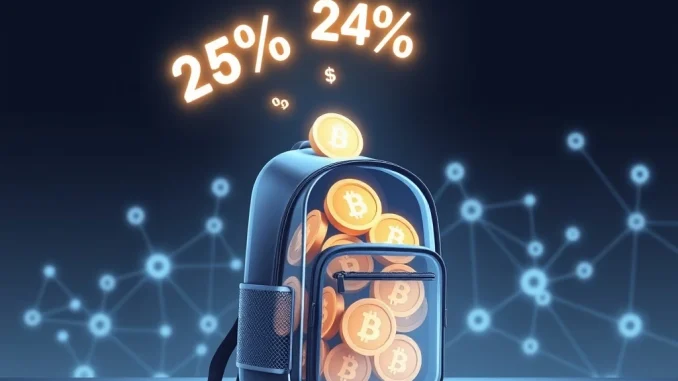
Global, April 2025: Backpack, the cryptocurrency exchange founded by former FTX and Alameda Research developer Armani Ferrante, has announced a significant token distribution strategy that will see 25% of its total token supply unlocked at its upcoming Token Generation Event (TGE). This substantial initial release represents a departure from traditional token launch models and signals a commitment to community-driven distribution from the outset. The announcement, made via the company’s official X account, provides concrete details about allocation percentages while leaving strategic questions about timing and full tokenomics for future disclosure.
Backpack Token Unlock Strategy: Breaking Down the 25% Distribution
The cryptocurrency exchange revealed that of the initial 25% token supply unlock, 24% will be allocated to points holders within the Backpack ecosystem. This substantial allocation to active platform users represents a deliberate strategy to reward early adopters and community participants. The remaining 1% of the initial unlock will be distributed to holders of Mad Lads NFTs, the Solana-based non-fungible token collection that has become closely associated with the Backpack ecosystem. This dual allocation approach creates a tiered distribution model that prioritizes platform engagement while acknowledging the historical significance of the Mad Lads community in Backpack’s development trajectory.
Token Generation Events represent critical moments in cryptocurrency project development, marking the transition from conceptual or private token models to publicly accessible digital assets. The percentage of tokens unlocked at TGE varies significantly across projects, with many opting for more conservative initial releases to manage market pressure and align long-term incentives. Backpack’s decision to unlock 25% immediately places it at the higher end of industry standards, suggesting confidence in both immediate demand and long-term token utility. Historical data from similar exchange token launches shows initial unlock percentages typically ranging from 10% to 30%, with the specific allocation strategy often determining early market dynamics and community reception.
Token Distribution Models in Cryptocurrency Exchanges
The cryptocurrency exchange token landscape has evolved significantly since the initial launches of platforms like Binance (BNB) and FTX (FTT). Modern distribution models increasingly emphasize community allocation, staking rewards, and ecosystem utility over purely speculative trading. Backpack’s announced distribution follows this contemporary trend while introducing specific innovations through its points-based allocation system. The exchange has been operating a points program that tracks user activity, trading volume, and platform engagement, creating a transparent metric for token distribution that rewards genuine participation rather than mere capital allocation.
Industry analysts note several key considerations for exchange token distributions:
- Vesting Schedules: The portion of tokens subject to lock-up periods after initial distribution
- Utility Design: How tokens function within the exchange ecosystem beyond speculative trading
- Governance Rights: Whether token holders receive voting power over platform decisions
- Fee Discounts: Traditional exchange token benefits like reduced trading fees
- Staking Rewards: Mechanisms for earning additional tokens through platform participation
Backpack CEO Armani Ferrante indicated in his announcement that the company would release detailed tokenomics “in stages as the TGE approaches,” suggesting that these critical design elements remain under development or strategic consideration. This phased disclosure approach allows for community feedback and market condition assessment before finalizing the complete token model.
Historical Context: Exchange Token Performance and Market Cycles
The performance of exchange tokens has varied significantly across market cycles, with successful launches typically correlating with strong platform fundamentals, clear utility, and sustainable tokenomics. The collapse of FTX and its associated FTT token in 2022 created increased scrutiny around exchange token models, particularly regarding transparency, reserve backing, and conflict of interest management. Backpack’s development team, including Ferrante’s background at FTX and Alameda, operates with awareness of these historical precedents and the increased regulatory attention on exchange-affiliated tokens.
Successful exchange token models from the past five years demonstrate several consistent characteristics:
| Exchange | Initial Unlock % | Primary Utility | Notable Feature |
|---|---|---|---|
| Binance (BNB) | ~20% | Fee discounts, ecosystem access | Quarterly token burns |
| FTX (FTT) | ~15% | Fee discounts, collateral | Collateral for leveraged positions |
| Crypto.com (CRO) | ~30% | Staking rewards, card tiers | Physical card integration |
| KuCoin (KCS) | ~25% | Dividend-like rewards | Daily profit sharing |
This historical context provides a framework for evaluating Backpack’s announced approach. The 25% initial unlock aligns with industry precedents while the specific allocation to points holders represents a modern adaptation of community-focused distribution. The relatively small allocation to Mad Lads NFT holders (1%) acknowledges community history without creating excessive concentration among a single group of early adopters.
Strategic Implications of Phased Tokenomics Disclosure
Ferrante’s statement about releasing tokenomics in stages represents a strategic approach to information management in volatile cryptocurrency markets. By announcing the distribution percentages first, Backpack establishes clear expectations for the community while retaining flexibility on other token design elements. This approach allows the exchange to gather market feedback, assess competitive developments, and potentially adjust utility features based on evolving regulatory guidance. The CEO’s additional comment that the token “will be distinct from existing tokens in its distribution, utility, and functionality” suggests deliberate differentiation from established models, potentially addressing criticisms of exchange token homogeneity.
The suggestion that the token “may even require a new name” indicates fundamental rethinking of what an exchange token represents and how it functions within a broader ecosystem. This could signal innovations in areas such as:
- Cross-chain functionality: Operating across multiple blockchain networks beyond Solana
- DeFi integration: Seamless connection with decentralized finance protocols
- Governance mechanisms: Novel approaches to decentralized decision-making
- Revenue sharing: Transparent distribution of exchange profits to token holders
- Identity verification: Integration with compliance and KYC processes
These potential innovations would position Backpack’s token not merely as a platform discount instrument but as a fundamental component of a broader financial ecosystem. The absence of a disclosed launch date maintains strategic flexibility while creating anticipation within the cryptocurrency community. Market participants will monitor for additional disclosures regarding vesting schedules for team and investor allocations, total token supply, inflation mechanisms, and specific utility features.
Regulatory Considerations for 2025 Token Launches
The regulatory landscape for cryptocurrency tokens has evolved significantly since the initial wave of exchange token launches. In the United States, ongoing Securities and Exchange Commission (SEC) actions against various token projects have created increased scrutiny around distribution models, promotional activities, and utility claims. The European Union’s Markets in Crypto-Assets (MiCA) regulation, fully implemented in 2024, establishes comprehensive requirements for token issuers including whitepaper disclosures, reserve requirements, and consumer protection measures.
Backpack’s phased disclosure approach may reflect careful navigation of these regulatory requirements, allowing for adjustments based on evolving interpretations and enforcement priorities. The emphasis on points-based distribution to active users could support arguments for utility rather than security classification in certain jurisdictions, though regulatory determinations remain complex and fact-specific. The exchange’s decision to announce distribution percentages without a launch date provides additional time for legal review and compliance structuring, particularly important given Ferrante’s previous association with FTX during its regulatory challenges.
Market Impact and Community Response Analysis
Initial community response to the announcement has focused on several key questions regarding implementation details and long-term implications. Points holders within the Backpack ecosystem are seeking clarification on how their accumulated points will convert to token allocations, whether there will be minimum or maximum allocation caps, and what timeline will govern the distribution process. Mad Lads NFT holders are similarly interested in the mechanics of their 1% allocation, particularly whether it will be proportional to NFT holdings or follow a different distribution model.
Market analysts are observing several potential impacts from this announcement:
- Increased platform engagement: Users may increase trading activity to accumulate more points before the TGE
- Secondary market effects: Mad Lads NFT prices may reflect the implied token allocation value
- Competitive positioning: Other exchanges may accelerate or modify their own token plans
- Investor interest: Venture capital and institutional investors may evaluate participation opportunities
- Regulatory attention: Authorities may scrutinize the points-to-tokens conversion mechanism
The broader cryptocurrency market context in 2025 includes continued institutional adoption, evolving regulatory frameworks, and technological innovations in scalability and interoperability. Backpack’s token launch enters this environment at a time when exchange tokens face both skepticism from past failures and opportunity from renewed market interest. The success of the distribution model will depend not only on the initial allocation mechanics but on the subsequent development of genuine utility that sustains token value beyond speculative trading.
Conclusion
Backpack’s announcement of a 25% token supply unlock at its upcoming Token Generation Event represents a significant development in cryptocurrency exchange token design. The allocation of 24% to points holders and 1% to Mad Lads NFT owners establishes a community-focused distribution model that rewards platform engagement and acknowledges historical community support. The phased disclosure of tokenomics, absence of a specific launch date, and suggestion of fundamental innovation in token functionality indicate a strategic approach to navigating complex market and regulatory environments. As the cryptocurrency industry continues to mature beyond the speculative excesses of previous cycles, Backpack’s token distribution model will serve as an important case study in balancing community incentives, platform utility, and sustainable token economics. The ultimate success of this Backpack token unlock strategy will depend on the forthcoming details of token utility, governance, and integration within the broader digital asset ecosystem.
FAQs
Q1: What percentage of Backpack’s total token supply will be unlocked at the TGE?
Backpack will unlock 25% of its total token supply at the Token Generation Event, with 24% allocated to points holders and 1% to Mad Lads NFT owners.
Q2: How does Backpack’s initial token unlock compare to other cryptocurrency exchanges?
The 25% initial unlock places Backpack at the higher end of industry standards, which typically range from 10% to 30% for exchange token launches, indicating a substantial immediate distribution to the community.
Q3: What are points holders in the Backpack ecosystem?
Points holders are users who have accumulated points through trading activity, platform engagement, and other participation metrics on the Backpack exchange, creating a transparent system for measuring and rewarding community contribution.
Q4: Why is only 1% of the initial unlock allocated to Mad Lads NFT holders?
The 1% allocation acknowledges the historical connection between Backpack and the Mad Lads NFT community while preventing excessive token concentration and maintaining focus on active platform users through the points system.
Q5: When will Backpack release more details about its tokenomics and launch date?
CEO Armani Ferrante stated that the company will release tokenomics details “in stages as the TGE approaches,” but no specific timeline or launch date has been disclosed at this time.