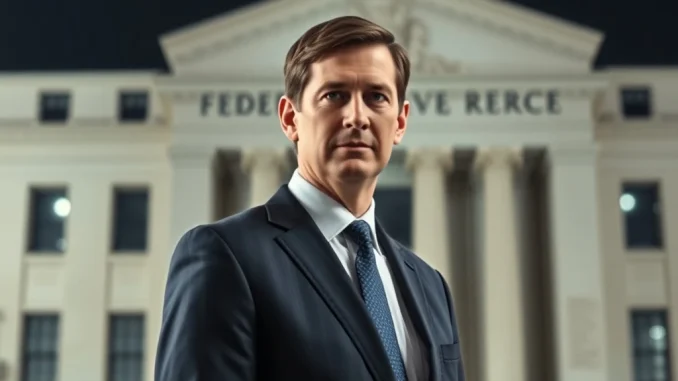
Washington D.C., October 26, 2025: The financial world is holding its breath as former Federal Reserve Governor Kevin Warsh emerges as the overwhelming favorite to be nominated as the next Chair of the Federal Reserve. According to a report from Watcher.Guru, Warsh currently holds an 81% probability of receiving the nomination, with U.S. President Donald Trump expected to make his official selection public tomorrow. This potential appointment carries profound implications for the direction of U.S. monetary policy, financial markets, and the global economy at a critical juncture.
Kevin Warsh: The Leading Contender for Federal Reserve Chair
The reported 81% chance places Kevin Warsh far ahead of any other potential candidates. This high probability stems from a confluence of factors, including his established relationship with President Trump, his previous experience within the Federal Reserve System, and his well-documented policy views. Warsh served as a Governor of the Federal Reserve Board from 2006 to 2011, a period encompassing the 2008 global financial crisis. Consequently, he brings firsthand crisis management experience to the role, a factor that likely weighs heavily in his favor given current economic uncertainties.
His tenure at the Fed was marked by his focus on financial stability and a sometimes-critical view of the central bank’s post-crisis quantitative easing programs. Since leaving the Board, Warsh has been a frequent commentator on monetary policy and a scholar at the Hoover Institution. His writings and speeches have consistently argued for a more rules-based, transparent, and less interventionist Fed—a philosophy that appears to align with the preferences of the current administration. Market analysts are now scrutinizing his past statements to forecast potential shifts in policy.
The Nomination Process and Presidential Decision
The nomination of a Federal Reserve Chair is one of the most consequential decisions a U.S. President can make. The Chair wields immense influence over interest rates, banking regulation, and the nation’s economic stability. President Trump’s expected announcement tomorrow will set in motion a formal Senate confirmation process. While the reported odds suggest high confidence in Warsh’s selection, the final decision rests solely with the President until an official statement is released.
Historical context is important here. The relationship between a President and the Fed Chair is often complex, balancing independence with political expectations. A Warsh nomination would signal a preference for a Chair with prior governance experience, unlike some of Trump’s previous appointments to the Board. The table below outlines key aspects of the impending transition:
| Aspect | Detail |
|---|---|
| Reported Probability | 81% (per Watcher.Guru) |
| Expected Announcement | Tomorrow, by President Trump |
| Candidate’s Previous Role | Federal Reserve Governor (2006-2011) |
| Next Step After Announcement | Senate Banking Committee Hearings |
| Key Policy Focus Area (Historical) | Financial Stability, Rules-based Policy |
Market Implications and Global Reactions
Financial markets have begun pricing in the likelihood of a Warsh-led Fed. Traders and investors are assessing what his leadership could mean for interest rate trajectories, balance sheet policy, and regulatory approaches. Generally, Warsh is perceived as more hawkish—or less inclined towards easy money policies—than some of his contemporaries. This perception could lead to:
- Yield Curve Adjustments: Longer-term bond yields may rise in anticipation of a less accommodative stance.
- Banking Sector Scrutiny: His focus on financial stability could mean stricter oversight for large financial institutions.
- Currency Market Volatility: The U.S. dollar might strengthen if markets expect tighter monetary policy relative to other central banks.
- Equity Market Re-evaluation: Sectors sensitive to interest rates, like technology and real estate, could see increased volatility.
Global central banks, from the European Central Bank to the Bank of Japan, will be closely monitoring this development. The U.S. Federal Reserve sets the tone for worldwide financial conditions, and a change in leadership philosophy can have ripple effects across international markets and capital flows.
Contrasting Policy Philosophies and the Fed’s Future
To understand the potential shift, one must contrast likely approaches. The current Fed leadership has navigated a period of high inflation with a series of aggressive rate hikes, followed by a cautious, data-dependent pause. A Chair Warsh might emphasize different priorities or communicate policy decisions in a distinct manner. His advocacy for clearer policy rules suggests he may seek to reduce ambiguity in the Fed’s forward guidance, potentially making its actions more predictable but less flexible in responding to unforeseen shocks.
Furthermore, his experience during the financial crisis informs a deep-seated concern for systemic risk. This could translate into a Fed that is more proactive in using macroprudential tools—regulations aimed at the financial system as a whole—to prevent bubbles, even if that means slightly lower economic growth in the short term. This represents a nuanced but significant potential departure from a focus solely on inflation and employment targets.
The Road to Confirmation and Potential Challenges
Once nominated, Kevin Warsh will face scrutiny from the Senate Banking Committee. Senators will question him on his views regarding inflation fighting, maximum employment, bank regulation, and the Fed’s independence. His past critiques of Fed policy will be a central topic. He will need to articulate how his philosophy aligns with the Fed’s dual mandate from Congress: price stability and maximum sustainable employment.
While his prior confirmation as a Governor suggests he can navigate this process, the political landscape has evolved. The hearings will serve as a public forum to clarify his stance on critical issues like digital currencies, climate risk in financial regulation, and inequality. His ability to provide clear, confident, and consistent answers will be crucial for securing bipartisan support and a smooth confirmation.
Conclusion
The reported 81% likelihood of a Kevin Warsh nomination for Fed Chair underscores a pivotal moment for American economic stewardship. President Trump’s imminent decision, expected tomorrow, will set the course for the Federal Reserve’s leadership for the next several years. A Warsh chairmanship would likely bring a heightened focus on financial stability, rules-based policy frameworks, and a potentially less interventionist approach to markets. As the world awaits the official announcement, markets, policymakers, and the public are preparing for a new chapter in U.S. monetary policy under a potential Chair Warsh, whose experience and philosophy will directly shape the economic landscape for years to come.
FAQs
Q1: Who is Kevin Warsh?
Kevin Warsh is a former Governor of the Federal Reserve Board, serving from 2006 to 2011. He is currently a scholar at the Hoover Institution and is reportedly the leading candidate to be nominated as the next Chair of the Federal Reserve.
Q2: What is the source of the 81% probability figure?
The 81% chance of nomination was reported by the financial news outlet Watcher.Guru, based on their analysis of political and financial market intelligence.
Q3: When will the next Fed Chair be announced?
President Donald Trump is expected to announce his nominee for the position tomorrow, according to the same report.
Q4: How would a Kevin Warsh Fed differ from the current one?
Based on his past writings and service, a Warsh-led Fed might place greater emphasis on financial stability, advocate for more transparent rules-based policymaking, and could be perceived as somewhat less accommodative in its monetary policy stance.
Q5: What happens after the President announces a nominee?
The nominee must then go through a confirmation process in the U.S. Senate, beginning with hearings in the Senate Banking Committee, followed by a vote in the full Senate.