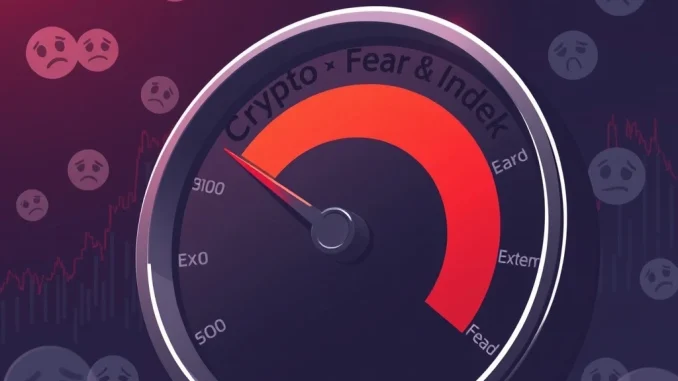
Global, May 2025: A critical gauge of cryptocurrency market psychology has flashed a severe warning signal. The widely monitored Crypto Fear & Greed Index, published by data provider Alternative, has plummeted 10 points to a reading of 16, officially shifting the market’s emotional state from ‘fear’ into the zone of ‘extreme fear.’ This sharp decline provides a data-driven snapshot of the intense anxiety currently gripping digital asset investors worldwide, offering a crucial context for understanding recent price volatility and trading behavior.
Crypto Fear & Greed Index Plunges to Extreme Fear
The Crypto Fear & Greed Index serves as a daily sentiment thermometer for the cryptocurrency market. It operates on a simple yet powerful scale from 0 to 100. A reading of 0 represents ‘Extreme Fear,’ while 100 signifies ‘Extreme Greed.’ The recent drop to 16 places the market deep into fearful territory, just 16 points from the theoretical maximum panic level. This single-digit drop of 10 points is significant, indicating a rapid deterioration in investor confidence over a short period. Analysts and portfolio managers closely watch these movements, as extreme readings often correlate with potential market inflection points, though they are not direct trading signals.
How the Index Calculates Market Sentiment
The index’s authority stems from its multi-factor, quantitative methodology. It does not rely on a single data point but synthesizes information from six distinct sources to avoid bias. The current weighting is as follows:
- Volatility (25%): Measures current price swings against historical averages. Increased volatility, especially to the downside, contributes to fear.
- Market Momentum/Volume (25%): Analyzes trading volume and recent price performance. Unusually high volume during downturns amplifies the fear score.
- Social Media (15%): Scans platforms like Twitter and Reddit for the volume and sentiment of cryptocurrency mentions.
- Surveys (15%): Incorporates data from periodic polls of retail and institutional investor sentiment.
- Dominance (10%): Tracks Bitcoin’s share of the total crypto market cap. Rising dominance often signals a ‘flight to safety’ during fear.
- Google Trends (10%): Monitors search volume for cryptocurrency-related terms, which typically spikes during both euphoria and panic.
This composite approach aims to filter out noise and present a holistic view of the market’s emotional state.
Historical Context of Extreme Fear Readings
To understand the gravity of a reading of 16, one must examine historical precedents. The index has touched single-digit ‘Extreme Fear’ levels during several major crypto market crises. Notably, it hovered between 5 and 15 during the market bottom following the collapse of the FTX exchange in November 2022. Similarly, it reached extreme lows during the COVID-19-induced market crash of March 2020 and the prolonged ‘crypto winter’ of 2018-2019. While past performance does not predict future results, these periods were subsequently followed by significant market recoveries, leading some contrarian investors to view extreme fear as a potential long-term buying opportunity. However, it is crucial to note that the index can remain in ‘Extreme Fear’ for extended periods during structural bear markets.
Potential Catalysts Behind the Sentiment Shift
The ten-point drop did not occur in a vacuum. Several concurrent factors in the global financial and regulatory landscape likely contributed to the surge in fear. These typically include a combination of macroeconomic pressures and crypto-specific events. Macro factors such as rising interest rates, inflationary concerns, or geopolitical instability can trigger a sell-off in risk assets like cryptocurrencies. Simultaneously, industry-specific news—such as regulatory crackdowns in major economies, the failure of a prominent project, or concerning security breaches—can exacerbate the negative sentiment. The index’s drop synthesizes the market’s reaction to this confluence of pressures, translating complex news flow into a single, digestible metric.
The Psychology of Extreme Fear and Market Cycles
Market veterans often reference the psychological cycle of investor emotions, from optimism to euphoria, denial, fear, and finally, capitulation and despondency. A ‘Fear & Greed Index’ reading of 16 suggests the market is progressing through the latter stages of this cycle. At this point, selling is often driven more by emotion and a desire to exit at any price than by fundamental analysis. This emotional trading can lead to assets being oversold relative to their underlying network activity or utility. Understanding this psychology helps explain why sentiment indicators are watched so closely; they attempt to quantify the often-irrational human element that drives short-term price movements.
Comparing Sentiment Across Asset Classes
The cryptocurrency market is not alone in experiencing fear. Traditional finance has analogous indicators, such as the CBOE Volatility Index (VIX) for stocks, often called the ‘fear gauge.’ It is instructive to compare trends. A scenario where both the Crypto Fear & Greed Index and the VIX are elevated suggests a broad-based risk-off environment affecting all speculative assets. Conversely, if crypto fear is extreme while stock market fear is muted, it may indicate issues specific to the digital asset ecosystem, such as regulatory uncertainty or technological growing pains. This cross-asset analysis provides deeper context for the index’s reading.
| Indicator | Asset Class | Current Reading | Implied Sentiment |
|---|---|---|---|
| Crypto Fear & Greed Index | Cryptocurrency | 16 | Extreme Fear |
| CBOE VIX | U.S. Stocks (S&P 500) | Varies Daily | Market Volatility |
| CNN Fear & Greed Index | U.S. Stocks | Varies Daily | Multi-factor Stock Sentiment |
Limitations and Proper Use of the Index
While invaluable, the Crypto Fear & Greed Index is a tool, not a crystal ball. Prudent investors recognize its limitations. First, it is a lagging indicator, reflecting sentiment that has already been expressed in the market. Second, ‘extreme fear’ can persist, and prices can continue to fall; the index does not pinpoint a market bottom. Its greatest utility lies in providing context. For example, a sharp market decline accompanied by only ‘neutral’ sentiment may be more concerning than a decline with ‘extreme fear,’ as the latter suggests panic selling may be exhausting itself. The index should always be used in conjunction with fundamental analysis, on-chain data, and macroeconomic research, not as a standalone trading signal.
Conclusion
The Crypto Fear & Greed Index reading of 16 stands as a clear, quantitative testament to the intense anxiety currently prevailing in cryptocurrency markets. This plunge into ‘extreme fear’ territory reflects a complex synthesis of volatility, social sentiment, and trading behavior driven by both macroeconomic and crypto-specific factors. Historically, such extreme readings have marked periods of significant stress but have also occasionally preceded major recoveries. For observers and participants, the index provides an essential, emotionally detached framework for understanding the market’s psychological state. It underscores that beneath the charts and price data, cryptocurrency markets remain profoundly human, driven by the timeless forces of fear and greed. Monitoring this sentiment shift is crucial for anyone seeking to navigate the volatile landscape of digital assets with informed perspective.
FAQs
Q1: What does a Crypto Fear & Greed Index score of 16 mean?
A score of 16 indicates ‘Extreme Fear’ in the market. The index ranges from 0 (Extreme Fear) to 100 (Extreme Greed), meaning the current sentiment is very close to the maximum fear level, reflecting high investor anxiety and panic selling.
Q2: Who creates the Crypto Fear & Greed Index and how often is it updated?
The index is created and published daily by the data analytics company Alternative. They continuously update the reading based on real-time data feeds from its six core metrics.
Q3: Is the Crypto Fear & Greed Index a good tool for predicting Bitcoin’s price?
No, it is not a predictive tool. It is a sentiment indicator that describes the current emotional state of the market. While extreme readings can signal potential turning points, they do not predict the direction or timing of future price movements and should not be used alone for trading decisions.
Q4: Has the index been this low before?
Yes. The index has fallen to similar or lower levels during previous major market downturns, such as the FTX collapse in late 2022 and the COVID-19 market crash in March 2020. These were periods of significant stress and price depreciation.
Q5: What is the difference between ‘Fear’ and ‘Extreme Fear’ on the index?
The index has general zones: 0-24 is ‘Extreme Fear,’ 25-49 is ‘Fear,’ 50-74 is ‘Greed,’ and 75-100 is ‘Extreme Greed.’ The shift from ‘Fear’ to ‘Extreme Fear’ signifies a quantitative and qualitative intensification of negative sentiment, often accompanied by higher volatility and volume.
Q6: Does a low Fear & Greed Index score mean I should buy cryptocurrency?
Not necessarily. While some contrarian investors view extreme fear as a potential long-term opportunity, it is not a buy signal. Prices can remain low or fall further. Any investment decision should be based on comprehensive research, risk assessment, and personal financial goals, not solely on a sentiment indicator.