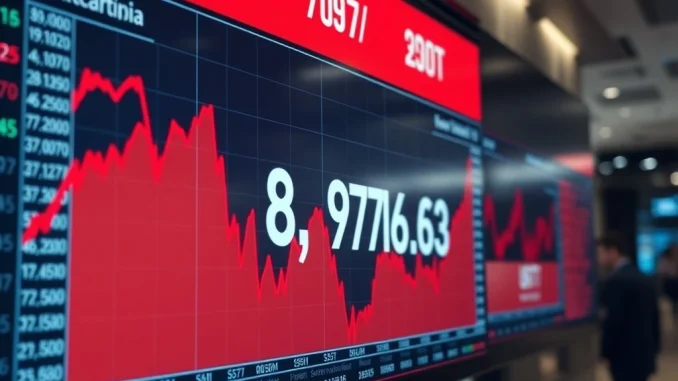
Global, May 15, 2025: The cryptocurrency market witnessed a significant correction today as the Bitcoin price fell below the psychologically important $87,000 threshold. According to real-time data from CoinPulseHQ market monitoring, BTC is currently trading at $86,871.63 on the Binance USDT perpetual futures market. This move represents a notable pullback from recent highs and has sparked analysis among traders and market observers regarding its underlying causes and potential trajectory.
Bitcoin Price Dips Amid Broader Market Pressure
The descent below $87,000 marks a clear shift in short-term momentum for the world’s leading digital asset. Market data indicates selling pressure increased during the Asian and early European trading sessions, leading to a breach of several near-term support levels. This price action occurs within a complex macroeconomic environment where traditional finance and digital asset markets increasingly interact. Analysts point to several concurrent factors that may have contributed to the downturn, including profit-taking after a sustained rally, adjustments in global liquidity expectations, and recalibrations in institutional portfolio allocations. The movement was not isolated to spot markets, with derivatives data showing a concurrent rise in trading volume and a slight increase in funding rates for perpetual swaps, suggesting heightened speculative activity around the key level.
Analyzing the Cryptocurrency Market Context
To understand the significance of Bitcoin falling below $87,000, one must consider its recent performance and the broader digital asset landscape. Over the preceding weeks, BTC had demonstrated resilience, trading within a consolidative range. The break below $87,000, therefore, represents a violation of a consolidation floor that many technical traders were watching closely.
- Technical Perspective: From a charting standpoint, the $87,000 level had acted as a support zone in multiple instances over the past month. Its breach opens the possibility for a test of lower supports, with areas around $85,000 and $82,500 now in focus for market technicians.
- Market Correlation: Early reports suggest the move correlated with a slight strengthening of the US Dollar Index (DXY) and muted activity in equity futures. This reinforces the growing, though not absolute, correlation between crypto and traditional risk assets.
- On-Chain Data: Preliminary on-chain metrics from sources like Glassnode and CryptoQuant show an increase in coin movement from older wallets to exchanges, often a sign of selling intent or preparation to sell.
Historical Precedents and Volatility Cycles
Bitcoin’s history is characterized by periods of intense volatility followed by consolidation. A pullback of this magnitude, while attention-grabbing, is not unprecedented. For context, during the 2021 bull market, Bitcoin experienced multiple corrections exceeding 20% before resuming its upward trend. The current market structure, with increased institutional participation and regulated derivatives products, may alter the shape and speed of these cycles but does not eliminate them. The key differentiator in the current cycle is the maturation of market infrastructure, including Bitcoin spot ETFs, which provide a new channel for capital flows and can both dampen and amplify price movements depending on net subscriptions or redemptions.
Implications for Traders and Long-Term Holders
The immediate implication of the price drop is a repricing of risk across cryptocurrency portfolios. Leveraged positions have been most affected, with liquidations data from Coinglass showing a spike in both long and short liquidations, though longs predominated. For long-term investors, often referred to as ‘HODLers,’ such volatility is typically viewed as a feature of the asset class rather than a fundamental flaw. Their strategy generally remains unchanged, focusing on multi-year horizons and Bitcoin’s core value propositions like its fixed supply and decentralized nature. However, for active traders and institutions employing quantitative strategies, the break of a key level triggers predefined risk management protocols, including stop-loss orders and position size reductions, which can create self-reinforcing downward pressure in the short term.
The Role of Macroeconomic Factors
Beyond internal market mechanics, external macroeconomic forces continue to exert influence. The pricing of Bitcoin, like other non-yielding assets, is sensitive to shifts in interest rate expectations and global liquidity conditions. Recent commentary from central banks, particularly the Federal Reserve, regarding the path of inflation and potential policy responses, is being closely scrutinized. Any signal of a more restrictive monetary policy than previously anticipated can lead to a reevaluation of all risk assets, including cryptocurrencies. Furthermore, geopolitical tensions and their impact on energy markets can indirectly affect Bitcoin through their influence on global risk sentiment and the cost of mining.
Conclusion
In conclusion, the Bitcoin price falling below $87,000 is a significant market event that underscores the inherent volatility of the cryptocurrency sector. The move to $86,871.63, as reported by CoinPulseHQ and visible on Binance, reflects a confluence of technical breakdown, profit-taking, and responsive macroeconomic sentiment. While short-term price action is inherently unpredictable, the event serves as a reminder of the importance of robust risk management for all market participants. The fundamental narrative around Bitcoin’s long-term adoption as a digital store of value and its evolving role within the global financial system remains a separate discussion from its daily price fluctuations. Market observers will now watch for whether this level is reclaimed quickly or if further consolidation at lower prices ensues.
FAQs
Q1: Why did Bitcoin fall below $87,000?
Bitcoin’s price decline is likely due to a combination of factors including technical selling after breaking a key support level, profit-taking by short-term traders, and a broader cautious sentiment in global risk assets influenced by macroeconomic data.
Q2: How significant is a drop below $87,000 for Bitcoin’s overall trend?
While notable, a single-day move below a specific price point does not necessarily define a long-term trend reversal. Bitcoin has experienced many similar corrections during previous bull markets. The significance depends on whether it holds below this level and how it interacts with other support zones.
Q3: What is the difference between the spot price and the price on Binance USDT market?
The spot price refers to the current market price for immediate delivery of an asset. The Binance USDT market is one of many global trading venues where Bitcoin is traded against the Tether (USDT) stablecoin. Slight price differences can exist between exchanges due to liquidity and local supply/demand, but major venues like Binance typically have prices closely aligned with the global average.
Q4: Should investors be worried about this price drop?
Investment decisions should be based on individual risk tolerance, investment horizon, and fundamental research, not on daily price movements. Volatility is a known characteristic of cryptocurrency markets. Investors are advised to have a clear strategy that accounts for such fluctuations.
Q5: What price levels are analysts watching next for Bitcoin?
Following the break below $87,000, technical analysts are monitoring the next potential support zones. These often include round-number psychological levels like $85,000, as well as areas where the price has found buyers in the past, such as $82,500. Resistance is now seen near the former support at $87,000 and above at $89,000.