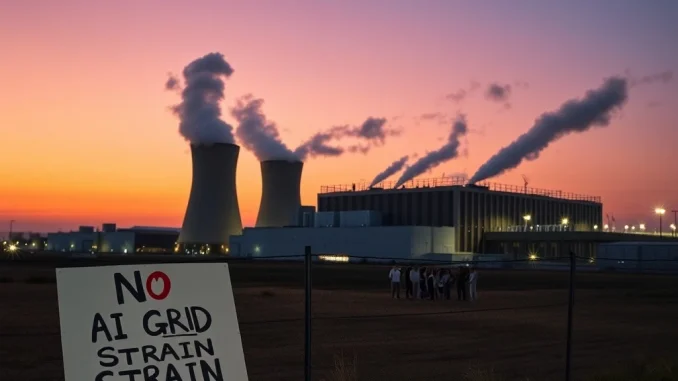
United States, March 2025: The artificial intelligence revolution, once celebrated as a purely digital transformation, now faces a physical reality check. Across multiple states, communities are pushing back against AI infrastructure expansion with concerns strikingly similar to those voiced during the cryptocurrency mining boom. This growing resistance highlights how the pursuit of computational power continues to collide with environmental limits and social acceptance, creating a pattern that industry observers recognize from recent history.
The Rising Tide of Community Opposition to AI Infrastructure
Artificial intelligence systems require substantial physical infrastructure to function. Unlike the abstract algorithms they run, AI models depend on massive data centers housing thousands of specialized processors. These facilities consume electricity at industrial scales, often requiring dedicated power infrastructure and significant water resources for cooling systems. The concentration of these demands in specific regions has created localized pressure points that communities are increasingly unwilling to bear.
According to tracking by Data Center Watchdog, an independent monitoring organization, citizen groups have successfully blocked or delayed data center projects worth approximately $64 billion across the United States. These projects span states including Oregon, Virginia, Texas, and Georgia—regions previously targeted by cryptocurrency mining operations for their favorable energy markets and regulatory environments. The parallel extends beyond geography to the nature of objections: concerns about grid stability, rising electricity costs for residents, environmental impact, and the transformation of local character.
Historical Parallels: From Bitcoin Mining to AI Computation
The current resistance movement against AI data centers follows a pattern established during the cryptocurrency mining expansion of the late 2010s and early 2020s. Bitcoin mining operations, which use specialized computers to solve complex mathematical problems, clustered in regions with cheap electricity and favorable regulations. Initially welcomed for promised economic benefits, these operations soon faced backlash as communities experienced tangible consequences.
Residents near mining facilities reported noise pollution from cooling systems, increased electricity rates as demand strained local grids, and concerns about the environmental footprint of largely non-productive computation. Municipal governments that initially offered tax incentives found themselves reconsidering as the trade-offs became clearer. The current opposition to AI infrastructure represents a more informed and proactive response from communities that have witnessed similar patterns before.
Industry analysts note several key similarities between the two technological waves:
- Both create concentrated, energy-intensive demand in specific locations
- Both promise economic benefits while externalizing environmental costs
- Both face criticism for energy use that appears disproportionate to immediate local benefits
- Both trigger concerns about long-term infrastructure commitments for potentially transient technologies
The Data Behind the Resistance
Current tracking indicates 142 active citizen groups organized specifically around data center opposition. These groups employ diverse strategies including municipal lobbying, legal challenges, public awareness campaigns, and direct engagement with project developers. Their concerns typically cluster around several core issues:
First, electricity grid impacts represent the most immediate concern. Data centers require reliable, high-capacity power connections that can strain existing infrastructure not designed for such concentrated demand. This can lead to increased rates for other consumers, reduced grid reliability, and accelerated need for infrastructure upgrades funded by ratepayers.
Second, water usage presents another critical concern. Advanced cooling systems for high-density computing can consume millions of gallons daily, creating competition with agricultural, residential, and ecological needs—particularly in regions already facing water scarcity.
Third, land use and community character changes generate significant opposition. Data centers typically offer limited employment relative to their physical footprint, transforming rural or suburban areas into industrial zones without corresponding community benefits.
Industry Responses and Alternative Energy Strategies
Facing mounting resistance, AI companies and data center operators are developing multiple response strategies. Some organizations have increased community engagement efforts, promising more transparent planning processes and commitments to address specific concerns. Others are exploring technological solutions to reduce environmental impacts, including advanced cooling systems and more energy-efficient processor designs.
The most ambitious responses involve completely rethinking energy sourcing. In Texas, Fermi America has announced plans for Project Matador—a combined nuclear power and data center campus designed specifically for AI computation. The project proposes to pair AP1000 nuclear reactors with ultra-high-density computing facilities, creating a self-contained energy ecosystem that wouldn’t strain local grids. This approach reflects a growing recognition that AI’s energy demands may require dedicated generation capacity rather than simply drawing from existing infrastructure.
Other experimental approaches include proposals for orbital data centers powered by space-based solar arrays, though these remain speculative given current technological and economic constraints. More immediately, some operators are exploring geographic diversification, moving toward regions with surplus renewable energy capacity or developing direct partnerships with renewable generation projects.
The Broader Implications for Technological Development
The current standoff between AI development and community acceptance reflects broader questions about how societies integrate increasingly resource-intensive technologies. Industry estimates suggest AI could consume 12% of global electricity by 2028 if current growth trends continue. This projection has prompted serious discussion about whether such allocation represents the best use of limited energy resources, particularly during a global transition toward sustainable systems.
Environmental advocates note that the comparison with cryptocurrency mining extends beyond operational similarities to fundamental questions of value. While AI applications promise tangible benefits across healthcare, scientific research, and productivity tools, critics question whether all current applications justify their energy costs. This scrutiny parallels earlier debates about whether cryptocurrency’s benefits justified its environmental footprint.
The situation also highlights evolving public attitudes toward technology infrastructure. Where communities once might have accepted large industrial projects based primarily on economic promises, many now demand more comprehensive assessments of environmental and social impacts. This shift reflects both increased environmental awareness and lessons learned from previous technological expansions that delivered uneven benefits.
Regulatory and Policy Responses Taking Shape
Governments at multiple levels are beginning to develop policy frameworks to address AI infrastructure challenges. Some municipalities have implemented moratoriums on new data center construction while developing comprehensive planning guidelines. Others are creating specific zoning categories with associated requirements for energy efficiency, water conservation, and community benefit agreements.
At the state level, policymakers are considering incentives tied to sustainable practices, including preferential treatment for facilities using renewable energy or implementing advanced cooling technologies. Some proposals would require data centers to contribute directly to grid infrastructure upgrades needed to support their operations, rather than passing these costs to general ratepayers.
Federal agencies are examining whether existing environmental review processes adequately address the unique characteristics of computing infrastructure. There’s growing discussion about whether energy-intensive computation should face similar scrutiny as other industrial activities with significant environmental footprints.
Conclusion: Learning from History or Repeating It?
The emerging conflict between AI development and community acceptance represents more than a simple planning dispute. It reflects fundamental questions about how societies balance technological ambition with environmental responsibility and social equity. The parallels with cryptocurrency mining’s trajectory suggest that ignoring community concerns and environmental impacts carries significant risks for technology adoption and public perception.
The AI industry now faces a critical choice: address these concerns proactively through sustainable design, transparent planning, and genuine community partnership, or risk repeating the backlash that constrained cryptocurrency mining expansion. The outcome will influence not only where and how AI develops, but also public trust in technological institutions and the social license for future innovations. As computing demands continue growing across multiple domains, the lessons from this AI energy backlash may shape infrastructure development for decades to come.
FAQs
Q1: Why are AI data centers facing similar opposition to cryptocurrency mining operations?
Both create concentrated, energy-intensive demand in specific locations, straining local grids and resources. Communities that experienced issues with crypto mining—including increased electricity rates, noise pollution, and environmental concerns—are applying lessons learned to AI infrastructure proposals.
Q2: What specific concerns do communities have about AI data centers?
Primary concerns include electricity grid strain leading to higher rates and reduced reliability, substantial water consumption for cooling systems, transformation of community character without proportional economic benefits, and long-term environmental impacts of energy-intensive computation.
Q3: How significant is the scale of blocked or delayed AI data center projects?
Tracking indicates approximately $64 billion worth of projects face delays or cancellations due to community opposition across multiple states. This represents a substantial portion of planned AI infrastructure expansion in the United States.
Q4: What alternative approaches are companies exploring to address energy concerns?
Strategies include dedicated nuclear power campuses like Fermi America’s Project Matador in Texas, geographic diversification to regions with renewable energy surpluses, technological improvements in processor efficiency and cooling systems, and increased community engagement with benefit-sharing agreements.
Q5: Could this opposition significantly slow AI development?
While unlikely to stop AI development entirely, sustained opposition could influence where and how infrastructure expands, potentially increasing costs and encouraging more sustainable approaches. The situation may accelerate innovation in energy-efficient computing and prompt reconsideration of which AI applications justify substantial energy investment.