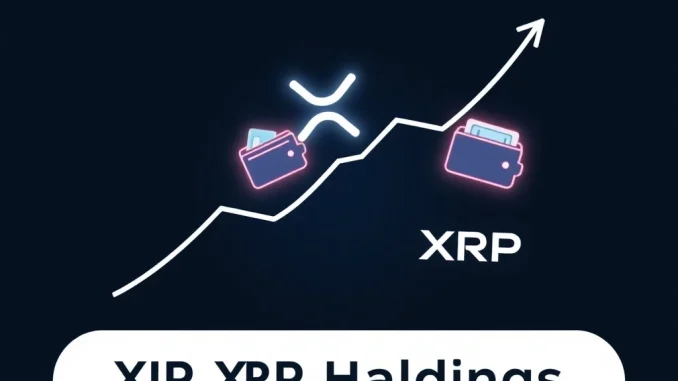
Global, May 2025: A significant shift in XRP holder behavior has emerged, with data revealing a notable 11.5% increase in holdings within so-called “smart money” addresses over the past month. This accumulation by sophisticated investors occurs against a backdrop of subdued price action for the digital asset, presenting a compelling narrative about long-term conviction diverging from short-term market sentiment.
XRP Smart Money Accumulation Defies Short-Term Price Trend
According to data from the blockchain analytics platform Nansen, wallets classified as “smart money” have increased their collective XRP holdings by 11.55% in the 30-day period leading into May 2025. This metric tracks addresses associated with experienced investors, such as venture capital funds, centralized exchanges, and known high-net-worth individuals. The increase is particularly noteworthy because XRP’s market price has declined approximately 4% year-to-date, reflecting a period of general caution and consolidation across broader cryptocurrency markets. This divergence—where large, informed entities accumulate while retail sentiment remains tepid—is a classic dynamic often scrutinized by market analysts for clues about future direction.
Decoding the Nansen Data and Smart Money Methodology
Understanding this signal requires a clear explanation of the data source and its definitions. Nansen’s “smart money” label is not assigned arbitrarily. The platform employs a multi-faceted methodology to tag addresses, analyzing historical transaction patterns, profitability, investment timing, and connections to known institutional entities.
- Profitability Track Record: Addresses consistently demonstrating profitable exits over multiple market cycles.
- Network Analysis: Identifying clusters of addresses linked to venture capital firms, crypto funds, or savvy traders.
- Behavioral Patterns: Actions like providing liquidity, participating in governance, or staking, which indicate sophisticated engagement beyond simple speculation.
When these addresses collectively move in a coordinated direction, such as accumulating a specific asset like XRP, it is interpreted as a data point reflecting informed confidence in the asset’s underlying fundamentals or future prospects, independent of its current market price.
Historical Context: Smart Money Signals in Crypto Cycles
This pattern of smart money accumulation during price stagnation or decline is not unprecedented in cryptocurrency history. Analysts often point to similar divergences observed in Bitcoin and Ethereum in late 2018 and early 2020, where on-chain data showed large holders accumulating during bearish phases that preceded significant bull markets. While past performance never guarantees future results, these historical precedents provide a framework for understanding current behavior. The logic suggests that sophisticated investors use periods of low prices and negative sentiment to build positions at a perceived discount, betting on a long-term thesis that may not be immediately apparent to the broader market.
Analyzing the Implications for XRP’s Fundamentals
The 11.5% increase in holdings prompts a deeper examination of XRP’s fundamental landscape. Several factors could be underpinning this institutional interest. First, the resolution of Ripple’s lengthy legal battle with the U.S. Securities and Exchange Commission (SEC) removed a major overhang of regulatory uncertainty, allowing institutions to assess the asset with clearer parameters. Second, Ripple’s continued focus on cross-border payment solutions and central bank digital currency (CBDC) partnerships provides a tangible use-case narrative distinct from pure speculative assets. Finally, XRP’s consensus mechanism offers speed and low cost for transactions, a technical advantage in the payments niche. The smart money accumulation could reflect a belief that these fundamentals are not adequately reflected in the current market valuation.
The Broader Market Sentiment and Retail Investor Dissonance
Contrasting the smart money activity is the prevailing sentiment among retail investors, which has remained cautious. This dissonance is a common feature of financial markets. Retail sentiment is often more reactive to price movements and headline news, while institutional players operate on longer time horizons and deeper fundamental analysis. The current data suggests a potential knowledge or conviction gap. It highlights the importance for all market participants to look beyond daily price charts and consider on-chain metrics and holder composition as part of a holistic analysis.
Conclusion: A Data Point of Strategic Patience
The 11.5% surge in XRP smart money addresses represents a significant data point in the asset’s evolving story. It signals that a cohort of sophisticated investors is demonstrating strategic patience and accumulating XRP despite near-term price weakness. This action underscores a potential belief in the long-term viability of XRP’s use case and its underlying technology. For observers and participants in the cryptocurrency market, this divergence between on-chain accumulation and price performance serves as a critical reminder that market bottoms and periods of accumulation are often characterized by fear and disinterest, not euphoria. While a single metric should never form the sole basis for an investment decision, the movement of XRP smart money provides a compelling, data-driven narrative worthy of attention and context.
FAQs
Q1: What does “smart money” mean in cryptocurrency?
In cryptocurrency, “smart money” refers to wallets or addresses controlled by investors perceived to have superior information, experience, or resources, such as institutional funds, venture capitalists, and highly successful traders. Their activity is tracked as a potential indicator of market sentiment.
Q2: How does Nansen identify a “smart money” address?
Nansen uses on-chain analysis to label addresses based on historical behavior, including profitability of trades, connections to known entities, participation in DeFi or governance, and patterns that suggest sophisticated, non-retail activity.
Q3: Does smart money buying guarantee that the XRP price will rise?
No, it does not guarantee a price increase. It is one signal among many. While it indicates confidence from informed players, market prices are influenced by a vast array of factors including macroeconomics, regulatory news, and overall crypto market trends.
Q4: Why would smart money buy XRP when the price is down?
Sophisticated investors often seek to “buy the dip” or accumulate assets they believe are undervalued relative to their long-term potential. They may use periods of negative sentiment and lower prices to build a larger position at a lower average cost.
Q5: Where can I check on-chain data like this for myself?
Platforms like Nansen, Glassnode, and Santiment provide on-chain analytics and metrics, including exchange flows, holder distribution, and smart money movements, though some features require a subscription.