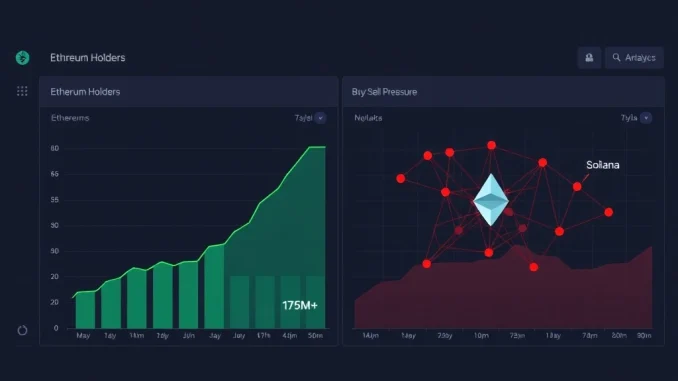
Global, February 2025: The Ethereum network achieved a significant adoption milestone in January 2025, with the total number of unique addresses holding ETH surging by approximately 3% to clear 175 million. This growth in Ethereum holders, a key metric for network health, unfolds against a backdrop of nuanced on-chain data for both Ethereum and Solana that analysts are interpreting as potential caution signals for near-term price action. Market observers note a divergence between expanding user bases and short-term trading pressure, creating a complex landscape for investors.
Ethereum’s 175 Million Holder Milestone Explained
The crossing of the 175 million unique holder threshold represents a critical inflection point for the Ethereum ecosystem. This metric, distinct from daily active addresses or transaction count, measures the cumulative number of addresses with a non-zero ETH balance. Analysts track this figure as a proxy for long-term adoption and distribution. The 3% monthly increase, while seemingly modest, translates to the addition of over 5 million new addresses holding ETH in a single month. This pace of growth, when sustained, indicates robust foundational interest beyond speculative trading. Historically, steady growth in holder count has often preceded periods of network utility expansion, as seen in the build-up to major protocol upgrades like The Merge and subsequent developments in Ethereum’s layer-2 scaling landscape.
Decoding Negative Buy/Sell Pressure Data
Concurrently, on-chain analytics platforms have flagged negative net buy/sell pressure for both Ethereum (ETH) and Solana (SOL). This metric analyzes the flow of assets to and from exchanges. A negative value typically indicates that the volume of tokens being deposited to exchanges (potential selling pressure) exceeds the volume being withdrawn to private wallets (potential accumulation). For January 2025, aggregated data from major centralized exchanges showed this trend for both assets. It is crucial to contextualize this signal. Negative exchange flow does not guarantee an immediate price drop but suggests a shift in short-term holder sentiment or profit-taking behavior, especially following periods of price appreciation in late 2024. It often reflects a cooling-off phase where the market seeks a new equilibrium.
The Historical Context of Holder Growth Versus Price
Market history provides essential perspective on the relationship between holder growth and price signals. During Ethereum’s early development phases, rapid increases in holder count sometimes coincided with price consolidation. The underlying narrative suggests that while new users are onboarding—potentially for DeFi, NFTs, or staking—existing holders may rebalance portfolios, leading to the observed exchange pressure. This pattern was observable in previous cycles where network fundamentals strengthened during periods of flat or negative price momentum. The current data may indicate a similar phase: foundational adoption continues apace (the 175M milestone), while short-term traders and investors react to macroeconomic factors or technical resistance levels.
Comparative Analysis: Ethereum and Solana Network Dynamics
The parallel caution signal for both Ethereum and Solana is notable, though the underlying dynamics differ. Ethereum’s growth is bolstered by its established role as the primary settlement layer for a vast ecosystem of layer-2 networks and institutional staking via its proof-of-stake consensus. The holder milestone underscores this entrenched position. Solana’s metrics, while also showing user growth, are more sensitive to high-frequency trading activity and memecoin trends, which can lead to more volatile exchange flow data. The simultaneous negative pressure suggests a broader market sentiment shift affecting large-cap smart contract platforms, possibly linked to interest rate expectations or regulatory developments in early 2025.
- Ethereum’s Driver: Growth is likely fueled by layer-2 adoption, restaking protocols, and sustained institutional interest.
- Solana’s Driver: Growth is closely tied to retail engagement, NFT volume, and the activity within its high-throughput DeFi ecosystem.
- Common Pressure: Both may be experiencing profit-taking after a strong Q4 2024 and recalibration ahead of key network upgrades.
Implications for Investors and the Ecosystem
For long-term investors, the expansion of the holder base is a fundamentally positive signal, suggesting the network is becoming more decentralized and resilient. For traders, the negative buy/sell pressure serves as a risk management indicator, prompting closer scrutiny of support levels and volume. For developers, continued user growth validates building on these platforms, even during periods of market uncertainty. The data collectively paints a picture of a maturing market where adoption metrics and short-term trading signals can diverge, requiring a more nuanced analysis than bullish or bearish headlines provide.
Conclusion
The January 2025 data presents a dual narrative for the cryptocurrency market. The achievement of 175 million Ethereum holders confirms the network’s deepening roots and expanding global user base, a testament to its enduring utility. Simultaneously, the negative buy/sell pressure observed for both Ethereum and Solana acts as a near-term caution signal, reflecting a period of consolidation and potential redistribution. This divergence highlights the maturation of crypto markets, where foundational growth and short-term price action are increasingly distinct concepts. Monitoring how these trends evolve—whether holder growth continues unabated or if exchange flows revert to positive—will be critical for understanding the next phase for these leading blockchain networks.
FAQs
Q1: What does ‘175 million Ethereum holders’ actually mean?
This refers to the total number of unique blockchain addresses with a non-zero balance of ETH. It’s a measure of adoption, not the number of individual people, as one person can control multiple addresses.
Q2: Is negative buy/sell pressure always bad for the price?
Not necessarily. It indicates more coins are moving to exchanges than away, which can precede selling. However, it can also reflect large entities rebalancing or moving assets for staking/custody without an intent to immediately sell. It’s a cautionary signal, not a definitive predictor.
Q3: Why are Ethereum and Solana showing similar pressure signals?
As two of the largest smart contract platforms, they are often influenced by similar macroeconomic factors, overall crypto market sentiment, and rotational flows of capital within the digital asset space.
Q4: Does holder growth guarantee a price increase?
No. Holder growth measures adoption and distribution, which are positive long-term fundamentals. Price is influenced by a wider array of factors including speculation, liquidity, macroeconomic conditions, and technological developments.
Q5: What should investors watch next after this data?
Key metrics to monitor include whether the negative exchange flow persists, if the growth in Ethereum holders maintains its pace, Bitcoin’s market dominance, and any changes in network activity (like gas fees on Ethereum or transaction volume on Solana).