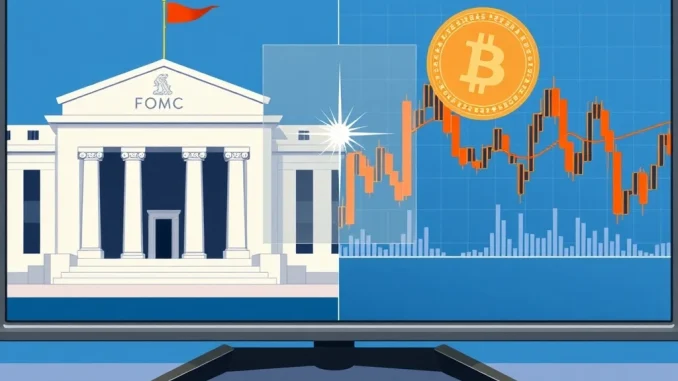
Global, May 2025: A compelling new analysis challenges a core assumption in cryptocurrency trading, revealing that Federal Open Market Committee (FOMC) meetings do not set Bitcoin’s direction. Instead, these highly anticipated economic events primarily function as catalysts for clearing excessive leverage and triggering sharp, short-term repositioning within the market. This insight, drawn from historical data, suggests traders may be overestimating the Fed’s direct influence on Bitcoin’s medium-term trajectory.
FOMC Meetings and Bitcoin: A Catalyst, Not a Compass
The U.S. Federal Reserve’s policy-setting committee consistently commands the attention of global financial markets, and the cryptocurrency sector is no exception. For years, traders have scrutinized every word from Chair Jerome Powell, treating interest rate decisions as potential signals for Bitcoin’s next major move. However, research from XWIN Research Japan, a contributor to the on-chain analytics platform CryptoQuant, presents a nuanced counter-narrative. The analysis posits that while FOMC meetings are undeniably significant market events, their primary role is not to dictate Bitcoin’s path but to expose and resolve built-up market imbalances. This distinction is crucial for investors seeking to navigate volatility. The report meticulously examines price action around recent meetings, finding that directional outcomes are often contradictory and short-lived, overshadowed by the mechanics of leverage unwinding.
Historical Data Debunks the Directional Myth
The research provides concrete examples to support its thesis. In 2024, when the FOMC held interest rates steady on multiple occasions, Bitcoin’s price frequently exhibited no clear, sustained directional movement in the following weeks. The market absorbed the news and continued trading on its own underlying fundamentals. A more telling case emerged during the rate-cutting cycle between September and December of last year. Contrary to traditional economic theory that might suggest lower rates boost risk assets, Bitcoin’s price actually declined by 6% to 8% following these announcements. The analysis attributes this counterintuitive move to a “sell the news” dynamic, where pre-existing bullish expectations had already been priced in. The official confirmation of the cut simply triggered profit-taking and the liquidation of over-leveraged long positions, causing a short-term price drop.
The Mechanics of Market Repositioning
To understand this process, one must examine the market conditions that typically precede an FOMC announcement. In the days leading up to the event, a peculiar stability often descends. Trading ranges tighten, and volatility, as measured by metrics like the Bitcoin Volatility Index, tends to fall. Beneath this calm surface, however, pressure builds. Data shows that open interest—the total number of outstanding derivative contracts—and the use of leverage frequently increase as traders position themselves for a potential breakout. Simultaneously, spot market liquidity can thin out as participants adopt a wait-and-see approach. This creates a fragile environment ripe for a sharp move. The FOMC statement and press conference act as the pin that pops this bubble. If the outcome lacks a clear, unexpected catalyst (like a surprise 50-basis-point cut), the market’s focus shifts inward, and the process of position clearing begins in earnest.
Key Variables for Bitcoin’s Next 30 Days
Moving beyond the immediate FOMC reaction, the analysis identifies the real factors that will likely determine Bitcoin’s direction over a one-month horizon. These variables are internal to the cryptocurrency market’s structure, not external political rhetoric.
- Leverage Reduction: A sustained decrease in aggregate leverage across futures and perpetual swap markets is a primary bullish signal. It indicates a healthier, less fragile market foundation less prone to cascading liquidations.
- Easing of Selling Pressure: This can be monitored through on-chain metrics such as exchange inflows from long-term holders. A decline in coins moving to exchanges suggests reduced intent to sell, potentially paving the way for accumulation.
- Recovery of Liquidity: The return of robust bid and ask support on major spot exchanges is essential for stable price discovery. Deep liquidity absorbs large orders without causing disproportionate price slippage.
These metrics, often overlooked in mainstream financial commentary, provide a more reliable gauge of market health than parsing Fed statements for hints about future policy.
Expert Insight: Separating Signal from Noise
Market veterans have long cautioned against overreacting to macroeconomic headlines. This analysis formalizes that intuition with data. The core argument is that Bitcoin, while sensitive to global liquidity conditions over the very long term, operates with a significant degree of autonomy in shorter timeframes. Its price discovery is increasingly driven by its own adoption cycles, technological developments, and internal market structure. The FOMC meeting serves as a scheduled stress test for this structure. It forces the market to reconcile its collective positioning with a new piece of information, leading to volatility that is often mean-reverting. For disciplined investors, this understanding transforms FOMC days from directional bets into opportunities to assess market health and potentially enter or exit positions amid the resulting liquidity.
Conclusion: A Framework for Informed Trading
The revelation that FOMC meetings act more as a catalyst for repositioning than a determinant of Bitcoin’s direction provides traders with a more sophisticated framework. It shifts the focus from predicting the Fed’s every move to understanding the state of the cryptocurrency market itself. By monitoring leverage, selling pressure, and liquidity—the true engines of short-to-medium-term price action—investors can make more informed decisions. While the Fed’s long-term policy trajectory remains a critical backdrop, its scheduled announcements are moments of reckoning for market excess, not the compass that guides Bitcoin’s journey. This nuanced perspective is essential for anyone looking to navigate the volatile intersection of traditional finance and digital assets.
FAQs
Q1: What is the main finding of the analysis regarding FOMC meetings and Bitcoin?
The primary finding is that FOMC meetings do not determine Bitcoin’s medium-term price direction. Instead, they act as catalysts that trigger the clearing of over-leveraged market positions, leading to short-term volatility and repositioning.
Q2: Why did Bitcoin’s price fall after rate cuts in late 2024?
According to the analysis, the price fell because bullish expectations for the cuts were already priced into the market. The official announcement triggered profit-taking and the liquidation of leveraged long positions, causing a “sell the news” event.
Q3: What typically happens in the crypto market before an FOMC meeting?
Often, a period of temporary stability occurs where volatility decreases, but leverage and open interest rise. Meanwhile, spot market liquidity can decline as traders await the news, creating a fragile, high-pressure environment.
Q4: What are the key variables for Bitcoin’s price direction in the next 30 days, according to the report?
The key variables are internal market metrics: a reduction in overall leverage, an easing of on-chain selling pressure from long-term holders, and a recovery of deep liquidity on spot exchanges.
Q5: Does this mean the Federal Reserve has no impact on Bitcoin?
No, it does not mean that. The Fed’s monetary policy sets the long-term backdrop for global liquidity, which is important for all risk assets, including Bitcoin. The analysis specifically argues that the short-term directional impact of individual FOMC meetings is overstated and that their immediate function is to catalyze corrections in market positioning.