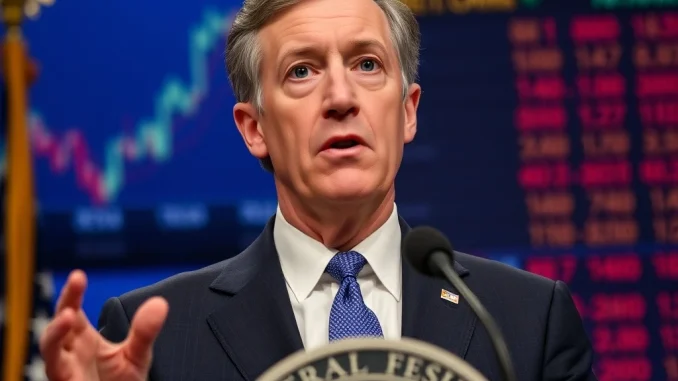
Washington, D.C., March 19, 2025: In a significant shift of tone, Federal Reserve Chair Jerome Powell indicated the central bank has observed “some signs of stability” in the U.S. labor market, prompting the removal of language highlighting downside risks from its latest policy statement. This crucial development marks a potential inflection point in the Fed’s assessment of employment conditions, though Powell immediately cautioned markets and analysts against drawing overly broad conclusions from this nuanced change.
Decoding the Fed’s Statement Shift on Employment Stability
The Federal Open Market Committee’s (FOMC) post-meeting statement serves as its primary communication tool. For several consecutive meetings, the statement had included language noting that “risks to achieving its employment and inflation goals have moved toward better balance.” The removal of this specific phrase regarding employment risks represents the key change Powell addressed. Analysts interpret this as the Fed’s acknowledgment that the extreme labor market tightness and rapid job growth seen in previous years have moderated to a more sustainable pace. The central bank now appears more confident that the employment side of its dual mandate—maximum employment and price stability—is on firmer ground, allowing greater focus to remain on the ongoing battle against inflation.
This shift did not occur in a vacuum. It follows months of labor market data showing a gradual cooling from red-hot levels. Key indicators like the quits rate, job openings, and wage growth have eased from their peaks while the unemployment rate has remained historically low. The Fed’s decision reflects a data-dependent approach, where consistent signals from multiple reports build a case for policy adjustment. However, Powell stressed that “stability” should not be confused with “weakness” or a completed mission. The labor market remains strong by historical standards, and the Fed’s goal is to preserve its health while restoring price stability.
Historical Context and Labor Market Analysis
To understand the significance of Powell’s remarks, one must examine the labor market’s trajectory since the pandemic recovery. The U.S. experienced an unprecedented rebound in hiring, creating a historic imbalance between labor demand and supply. This contributed significantly to inflationary pressures. The Fed’s aggressive rate-hiking campaign, which began in March 2022, aimed specifically to cool demand across the economy, including the labor market.
The recent data suggests this transmission mechanism is working. Consider the following key metrics that likely informed the Fed’s view:
- Job Openings: The JOLTS report shows openings have declined substantially from over 12 million in early 2022 to levels closer to pre-pandemic trends.
- Wage Growth: The Employment Cost Index (ECI) and Average Hourly Earnings show a clear deceleration in wage pressures, though growth remains above pre-2020 rates.
- Unemployment Rate: This headline figure has ticked up modestly but remains below 4%, indicating overall labor market resilience.
- Labor Force Participation: The prime-age participation rate has recovered to and even exceeded pre-pandemic levels, easing some supply constraints.
This combination of factors paints a picture of a labor market moving from “overheated” to “balanced.” The Fed’s removal of the downside risk language is a technical acknowledgment of this progress. It does not signal an imminent shift to easing policy but rather adjusts the baseline assumption for future decisions.
The Delicate Balance: Powell’s Cautious Tone Explained
Chair Powell’s immediate caution against “over-interpreting” these signals was arguably as important as the signal itself. This reflects the Federal Reserve’s institutional memory and current communication strategy. Central bankers are acutely aware that financial markets can amplify subtle policy nuances, potentially loosening financial conditions prematurely and undermining the Fed’s inflation fight. Powell’s message aimed to prevent such a scenario.
His caution stems from several realities. First, economic data is subject to revision. A single month’s positive report does not make a trend. Second, the path of inflation remains the paramount concern. Services inflation, closely tied to wage growth, has proven sticky. Until the Fed sees more convincing, broad-based progress on inflation returning sustainably to its 2% target, its policy will remain restrictive. Third, geopolitical risks and global economic uncertainty provide ample reason for policymakers to retain flexibility. Powell’s balanced messaging—acknowledging progress while maintaining vigilance—is designed to keep all options on the table without triggering market volatility.
Implications for Monetary Policy and Interest Rates
The immediate implication of recognizing employment stability is that it allows the Federal Reserve to focus more singularly on inflation. With one half of its dual mandate appearing less at risk, the bar for further interest rate hikes becomes very high. Conversely, the bar for cutting rates remains equally high until inflation data confirms sustained progress.
Market participants now scrutinize the Fed’s “dot plot,” which charts individual policymakers’ rate projections. A stable employment outlook could lead to a dot plot that shows fewer projected rate cuts for 2025 than markets currently price in, as the Fed feels less urgency to stimulate a weakening job market. The central bank’s next moves will be dictated by a sequential analysis of incoming data. The timeline for any policy shift remains uncertain and conditional.
For consumers and businesses, this signals a prolonged period of “higher for longer” interest rates. Mortgage rates, auto loans, and business borrowing costs are unlikely to see significant relief until the Fed gains greater confidence on inflation. The stability in employment provides a crucial underpinning for the overall economy, suggesting the Fed can maintain its restrictive stance without triggering a sharp rise in unemployment—a scenario often termed a “soft landing.”
Expert Perspectives on the Fed’s Communication
Former Fed officials and economic analysts have weighed in on the strategic nature of this communication shift. Many view it as a classic Fed maneuver: using incremental changes in statement language to guide market expectations without the shock of a major policy change. It is a tool for managing the economic narrative. By acknowledging stability, the Fed subtly prepares the public and markets for a future pivot, whenever that may come, by establishing the rationale in advance. This reduces the risk of a disruptive, surprise announcement later.
Other experts note the challenges ahead. While employment may be stable, productivity growth, global supply chains, and fiscal policy remain wild cards. The Fed’s path is narrow, and its updated assessment of the labor market is just one piece of a complex puzzle. The central bank’s credibility hinges on its ability to accurately read these signals and adjust course as needed, a task Powell emphasized requires humility and constant scrutiny.
Conclusion
Federal Reserve Chair Jerome Powell’s acknowledgment of emerging employment stability represents a pivotal, yet cautious, evolution in the central bank’s economic assessment. By removing language on employment downside risks, the Fed signals a labor market in better balance, allowing it to concentrate on the unfinished task of taming inflation. However, Powell’s explicit warnings against over-interpretation underscore the data-dependent and uncertain path ahead. For markets, businesses, and households, the message is clear: the Fed sees progress but is not declaring victory. The journey toward a stable price environment and a sustainably strong labor market continues, with monetary policy poised to respond to the next set of crucial economic data points. The focus keyword, employment stability, now serves as a foundation for policy, not a trigger for immediate change.
FAQs
Q1: What exactly did the Federal Reserve change in its statement?
The Fed removed language from its policy statement that previously noted risks to achieving its employment goal had moved “toward better balance.” This technical change indicates policymakers see fewer downside risks to the labor market, suggesting it has reached a state of greater stability.
Q2: Does this mean the Fed will start cutting interest rates soon?
Not necessarily. Chair Powell strongly cautioned against this interpretation. While stable employment reduces the urgency for rate cuts to support jobs, the Fed’s primary focus remains inflation. Rate cuts will only commence when the Fed has greater confidence that inflation is moving sustainably toward its 2% target.
Q3: How does a “stable” labor market differ from a “strong” one?
A “strong” labor market is characterized by rapid job growth, rising wages, and very low unemployment, which can contribute to inflation. A “stable” market, as the Fed now suggests, features moderate job growth, cooling wage pressures, and low but steady unemployment—a balance that can coexist with falling inflation.
Q4: What data points is the Fed looking at to determine employment stability?
The Fed analyzes a wide array of data including the unemployment rate, job openings (JOLTS), wage growth (ECI and Average Hourly Earnings), labor force participation, hiring rates, and quits rates. The convergence of these indicators toward pre-pandemic trends informs their assessment.
Q5: What are the risks of over-interpreting Powell’s comments, as he warned?
Over-interpretation could lead financial markets to prematurely price in aggressive interest rate cuts. This would loosen financial conditions (e.g., lower market interest rates, higher stock prices), which could stimulate economic demand and potentially reignite inflationary pressures, undermining the Fed’s efforts.