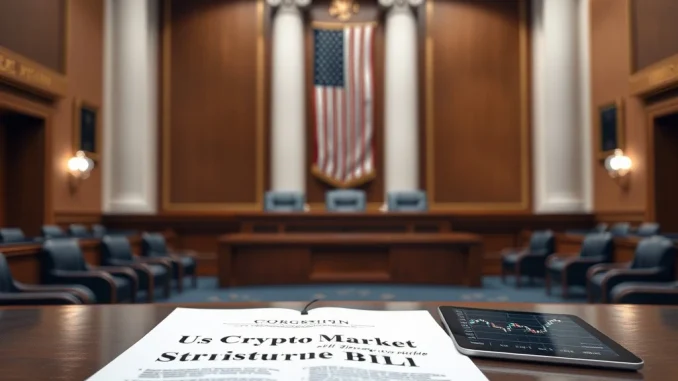
Washington D.C., March 2025: A pivotal piece of cryptocurrency legislation is navigating a complex political landscape, with a major global bank now weighing in on its likely fate. According to a recent analysis by banking giant HSBC, the proposed U.S. crypto market structure bill is expected to pass into law, even in the face of significant opposition from one of the industry’s largest players, Coinbase. This prediction underscores a critical juncture for digital asset regulation, where the pursuit of a foundational legal framework may outweigh perfect consensus.
HSBC’s Analysis: Stability Trumps Perfection in US Crypto Bill
HSBC’s assessment, reported by financial news outlet CoinDesk, centers on a pragmatic view of legislative progress. The bank’s analysts argue that establishing a clear legal baseline for cryptocurrency operations in the United States is an urgent priority. Their core thesis is that regulatory certainty, more than the specific details of any initial bill, is the key catalyst needed for broader institutional adoption. Large-scale financial institutions, pension funds, and traditional asset managers have largely remained on the sidelines of the crypto market, citing regulatory ambiguity as a primary barrier to entry. A passed bill, however imperfect, would begin to dismantle that barrier.
The bank’s commentary suggests that the current political and administrative climate may present a unique window of opportunity. HSBC noted that the existing draft of the legislation, while flawed from some perspectives, could be more favorable to the industry’s long-term growth than potential future amendments crafted under a different presidential administration or congressional majority. This forward-looking stance frames the legislative process as a strategic choice between an achievable compromise now and an unpredictable regulatory environment later.
The Heart of Coinbase’s Opposition: A Stablecoin Showdown
The withdrawal of support from Coinbase, a publicly-traded company often viewed as a bellwether for the U.S. crypto industry, marks a significant fracture in what was previously a more unified industry front. Coinbase’s primary objection hinges on a specific provision within the sprawling market structure bill. The company has raised alarms over language it interprets as potentially banning interest payments, or “yield,” on stablecoin holdings.
Stablecoins—digital assets pegged to stable reserves like the U.S. dollar—are considered a cornerstone of the crypto economy, facilitating trading and serving as a bridge between traditional finance and blockchain networks. The ability for users to earn interest on these holdings, often through decentralized finance (DeFi) protocols or lending platforms, has become a standard feature and a key value proposition. Coinbase argues that prohibiting this functionality would stifle innovation, limit consumer choice, and put U.S.-based companies at a severe competitive disadvantage against global firms operating in less restrictive jurisdictions.
- Regulatory Clarity vs. Innovation: The debate encapsulates a classic tension in tech regulation: the need for clear rules versus the risk of stifling new business models.
- Consumer Protection Angle: Proponents of the restrictive clause may argue it protects consumers from the risks associated with complex yield-generating schemes, which have been prone to collapses in the past.
- Global Competitiveness: The outcome will directly impact whether the U.S. can cultivate a leading digital asset ecosystem or cede ground to financial hubs in Europe, Asia, and the Middle East.
The Legislative Timeline and Historical Context
The push for a comprehensive U.S. crypto framework is not new. For nearly a decade, lawmakers have grappled with how to classify and oversee digital assets, which do not fit neatly into existing securities and commodities laws. High-profile failures of crypto companies, coupled with concerns over illicit finance and consumer protection, have increased the political pressure to act. The current bill represents one of the most serious and advanced attempts to create that overarching structure, addressing areas like:
- Market surveillance and anti-fraud measures
- Clear delineation of regulatory authority between the SEC and CFTC
- Rules for custody, trading, and disclosure
- The treatment and issuance of payment stablecoins
Previous legislative sessions have seen similar bills stall in committee or fail to reach a floor vote. The current momentum, as highlighted by HSBC’s analysis, suggests a different trajectory is possible, driven by a growing consensus that inaction is a greater risk than imperfect action.
Implications for the Broader Financial Ecosystem
The passage of this bill would send a seismic signal through global finance. For traditional banks like HSBC, which have cautiously begun offering crypto custody and trading services to select clients, a clear U.S. rulebook would accelerate their roadmaps. It would enable more standardized risk management, clearer accounting treatment, and the potential for new, regulated crypto-based financial products to enter the mainstream market.
Conversely, if the bill fails or is delayed indefinitely, the current state of “regulation by enforcement”—where agencies like the SEC primarily use lawsuits to establish boundaries—is likely to continue. This approach creates a chilling effect on innovation within the U.S. and pushes development activity offshore. The table below outlines the potential contrasting futures:
| Scenario: Bill Passes | Scenario: Bill Fails |
|---|---|
| Increased institutional capital inflow | Prolonged institutional hesitation |
| Formalized consumer protection rules | Continued reliance on disparate state laws and enforcement actions |
| U.S. exchanges operate under a national license framework | Fragmented state-by-state licensing (“Money Transmitter” model) persists |
| Clear path for compliant stablecoin issuance | Uncertainty hinders USD-pegged stablecoin innovation |
Conclusion
The evolving narrative around the US crypto bill highlights a maturation phase for the entire digital asset industry. HSBC’s prediction of its passage, despite Coinbase’s opposition, reflects a hard-nosed financial reality: large institutions prioritize predictable rules over ideal rules. While the clash over stablecoin yield provisions is a substantive and critical debate, it may ultimately occur within the boundaries of an established law rather than preventing its existence. The coming months will test whether the U.S. political system can deliver the regulatory stability that global finance demands, setting the stage for the next chapter of cryptocurrency’s integration into the world economy.
FAQs
Q1: What is the main reason HSBC thinks the crypto bill will pass?
HSBC analysts believe the need for a basic legal framework to provide stability for institutional investors is so pressing that lawmakers will prioritize passing a compromise bill, even an imperfect one, over leaving the industry in a state of prolonged regulatory uncertainty.
Q2: Why did Coinbase withdraw its support for the bill?
Coinbase pulled its support due to specific concerns about language in the bill that it interprets as potentially banning interest payments (yield) on stablecoin holdings, which it views as a critical feature for consumers and a competitive necessity.
Q3: What are stablecoins and why are they important to this debate?
Stablecoins are cryptocurrencies designed to maintain a stable value, typically pegged to a fiat currency like the U.S. dollar. They are essential for trading and transferring value in crypto markets. The rules governing their issuance and use are a central component of the market structure bill.
Q4: How would this bill affect ordinary cryptocurrency users?
If passed, the bill would aim to provide clearer consumer protections, define what activities are legal, and potentially lead to more traditional financial services (like retirement accounts) offering exposure to crypto. It could also influence which products and services exchanges like Coinbase can offer in the U.S.
Q5: What happens if the bill does not pass?
Without a comprehensive federal law, the current patchwork of state regulations and “regulation by enforcement” from federal agencies like the SEC would continue. This likely means less clarity for businesses, continued hesitation from large institutions, and potential for more innovation to move outside the United States.