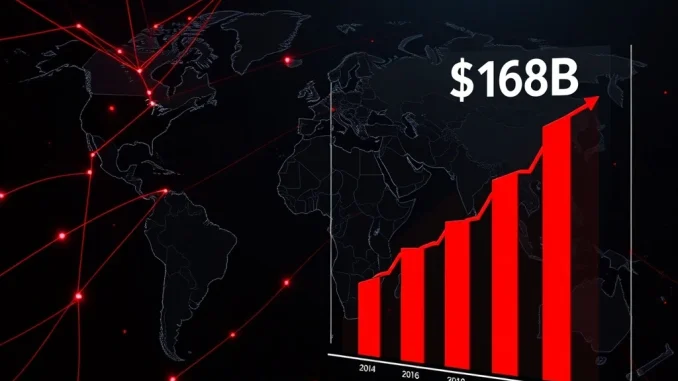
Global, March 2025: The cryptocurrency ecosystem faces a stark reversal in its long-term security trend. A comprehensive new report from blockchain intelligence firm TRM Labs reveals that the total volume of cryptocurrency-related crime surged dramatically in 2025, reaching an estimated $158 billion. This alarming increase follows several consecutive years of decline and marks a pivotal moment for global regulators and the digital asset industry. While illicit activity’s share of total crypto transaction volume continues to fall—now around 1.2%—the sheer scale and evolving nature of the threat demand urgent attention.
Cryptocurrency Crime Reaches a Record $158 Billion in 2025
TRM Labs’ 2025 Illicit Crypto Economy Report, first covered by CoinDesk, delivers a sobering assessment. The $158 billion figure represents a significant year-over-year increase, shattering the downward trajectory observed since the peak of the 2021 bull market. Analysts attribute this surge not to a resurgence of retail-level scams, but to a more sophisticated, state-adjacent phenomenon. The report meticulously tracks flows from ransomware, hacks, fraud, sanctions evasion, and terrorist financing. This data provides a critical, evidence-based foundation for understanding the shifting landscape of digital asset crime, moving the conversation beyond speculation.
The increase occurs against a backdrop of massive growth in legitimate cryptocurrency adoption and institutional investment. Consequently, the proportional share of illicit activity relative to total on-chain volume has continued its gradual decline to approximately 1.2%. This statistical nuance is crucial; it indicates that while the legitimate economy is expanding rapidly, the illicit sector is growing even faster in absolute terms. This parallel growth presents unique challenges for law enforcement and compliance teams worldwide.
The Institutionalization of Illicit Finance by Nation-States
The most significant finding of the TRM Labs analysis is not the raw dollar figure, but the fundamental shift in who is driving the activity. The report identifies a troubling trend: the institutionalization of cryptocurrency-based illicit finance by sanctioned nations. While networks linked to Russia accounted for a substantial plurality of the activity—a continuation of patterns established after the 2022 invasion of Ukraine—the more strategically concerning development involves other states.
Nations under heavy international sanctions, namely Venezuela and China, are now systematically leveraging cryptocurrency infrastructures to bypass traditional financial barriers. This represents a move from opportunistic use by criminal groups within these countries to a coordinated, state-level strategy. These governments and their affiliated entities are allegedly using complex networks of exchanges, mixers, and decentralized protocols to move capital, fund operations, and procure restricted goods, effectively building parallel financial systems.
- Venezuela: Facing crippling economic sanctions, state actors have reportedly deepened their use of cryptocurrencies to facilitate oil sales and import essential goods, creating quasi-official channels that blend government and criminal networks.
- China: Despite a domestic ban on cryptocurrency trading, Chinese-linked networks remain highly active in global illicit finance. The report suggests sophisticated operations moving capital across borders, evading strict capital controls, and facilitating fraud schemes targeting global victims.
- Russia: Russian-linked cybercriminal groups and sanctions evasion networks continue to be the most prolific actors, utilizing a wide array of methods from ransomware to laundering proceeds from illicit natural resource sales.
Expert Analysis: A New Phase of Crypto Crime
Financial crime experts interpreting the report warn that 2025 may mark the beginning of a new, more resilient phase for crypto-related illicit activity. “The decline in previous years was largely due to the dismantling of major mixing services, the takedown of darknet markets, and improved exchange compliance,” explains a former OFAC analyst who reviewed the findings. “What we’re seeing now is adaptation. Sanctioned regimes have studied those defenses and are building their own dedicated infrastructure. They’re not just using crypto; they’re building their own tailored illicit ecosystems.”
This institutionalization makes the threat harder to combat. Unlike rogue hackers or fraudsters, state-backed actors have greater resources, coordination, and geopolitical incentives to protect their operations. They can establish shell companies, corrupt local officials, and leverage diplomatic pressure to shield their activities. The technological sophistication is also increasing, with greater use of privacy coins, cross-chain bridges, and decentralized finance (DeFi) protocols with weak or no know-your-customer (KYC) controls.
Historical Context and the Regulatory Response Timeline
To understand the 2025 surge, one must view it as a reaction to a period of intense regulatory pressure. The years 2022-2024 saw unprecedented global coordination. Key events include the sanctioning of Tornado Cash, the arrest of founders of mixing services, and the implementation of the Travel Rule by major jurisdictions. These actions successfully constricted the easy avenues for laundering funds, leading to the observed decline.
The current surge suggests that illicit actors have completed a period of retooling. The response has been multifaceted: migrating to jurisdictions with lax regulation, developing new obfuscation techniques, and, most importantly, finding willing institutional partners in sanctioned states. This creates a cat-and-mouse game where each regulatory victory prompts a more sophisticated and entrenched countermove from adversaries with significant resources.
Implications for the Legitimate Cryptocurrency Industry
This report carries profound implications for businesses operating in the digital asset space. The staggering $158 billion figure will undoubtedly fuel regulatory scrutiny. Legislators in the US, EU, and elsewhere will point to it as evidence for stricter legislation, potentially targeting the foundational protocols of DeFi or imposing draconian liability on software developers.
For cryptocurrency exchanges, custody providers, and financial institutions, the pressure to implement even more rigorous compliance will intensify. The focus will shift from detecting individual bad actors to identifying complex transaction patterns indicative of state-level sanctions evasion. This requires advanced analytics, greater information sharing between firms, and potentially uncomfortable decisions about servicing entire geographic regions. The cost of compliance, already high, is set to rise further, potentially consolidating the industry around a few heavily regulated players.
Conclusion: A Critical Juncture for Crypto Security
The TRM Labs report on 2025 cryptocurrency crime presents a clear and present challenge. The surge to $158 billion in illicit activity, driven by the institutionalization of crypto finance by sanctioned nations like Venezuela and China, signals a dangerous evolution in the threat landscape. While the percentage of crime relative to total volume remains low, the absolute growth and sophisticated, state-backed nature of the activity cannot be ignored. The coming years will test the resilience of the cryptocurrency industry’s security measures and the ability of the global community to foster innovation while preventing its exploitation by rogue states. The response to this 2025 surge will define the integrity and future of the digital asset ecosystem for a decade to come.
FAQs
Q1: What was the total value of cryptocurrency crime in 2025 according to TRM Labs?
The TRM Labs report estimates the total value of cryptocurrency-related illicit activity reached $158 billion in 2025.
Q2: Did the share of illicit crypto transactions increase in 2025?
No. While the absolute value surged, the share of illicit transactions as a percentage of total cryptocurrency volume continued to fall, reaching approximately 1.2%.
Q3: Which countries are most implicated in the 2025 crypto crime surge?
The report notes that while Russia-linked networks account for a majority of the activity, a key development is the institutionalization of such practices by other sanctioned nations, specifically Venezuela and China.
Q4: What does “institutionalization” of crypto crime mean?
It refers to state-level actors in sanctioned nations systematically adopting and integrating cryptocurrency tools into their financial strategies to bypass sanctions, move capital, and fund operations, moving beyond use by independent criminal groups.
Q5: Why is this surge significant after years of decline?
The surge indicates that illicit actors, particularly state-backed ones, have adapted to previous regulatory crackdowns. It marks a shift towards more sophisticated, resilient, and resource-intensive methods that are harder for authorities to disrupt.