Global, May 2025: The cryptocurrency derivatives market experienced a significant wave of forced position closures over a recent 24-hour period, with total estimated crypto futures liquidations surpassing $195 million. Data from major trading platforms indicates a pronounced skew, with short sellers bearing the brunt of the losses on leading assets like Ethereum (ETH) and Bitcoin (BTC), as well as on the more volatile HYPE token. This event provides a critical case study in market leverage, volatility, and risk management within the digital asset ecosystem.
Crypto Futures Liquidations: Decoding the $195 Million Market Shakeout
The core data reveals a concentrated period of deleveraging. Across all tracked perpetual futures contracts, traders faced an estimated $195.51 million in liquidations. A liquidation occurs when an exchange automatically closes a trader’s leveraged position due to a partial or total loss of the trader’s initial margin. This mechanism is a fundamental risk control but can exacerbate market moves. The 24-hour snapshot is not an isolated incident but a symptom of building market pressure, likely triggered by a price movement contrary to the dominant leveraged bias. Analyzing which side of the market gets liquidated—longs or shorts—offers immediate insight into recent price direction and trader sentiment.
A Detailed Breakdown of Major Asset Liquidations
The liquidation volumes were not evenly distributed, highlighting varying degrees of leverage and speculative activity across different cryptocurrencies. The data paints a clear picture of a market where short positions were overwhelmingly caught off-guard.
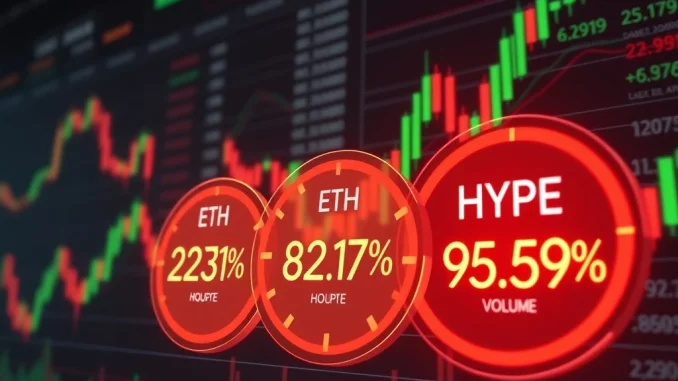
- Ethereum (ETH): Topping the list, ETH saw $91.32 million in positions forcibly closed. A commanding 82.31% of these were short positions, suggesting a rapid price increase triggered a cascade of stop-loss orders and margin calls against traders betting on a decline.
- Bitcoin (BTC): The flagship cryptocurrency recorded $79.06 million in liquidations. Mirroring ETH’s pattern, 80.19% were short positions. This indicates a broad-based upward move that pressured the entire market’s short-side leverage.
- HYPE Token: While a smaller absolute figure at $25.13 million, the composition is stark. A remarkable 93.59% of HYPE’s liquidations were shorts, pointing to an extremely one-sided and likely volatile price surge that obliterated leveraged bets against it.
This collective action points to a classic short squeeze scenario across multiple assets. As prices rose, short sellers were forced to buy back the asset to cover their positions, creating additional upward buying pressure and fueling further liquidations in a self-reinforcing cycle.
The Mechanics of Perpetual Futures and Leverage
To understand why these events happen, one must grasp the instrument at play: perpetual futures contracts. Unlike traditional futures with set expiry dates, perpetual contracts, or “perps,” allow traders to hold leveraged positions indefinitely, provided they pay a funding rate to balance demand between longs and shorts. Traders often use high leverage—sometimes 10x, 25x, 50x, or even higher—to amplify potential gains. However, this leverage is a double-edged sword. A relatively small adverse price move, often just 1-2% for highly leveraged positions, can wipe out the entire collateral (margin) and trigger an automatic liquidation by the exchange’s engine.
Historical Context and Market Implications
Liquidation events of this scale are not unprecedented but serve as potent reminders of market dynamics. Historically, large clustered liquidations often mark local tops or bottoms, as they flush out extreme leverage and can temporarily exhaust a price move. The concentration in short liquidations suggests the market was overly pessimistic or positioned for a drop, leaving it vulnerable to a bullish catalyst. For the broader ecosystem, such events impact market liquidity, increase volatility, and can influence spot prices due to the forced buying or selling from liquidated positions. They also underscore the critical importance of risk management for traders, including the use of stop-loss orders (though these can become liquidation triggers in illiquid conditions) and responsible leverage ratios.
Expert Insight on Risk and Market Structure
Market analysts often view liquidation data as a gauge of market sentiment and leverage saturation. A high volume of liquidations, particularly clustered on one side, indicates that a significant amount of “weak hands” or over-leveraged positions have been cleared from the system. This can create a healthier foundation for the next price move, as it reduces immediate forced selling (or buying) pressure. However, it also highlights structural vulnerabilities within crypto markets, where derivative trading volumes often dwarf spot markets, meaning price discovery can be disproportionately driven by leveraged speculation. Regulatory bodies globally continue to scrutinize this aspect of the crypto industry, focusing on consumer protection and systemic risk.
Conclusion
The recent 24-hour data on crypto futures liquidations, totaling nearly $200 million with a heavy bias toward short positions, provides a transparent window into the high-stakes world of leveraged cryptocurrency trading. It demonstrates how rapid price movements can trigger cascading, automated closures that amplify volatility. For traders, this event is a lesson in the perils of excessive leverage and the importance of understanding funding rates and liquidation mechanics. For observers and the industry, it reinforces the need for robust infrastructure, clear risk disclosures, and educated participation. As the crypto market matures, managing the interplay between spot prices and derivative leverage remains one of its most significant challenges.
FAQs
Q1: What does “82.31% shorts” mean in liquidation data?
It means that 82.31% of the total value liquidated for that asset came from positions where traders were betting the price would go down (short positions). The remaining percentage came from long positions (bets on price increases) being liquidated.
Q2: What triggers a futures liquidation?
A liquidation is triggered automatically by the exchange when a trader’s position loses so much value that their remaining collateral (margin) can no longer cover the potential loss. This happens to prevent the trader’s account from going into negative balance and owing the exchange money.
Q3: Why do liquidations sometimes cause a “squeeze”?
In a short squeeze, rising prices force short sellers to buy back the asset to close their positions and limit losses. This forced buying adds more upward pressure on the price, which can trigger more short liquidations, creating a feedback loop. The opposite is a long squeeze during a price crash.
Q4: Are liquidation events bad for the crypto market?
They are a neutral mechanism of risk management but can increase short-term volatility. While painful for affected traders, they can be seen as “resetting” excessive leverage, potentially making the market more stable afterward by removing overextended positions.
Q5: How can traders avoid being liquidated?
Traders can avoid liquidation by using lower leverage, maintaining sufficient margin (collateral) above the maintenance margin requirement, employing prudent stop-loss orders, and actively monitoring their positions, especially during periods of high volatility.