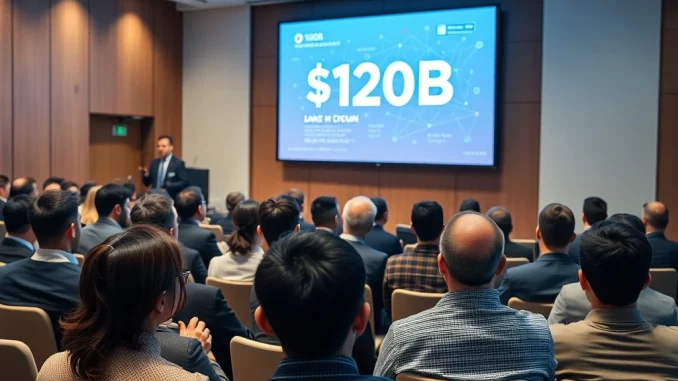
Seoul, South Korea, January 28, 2025: The global on-chain finance sector has reached a significant commercialization milestone, with $120 billion now deposited across blockchain-based financial services worldwide. Derik Han, Head of Asia-Pacific at Mysten Labs, revealed this substantial figure during the ninth News1 Blockchain Leaders Club event, highlighting how Layer 1 blockchain infrastructure is transitioning from experimental technology to practical, real-world financial applications. This development signals a maturation phase for decentralized finance, where substantial capital deployment now supports genuine commercial use cases beyond speculative trading.
On-Chain Finance Reaches Commercialization Tipping Point
The $120 billion figure represents more than just capital accumulation—it signifies a fundamental shift in how financial services operate on blockchain networks. Traditional finance has historically viewed blockchain technology with skepticism, focusing primarily on cryptocurrency volatility rather than infrastructure potential. However, this substantial deposit volume demonstrates growing institutional and retail confidence in blockchain-based financial systems. The funds now flowing through on-chain finance protocols support everything from lending and borrowing platforms to decentralized exchanges, payment systems, and asset management tools that operate without traditional intermediaries.
Industry analysts note that this milestone follows years of infrastructure development. Early blockchain networks struggled with scalability issues that limited their financial application potential. The emergence of more efficient Layer 1 solutions, combined with improved developer tools and regulatory clarity in certain jurisdictions, has created an environment where practical financial services can flourish. The Asia-Pacific region, where Han made his announcement, has been particularly active in adopting these technologies, with countries like Singapore, South Korea, and Japan implementing regulatory frameworks that balance innovation with consumer protection.
Sui Blockchain Emerges as Performance Leader
Within this broader landscape, the Sui blockchain—developed by Mysten Labs—has demonstrated remarkable growth despite its relatively recent 2023 launch. Han specifically highlighted that Sui-based on-chain finance services now manage approximately $2 billion in assets. This represents significant traction for a newer network competing against established players like Ethereum, Solana, and Avalanche. The $2 billion figure is particularly noteworthy when considering the competitive landscape and the network effect advantages enjoyed by earlier blockchain platforms.
Sui’s technical architecture contributes directly to its financial service capabilities. The blockchain utilizes a unique object-centric model and the Move programming language, originally developed for Meta’s Diem project. This design enables parallel transaction processing, meaning multiple transactions can occur simultaneously without conflicting with each other. In practical terms, this architecture supports the high throughput necessary for financial applications where milliseconds matter. Han emphasized that Sui has processed a cumulative 12 billion transactions since its mainnet launch, with consistent speed enhancements establishing it as what he described as “the fastest existing Layer 1 blockchain.”
The Infrastructure Behind Commercial Adoption
The transition from theoretical potential to practical application requires robust infrastructure that traditional financial institutions recognize as reliable. Layer 1 blockchains like Sui are actively collaborating with various companies to build this infrastructure, focusing particularly on solving the issue of fragmented liquidity. In traditional finance, liquidity pools in different markets or exchanges can create price discrepancies and inefficiencies. Blockchain networks aim to create unified liquidity layers that transcend geographical and institutional boundaries.
Several key developments have enabled this infrastructure maturation:
- Improved Transaction Finality: Modern Layer 1 networks achieve transaction finality in seconds rather than minutes or hours, making them viable for time-sensitive financial operations.
- Enhanced Security Models: Advanced consensus mechanisms and formal verification tools provide the security assurances necessary for handling significant financial value.
- Developer Ecosystem Growth: Comprehensive software development kits and documentation have lowered barriers for financial institutions to build on blockchain infrastructure.
- Regulatory Technology Integration: Built-in compliance tools help institutions meet know-your-customer and anti-money laundering requirements while operating on decentralized networks.
Real-World Applications Driving Growth
The $120 billion in on-chain finance deposits supports tangible applications that extend far beyond cryptocurrency trading. During his presentation, Han detailed several practical implementations currently operational or in advanced development stages. These include cross-border payment systems that reduce settlement times from days to minutes, decentralized lending platforms that operate 24/7 without traditional banking hours, and tokenized real-world assets like real estate and commodities that gain liquidity through blockchain representation.
In the Asia-Pacific region specifically, several notable implementations demonstrate this trend:
| Application Type | Primary Use Case | Notable Example |
|---|---|---|
| Trade Finance | Document verification and payment automation | Singapore-based platform reducing letter of credit processing from 10 days to 24 hours |
| Supply Chain Finance | Early payment for suppliers based on verifiable shipment data | Korean manufacturing consortium using smart contracts for tier-2 supplier financing |
| Institutional DeFi | Corporate treasury management and yield generation | Japanese financial institution piloting blockchain-based bond issuance and trading |
These applications share a common characteristic: they leverage blockchain’s transparency and programmability to solve specific business problems rather than simply creating new financial instruments. The technology provides auditable transaction histories, reduces counterparty risk through smart contract automation, and creates interoperable systems that can communicate across organizational boundaries.
Addressing Fragmented Liquidity Challenges
One of the most significant hurdles for on-chain finance has been liquidity fragmentation across different blockchain networks and decentralized applications. Han specifically mentioned that Layer 1 blockchains are working collaboratively to solve this issue. Fragmented liquidity occurs when assets are siloed within specific protocols or networks, reducing overall market efficiency and increasing slippage for large transactions. The industry is developing several approaches to address this challenge, including cross-chain communication protocols, liquidity aggregation layers, and standardized asset representations.
The collaboration Han referenced involves both technical standardization efforts and business development initiatives. Technically, projects are working on interoperability standards that allow assets to move seamlessly between different blockchain environments. From a business perspective, financial institutions and blockchain developers are creating incentive structures that encourage liquidity provision across multiple platforms. This coordinated approach recognizes that no single blockchain will dominate all financial applications, making interoperability essential for the sector’s continued growth.
Future Trajectory and Industry Implications
The $120 billion milestone represents a foundation rather than a ceiling for on-chain finance. Industry projections suggest continued growth as more traditional financial institutions explore blockchain integration. Several factors will influence this trajectory, including regulatory developments, technological advancements, and macroeconomic conditions. The Asia-Pacific region, with its combination of technological adoption, financial sophistication, and progressive regulatory approaches, will likely remain a significant driver of this evolution.
Key areas to watch include:
- Institutional Adoption Patterns: How traditional banks, asset managers, and insurance companies incorporate blockchain technology into their existing operations.
- Regulatory Evolution: Whether jurisdictions develop harmonized standards that enable cross-border on-chain finance while maintaining consumer protections.
- Technological Convergence: How blockchain infrastructure integrates with other emerging technologies like artificial intelligence for risk assessment and internet-of-things for asset verification.
- Market Structure Changes: Whether on-chain finance creates fundamentally new financial service models or primarily optimizes existing processes.
Conclusion
The revelation that $120 billion is now deposited in on-chain finance globally marks a definitive shift toward commercialization for blockchain-based financial services. As Derik Han of Mysten Labs articulated in Seoul, this capital supports practical applications built on Layer 1 infrastructure like the Sui blockchain, which itself manages $2 billion in assets despite its recent launch. The consistent speed enhancements and transaction throughput demonstrated by modern blockchains address previous limitations that hindered financial adoption. As Layer 1 networks collaborate to solve challenges like fragmented liquidity, the on-chain finance sector appears poised for continued expansion beyond speculative trading into core financial services that impact businesses and consumers worldwide. This evolution represents not just technological progress but a fundamental reimagining of financial infrastructure for the digital age.
FAQs
Q1: What does “on-chain finance” actually mean?
On-chain finance refers to financial services and applications that operate directly on blockchain networks. Unlike traditional finance that relies on centralized institutions and private databases, on-chain finance uses decentralized ledgers, smart contracts, and cryptocurrency tokens to facilitate activities like lending, borrowing, trading, and asset management without intermediaries.
Q2: How does the $120 billion in on-chain finance deposits compare to traditional finance?
While $120 billion represents significant growth for blockchain-based finance, it remains a small fraction of the global financial system. For context, global banking assets exceed $100 trillion. However, the $120 billion figure is notable because it represents capital actively deployed in decentralized protocols rather than simply held in cryptocurrency wallets, indicating practical usage beyond asset speculation.
Q3: What makes Sui blockchain different from other Layer 1 networks?
Sui utilizes an object-centric data model and the Move programming language, enabling parallel transaction processing that improves scalability. Since its 2023 launch, it has processed 12 billion transactions with consistent speed improvements. Its architecture is particularly suited for financial applications requiring high throughput and low latency, contributing to its rapid adoption for on-chain finance services.
Q4: What are some real-world examples of on-chain finance applications?
Practical implementations include cross-border payment systems that settle in minutes instead of days, decentralized lending platforms that operate continuously, tokenized representations of real-world assets like real estate, trade finance solutions that automate document verification, and supply chain finance tools that provide early payments to suppliers based on verifiable shipment data.
Q5: What challenges does on-chain finance still need to overcome?
Key challenges include fragmented liquidity across different blockchain networks, regulatory uncertainty in many jurisdictions, user experience complexities for non-technical users, integration with traditional financial systems, and scalability during periods of peak demand. The industry is actively working on interoperability solutions, regulatory technology tools, and interface improvements to address these issues.