Global, May 2025: Bitcoin traders and analysts are experiencing a chilling sense of déjà vu as a critical technical indicator, absent since the depths of the 2022 bear market, has reappeared on the cryptocurrency’s charts. The crossing of key exponential moving averages (EMAs) has triggered a market flashback, prompting serious questions about whether Bitcoin is repeating a painful historical pattern or charting a new course entirely. This development comes at a pivotal moment, challenging post-halving optimism and forcing a reassessment of the dominant four-year cycle narrative.
Bitcoin’s EMA Cross: A Technical Breakdown of the Signal
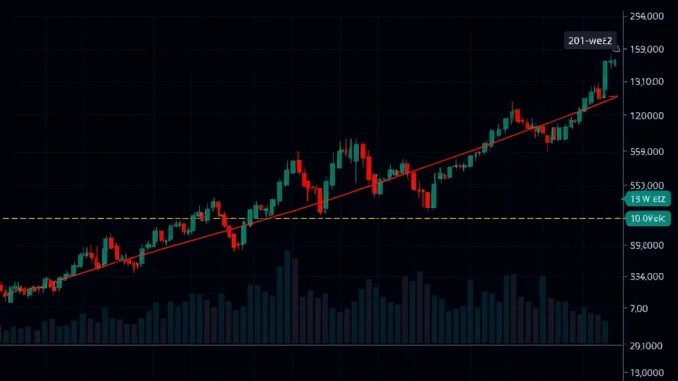
For the first time since April 2022, Bitcoin’s 21-week exponential moving average (21W EMA) has crossed below its 50-week counterpart (50W EMA). This event, confirmed by prominent analyst Rekt Capital in a public statement, is not a routine fluctuation. Exponential moving averages place greater weight on recent price data, making them more responsive to new trends than simple moving averages. A crossover where a shorter-term average moves below a longer-term one is classically interpreted by technical analysts as a bearish trend reversal signal, suggesting weakening momentum and a potential shift from an uptrend to a downtrend.
The significance of this specific crossover—the 21W EMA and the 50W EMA—is rooted in its historical precedent. During the previous cycle, this same crossover in Q2 2022 preceded a prolonged and severe downturn. Following that signal, Bitcoin’s price did not find a definitive bottom for approximately seven months, eventually reaching a low near $15,600 in November 2022. The recurrence of this configuration naturally draws comparisons, leading many to scrutinize whether the market is mechanically replaying a script from the last bear cycle.
Historical Context and the Ghost of 2022
To understand the current apprehension, one must examine the market environment of 2022. That period was characterized by a perfect storm of macroeconomic headwinds, including aggressive interest rate hikes by central banks to combat inflation, which drained liquidity from risk assets. The crypto industry faced its own internal crises, most notably the collapse of the Terra/Luna ecosystem and the FTX exchange. The EMA crossover occurred within this context of fundamental and technical deterioration.
The current market dynamic presents both parallels and divergences. While Bitcoin trades significantly higher, around the $65,000 mark compared to 2022’s lower levels, it has been consolidating without a clear bullish catalyst to propel it to new highs. The post-2024 halving euphoria has been muted, failing to generate the explosive rally some historical models predicted. This stagnation, coupled with the EMA crossover, fuels the narrative of a “classic bear market setup”—a scenario of gradual weakening and distribution rather than a sudden, dramatic crash.
Analyst Perspectives and Cycle Debate
The emergence of this signal has reignited a fundamental debate within crypto analysis: the validity of the presumed four-year cycle tied to Bitcoin’s halving events. Proponents of the cycle theory point to historical rhythms of boom and bust following each halving. Skeptics, however, argue that as Bitcoin matures and its market capitalization grows, its cycles may elongate, deform, or decouple from this simplistic model. The current technical picture, for some analysts, supports the skeptical view, suggesting the market may be entering a phase of extended consolidation that doesn’t neatly fit the old timeline.
Technical analysts monitoring the situation emphasize several key observations. First, the signal itself is identical to the 2022 bear market trigger. Second, Bitcoin’s price action remains within a defined consolidation zone, lacking decisive upward momentum. Third, overall market structure appears to be weakening gradually. This collective evidence leads many to adopt a cautious stance, awaiting either a breakdown that confirms the bearish outlook or a powerful bullish reversal that invalidates it.
The Bitcoin/Silver Ratio: A Macroeconomic Warning Signal
Adding another layer of complexity to the analysis is Bitcoin’s performance relative to traditional assets, particularly precious metals. Analyst Daan Crypto Trades highlighted that the Bitcoin-to-Silver ratio has retreated to levels last seen in late 2022, coinciding with the FTX collapse. This metric measures how many ounces of silver one bitcoin can purchase.
The fact that this ratio has returned to those crisis-level points is analytically “amazing,” as Daan noted, because silver achieved this depreciation relative to Bitcoin in half the time, despite both assets appreciating in nominal U.S. dollar terms. This performance asymmetry suggests a shift in market perception. It may indicate that capital is reassessing the hierarchy of so-called “safe haven” or inflation-hedge assets, potentially flowing into tangible assets like silver over digital assets like Bitcoin in the current risk environment.
Daan’s conclusion that this movement highlights “the real reason for these movements: the depreciation of fiat currencies” points to a broader macroeconomic driver. In an era of persistent inflation and fiscal uncertainty, all asset movements must be contextualized within the declining purchasing power of major currencies. Bitcoin’s price action, therefore, may be influenced less by internal crypto dynamics and more by global capital allocation decisions between various inflation-resistant stores of value.
Market Sentiment and the Macro Backdrop
The technical warnings are emerging against a backdrop of fragile investor sentiment. Fears related to U.S. government fiscal policy, including debates over the debt ceiling and potential shutdowns, have introduced fresh uncertainty into global markets. Cryptocurrencies, still largely perceived as risk assets, are sensitive to this kind of macroeconomic tension. When risk appetite declines, capital often flows out of speculative assets, which can exacerbate technical breakdowns.
This confluence of factors—a bearish technical crossover, a worrying ratio reversion, and a tense macroeconomic climate—has created a precarious equilibrium for Bitcoin. The market appears poised, waiting for a fundamental catalyst or a major price movement to confirm the next directional trend. Will it be a denial of the bearish setup through a strong rally above key resistance, or a confirmation through a break below critical support levels near $60,000?
Conclusion: Navigating Uncertainty in Bitcoin’s Evolving Market
The reappearance of Bitcoin’s EMA cross, a technical signal last seen during the 2022 bear market, serves as a stark reminder of the cryptocurrency’s volatility and the weight of historical patterns. While technical analysis provides a framework for understanding market structure, it is not a definitive predictor. The current situation underscores the importance of context, highlighting the interplay between internal market mechanics, cross-asset correlations, and the broader macroeconomic landscape.
For investors and observers, this development necessitates a balanced perspective. It reinforces the need for rigorous risk management, diversification, and a focus on long-term fundamentals rather than short-term price predictions. Whether this Bitcoin EMA cross marks the beginning of a prolonged downturn or merely a deep correction within a larger bull trend remains to be seen. What is clear is that the market is at an inflection point, demanding attention to both the charts on the screen and the economic forces shaping the world beyond them.
FAQs
Q1: What does it mean when the 21-week EMA crosses below the 50-week EMA?
This is typically interpreted by technical analysts as a bearish trend reversal signal. It suggests that the shorter-term momentum (21 weeks) has weakened sufficiently to fall below the longer-term trend (50 weeks), indicating a potential shift from an upward to a downward price trajectory.
Q2: How reliable is this EMA crossover signal for predicting Bitcoin’s price?
While historically significant—the last occurrence preceded the 2022 bear market—no single technical indicator is foolproof. Its reliability depends on confirmation from other indicators, trading volume, and broader market fundamentals. It should be used as one tool among many in a comprehensive analysis.
Q3: Why is the Bitcoin/Silver ratio important?
The ratio measures Bitcoin’s strength relative to a traditional precious metal. A declining ratio can signal that Bitcoin is underperforming as a perceived store of value or inflation hedge compared to tangible assets, offering insight into shifting investor preferences and macroeconomic sentiment.
Q4: Does this signal mean the four-year Bitcoin cycle is broken?
It raises questions but doesn’t provide a definitive answer. The signal suggests the current market phase may not align perfectly with past post-halving cycles, indicating that Bitcoin’s market behavior is evolving as it matures and faces new macroeconomic conditions.
Q5: What should investors watch for following this EMA crossover?
Key factors include Bitcoin’s ability to hold major support levels (e.g., around $60,000), a potential bullish reversal candle pattern on weekly charts, significant changes in trading volume, and developments in macroeconomic policy that affect global liquidity and risk appetite.