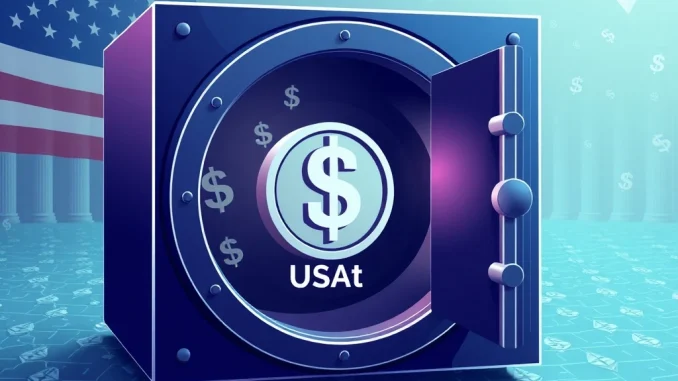
New York, April 2025: In a landmark move for the digital asset industry, Tether Operations Limited has officially announced the launch of USAT, a new U.S. dollar-pegged stablecoin engineered from the ground up for full compliance with evolving federal regulations. This strategic launch directly responds to the regulatory framework established by the U.S. stablecoin bill, known as the GENIUS Act, and represents a significant pivot for the world’s largest stablecoin issuer. The company has structured USAT with a clear division of roles: crypto bank Anchorage Digital will serve as the official issuer, while financial services firm Cantor Fitzgerald will manage reserve custody and act as the primary dealer. Initial distribution for the new Tether USAT stablecoin will commence on major exchanges including Bybit, Crypto.com, Kraken, and OKX.
Tether USAT Stablecoin and the Drive for Regulatory Clarity
The announcement of USAT marks a pivotal chapter in Tether’s corporate evolution and the broader stablecoin narrative. For years, the dominant stablecoin, USDT, operated in a global regulatory gray area, facing scrutiny over its reserve composition and operational transparency. The passage of the GENIUS Act (Guidelines for Electronic Networked and Interoperable Uniform Stablecoins) in late 2024 created a definitive U.S. regulatory pathway. This legislation mandates strict requirements for issuers, including full asset backing, regular attestations and audits by approved firms, clear redemption policies, and restrictions on reserve asset types. Tether’s launch of USAT is a direct and calculated adaptation to this new environment, signaling a mature phase where compliance becomes a primary product feature rather than an afterthought.
Industry analysts view this as a necessary step for Tether to maintain and grow its institutional and mainstream presence within the United States. The structure deliberately separates key functions: issuance, custody, and dealing. This model aligns with traditional finance practices and regulatory expectations, reducing single-point-of-failure risks. By appointing Anchorage Digital—a federally chartered digital asset bank regulated by the Office of the Comptroller of the Currency (OCC)—as the issuer, Tether immediately grafts a layer of regulatory legitimacy onto USAT that its global USDT lacks in the U.S. context.
Deconstructing the USAT Ecosystem: Roles and Responsibilities
The operational blueprint for USAT reveals a carefully constructed compliance-first architecture. Understanding the roles of each entity is crucial to grasping the model’s significance.
- Anchorage Digital as Issuer: As a regulated crypto bank, Anchorage Digital holds the charter to legally issue the USAT token on-chain. This means they are the entity legally responsible for minting and burning tokens in response to user deposits and redemptions, and for ensuring these actions comply with Bank Secrecy Act (BSA) and Anti-Money Laundering (AML) rules. Their involvement provides a regulated on-ramp and off-ramp for the stablecoin.
- Cantor Fitzgerald as Custodian and Primary Dealer: This appointment is equally strategic. Cantor Fitzgerald, a well-established institutional financial services firm, will hold the underlying reserve assets (presumably U.S. Treasury bills and similar high-liquidity instruments) in segregated custody. As the primary dealer, they will also manage the liquidity and market-making for USAT, ensuring tight spreads and deep order books, particularly for institutional clients. This role mirrors their existing function in traditional government bond markets.
- Tether’s Role: Tether Operations Limited shifts to a technology, branding, and global distribution role for USAT. They provide the technical infrastructure and blockchain integration, manage the brand, and facilitate listings on global exchanges outside the primary dealer network.
This tripartite structure is designed to satisfy regulators by dispersing control and ensuring that reserve management and issuance are handled by regulated, auditable U.S. entities.
The GENIUS Act: The Regulatory Bedrock
The GENIUS Act is not merely background context; it is the foundational reason for USAT’s existence. The law establishes a federal framework that pre-empts a patchwork of state laws, providing uniform rules for “payment stablecoins.” Key mandates that directly shape USAT include:
- Asset-Backing: Stablecoins must be backed 100% by high-quality liquid assets (HQLA), with strict limits on riskier holdings.
- Transparency: Monthly attestations and quarterly full-reserve audits by SEC-approved auditors are required.
- Redemption Rights: Holders must have a legal claim for prompt redemption at par value, with clear procedures.
- Issuer Requirements: Issuers must be insured depository institutions or licensed money transmitters at the federal level.
By building USAT to these specifications from day one, Tether aims to create a “clean” stablecoin for the U.S. market, distinct from its global USDT product.
Market Implications and Exchange Rollout Strategy
The initial distribution of USAT on Bybit, Crypto.com, Kraken, and OKX is a strategic first wave. These exchanges represent a mix of global reach and significant U.S. user bases (where applicable). Kraken and Crypto.com, in particular, have been proactive in engaging with U.S. regulators. This selective rollout allows Tether to control liquidity depth from the outset and target sophisticated traders and institutions who prioritize regulatory certainty. The success of USAT will hinge on its ability to achieve liquidity parity with USDT and USD Coin (USDC) on these and subsequent platforms. Market observers will closely watch the spread between USAT and other stablecoins; a minimal spread will indicate successful market-maker integration and trader confidence in the new model.
The launch also creates a fascinating competitive dynamic. Circle’s USDC, which has long positioned itself as the compliant alternative, now faces a direct challenger built to the same federal standard. However, USAT enters with the immense distribution network and brand recognition of Tether. The long-term question is whether the market will bifurcate, with USAT becoming the preferred vehicle for regulated U.S. activity and USDT remaining the dominant medium for international trade and decentralized finance (DeFi) ecosystems outside U.S. jurisdiction.
A Timeline of Regulatory Evolution and Industry Response
The path to USAT began years before its announcement. A condensed timeline highlights the regulatory pressure and industry adaptation:
- 2019-2021: Increased regulatory scrutiny on Tether’s reserves for USDT, resulting in settlements with the New York Attorney General and the Commodity Futures Trading Commission (CFTC).
- 2022: The collapse of the algorithmic stablecoin UST accelerates global regulatory calls for stablecoin legislation.
- 2023: Draft versions of U.S. stablecoin bills circulate in Congress, with industry heavyweights lobbying for clear rules.
- Late 2024: The GENIUS Act is passed and signed into law, establishing a 12-month compliance window.
- Early 2025: Tether announces partnerships with Anchorage Digital and Cantor Fitzgerald, telegraphing its compliant product strategy.
- April 2025: Official launch of the USAT stablecoin on select exchanges.
This timeline demonstrates a clear cause-and-effect relationship between regulatory action and corporate strategy, moving the industry from a “move fast and break things” ethos to a more deliberate, compliance-driven approach.
Conclusion
The launch of the Tether USAT stablecoin is more than a new product announcement; it is a bellwether for the maturation of the cryptocurrency market under formal regulation. By meticulously structuring USAT in alignment with the GENIUS Act and partnering with established, regulated U.S. financial entities like Anchorage Digital and Cantor Fitzgerald, Tether is strategically future-proofing its access to the American financial system. This move validates the federal regulatory framework while challenging existing compliant stablecoins. For users, developers, and institutions, the arrival of USAT provides a new, high-compliance option for dollar-denominated digital asset transactions, potentially increasing institutional adoption and fostering greater integration between traditional and digital finance. The success of the Tether USAT stablecoin will ultimately be measured by its liquidity, trust, and adoption in the months ahead.
FAQs
Q1: What is the main difference between Tether’s USDT and the new USAT?
The primary difference is regulatory design. USDT is a global stablecoin, while USAT is specifically architected for compliance with the United States’ GENIUS Act. USAT uses Anchorage Digital as its regulated issuer and Cantor Fitzgerald as its custodian and dealer, a structure mandated for U.S. compliance.
Q2: Can I redeem USAT directly for U.S. dollars?
Yes, a core requirement of the GENIUS Act is that holders have a legal claim for redemption at par value. The redemption process will be managed through the regulated issuer, Anchorage Digital, and its associated banking partners, following strict AML/KYC procedures.
Q3: Will USAT replace USDT on exchanges?
In the short term, no. Tether has indicated USAT is a complementary product for the U.S. regulated market. USDT will continue to operate globally. Exchanges may list both, with USAT potentially being promoted for users seeking verified U.S. regulatory compliance.
Q4: Who audits the reserves backing USAT?
Under the GENIUS Act, USAT’s reserves will undergo monthly attestations and quarterly full-reserve audits by an independent accounting firm approved by the U.S. Securities and Exchange Commission (SEC). Cantor Fitzgerald, as custodian, will hold these reserves.
Q5: How does the GENIUS Act protect stablecoin holders?
The GENIUS Act protects holders by mandating 100% high-quality asset backing, requiring regular transparent audits, guaranteeing redemption rights, ensuring issuers are regulated entities, and establishing clear operational standards to prevent misuse of funds.