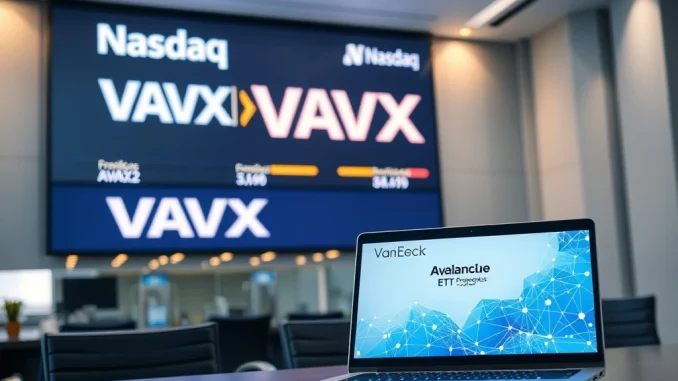
New York, January 26, 2026: In a definitive move that signals the next phase of institutional cryptocurrency adoption, asset management giant VanEck has launched the VanEck Avalanche ETF (VAVX). This pioneering product, now trading on the Nasdaq exchange, represents the first U.S. spot exchange-traded fund offering direct exposure to the Avalanche (AVAX) token while integrating a novel staking yield component. The launch marks a significant evolution beyond simple price-tracking crypto ETFs, introducing a hybrid model that combines asset appreciation potential with income generation directly within a regulated, transparent vehicle.
VanEck Avalanche ETF: A First-of-its-Kind Financial Instrument
The formal launch of the VanEck Avalanche ETF (VAVX) on January 26, 2026, culminates a strategic process that began with VanEck’s initial filing in March 2025. The fund is structured as a spot ETF, meaning it holds the underlying AVAX tokens directly, rather than derivatives or futures contracts. This structure provides investors with pure exposure to the token’s market price. However, the VAVX introduces a critical innovation: the fund actively stakes a portion of its AVAX holdings on the Avalanche network. This process, fundamental to proof-of-stake blockchains, involves participating in network validation to earn rewards, which are then passed through to ETF shareholders as yield.
Kyle DaCruz, Director of Digital Products at VanEck, framed the launch as a response to growing institutional demand. “We are excited to launch VAVX to provide investors with a publicly traded, transparent vehicle giving them access to a network that we believe will drive the next phase of institutional blockchain adoption,” DaCruz stated. The product specifically targets financial advisors and institutional investors who seek exposure to the potential of blockchain technology and its associated yields but wish to avoid the technical complexities and regulatory uncertainties of direct token ownership and staking.
Strategic Rationale: Why Avalanche Attracts Institutional Capital
VanEck’s selection of Avalanche as the underlying asset for this innovative ETF is not arbitrary. Since its mainnet launch in 2020 by Ava Labs, the Avalanche network has positioned itself as a high-performance, scalable alternative to Ethereum. Its consensus mechanism and unique architecture of multiple interoperable blockchains (subnets) enable high transaction throughput and low latency. This technological foundation has attracted significant enterprise and institutional development.
- Enterprise Adoption: Major entities like global banking giant Citi have experimented with tokenization projects on Avalanche. FIFA, the world’s governing body for soccer, has utilized the network for fan engagement platforms. Gaming studio Gunzilla Games is building on Avalanche for its flagship title.
- Technical Merits: The network’s modular design allows organizations to deploy custom blockchains tailored to specific needs while maintaining interoperability with the broader Avalanche ecosystem, a feature appealing to regulated institutions.
- Market Position: Despite a significant decline from its 2021 all-time high—a trend common across the crypto sector—Avalanche maintains a substantial market capitalization and developer community, indicating sustained ecosystem vitality.
By launching an ETF on Avalanche, VanEck is betting on the network’s utility and its role in the growing trend of real-world asset (RWA) tokenization and institutional blockchain infrastructure.
The Hybrid ETF Model: Tracking Price and Generating Yield
The VAVX ETF embodies a new generation of crypto investment products. Traditional spot Bitcoin or Ethereum ETFs offer exposure to price movement alone. The VAVX model is hybrid, aiming to deliver a “total return” strategy common in traditional finance but novel for crypto ETFs. The fund’s prospectus outlines a gross staking yield target of approximately 5.57%. This yield is generated from the network’s native inflation rewards and transaction fees, distributed to those who stake their AVAX to secure the network.
To incentivize early adoption, VanEck has implemented a compelling fee structure: a 0% management fee until the fund’s assets under management (AUM) reach $500 million. After that threshold, a 0.20% annual fee will apply. The fund launched with initial seed capital of $2.4 million. This aggressive pricing strategy is clearly designed to capture market share quickly and establish VAVX as the dominant vehicle for institutional Avalanche exposure.
The Evolving Landscape of Crypto Exchange-Traded Funds
The launch of VAVX occurs within a rapidly maturing ecosystem for cryptocurrency ETFs. Following the landmark approvals of spot Bitcoin ETFs in early 2024, the market has been anticipating the next wave of product innovation. VanEck’s move aligns with a broader industry shift toward yield-generating crypto products.
For instance, BlackRock recently filed paperwork for an “iShares Bitcoin Premium Income ETF,” which would combine Bitcoin exposure with an options-selling strategy to generate income. Eric Balchunas, a senior ETF analyst at Bloomberg Intelligence, noted this trend, describing the strategy as tracking Bitcoin’s price “while generating additional income through active management based on selling call options.”
These developments indicate that major asset managers are no longer content to offer simple beta exposure to crypto assets. They are now engineering products that incorporate the unique financial mechanics of blockchain, such as staking and decentralized finance (DeFi) strategies, wrapped in the familiar, regulated format of an ETF. This evolution bridges the gap between traditional finance’s demand for yield and the native yield-generating properties of proof-of-stake crypto networks.
Risk Considerations and Market Context
Despite the innovative structure and institutional backing, the VanEck Avalanche ETF carries significant risks, which are prominently disclosed in its regulatory filings. The document explicitly warns that an investment in the fund “may result in a total loss of capital.” These risks are multifaceted:
- Asset Volatility: AVAX, like all cryptocurrencies, is subject to extreme price volatility influenced by market sentiment, technological developments, and regulatory changes.
- Technology Risk: The fund’s performance is tied to the success and security of the Avalanche network. Potential software bugs, network attacks, or competitive displacement pose risks.
- Staking and Slashing: The process of staking involves locking tokens. While designed to generate yield, technical missteps or network penalties (“slashing”) could potentially lead to a loss of staked tokens.
- Regulatory Uncertainty: The regulatory treatment of staking rewards, both for the fund and its shareholders, remains an evolving area of tax and securities law.
The fund’s launch also intensifies competition among asset managers for dominance in the crypto ETF space. Grayscale has signaled intentions to launch a fund based on the BNB token, suggesting a race to offer ETFs on major alternative layer-1 blockchain networks beyond Bitcoin and Ethereum.
Conclusion: A Milestone for Institutional Crypto Finance
The launch of the VanEck Avalanche ETF (VAVX) is a landmark event that underscores the accelerating institutionalization of cryptocurrency markets. By creating a regulated, transparent vehicle that offers both direct asset exposure and integrated staking yield, VanEck has addressed a key demand from professional investors. This move validates Avalanche’s technological proposition and its growing relevance in enterprise blockchain adoption. More broadly, the VAVX ETF represents the maturation of crypto financial products, shifting from speculative instruments to sophisticated investment tools that harness the fundamental economic properties of blockchain networks. As this hybrid model gains traction, it is likely to set a new standard for what institutional investors expect from cryptocurrency exposure, further blurring the lines between traditional finance and the digital asset ecosystem.
FAQs
Q1: What is the VanEck Avalanche ETF (VAVX)?
The VanEck Avalanche ETF (ticker: VAVX) is the first U.S. spot exchange-traded fund that invests directly in the Avalanche (AVAX) cryptocurrency. It is unique because it also stakes those holdings to generate a yield for investors, combining price appreciation potential with income.
Q2: How does the staking yield work in the VAVX ETF?
The fund’s managers stake a portion of the ETF’s AVAX holdings on the Avalanche network. By participating in network validation (proof-of-stake), the fund earns rewards in the form of additional AVAX. These rewards contribute to the fund’s net asset value (NAV) and are targeted to provide a gross yield of approximately 5.57%.
Q3: What are the fees for investing in the VAVX ETF?
VanEck is waiving the entire 0.20% management fee until the fund’s assets under management reach $500 million. During this promotional period, the fee is 0%. After crossing the $500 million AUM threshold, the standard 0.20% annual fee will apply.
Q4: Why did VanEck choose Avalanche for this ETF?
VanEck selected Avalanche due to its high-performance technology, growing institutional adoption by firms like Citi and FIFA, and its position as a leading layer-1 blockchain for enterprise use cases and tokenization projects, signaling long-term utility beyond mere speculation.
Q5: What are the main risks of investing in the VAVX ETF?
Key risks include the high volatility of the AVAX token, potential technological failures or security breaches on the Avalanche network, risks associated with the staking process (like slashing penalties), and the evolving regulatory landscape for staking rewards and crypto securities.