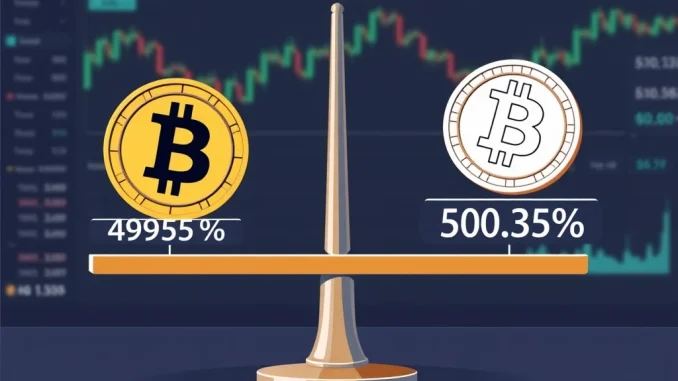
Global, April 2025: The latest BTC perpetual futures long/short ratio data from the world’s leading cryptocurrency derivatives exchanges reveals a market in near-perfect equilibrium, with traders displaying remarkably balanced sentiment toward Bitcoin’s immediate price direction. This crucial metric, often viewed as a barometer of market psychology, shows an aggregate positioning of 49.65% long versus 50.35% short across Binance, OKX, and Bybit. The data provides a transparent, real-time snapshot of how professional and retail traders are positioning themselves in the volatile crypto derivatives landscape, offering valuable context beyond simple spot price movements.
Decoding the BTC Perpetual Futures Long/Short Ratio
For newcomers and seasoned traders alike, understanding the long/short ratio requires foundational knowledge of perpetual futures contracts. Unlike traditional futures with set expiry dates, perpetual futures, or “perps,” allow traders to hold positions indefinitely, using a funding rate mechanism to tether the contract price to the underlying asset’s spot price. The long/short ratio measures the proportion of open interest held by traders betting on price increases (long) versus those betting on declines (short). It is a sentiment indicator, not a predictive tool. A ratio skewed heavily toward longs can signal over-optimism or potential for a long squeeze, while a dominant short position might indicate pervasive fear or set the stage for a short squeeze. The current near-even split suggests a market lacking strong consensus, where bulls and bears are locked in a tense standoff, awaiting a catalyst.
Exchange-by-Exchange Analysis of Trader Positioning
The aggregated data masks subtle but important variations between the three largest venues by open interest. A detailed breakdown shows distinct trader behaviors on each platform, which often cater to slightly different user demographics and geographic regions.
| Exchange | Long Positions | Short Positions | Net Sentiment |
|---|---|---|---|
| Binance | 50.04% | 49.96% | Marginally Bullish |
| OKX | 51.80% | 48.20% | Bullish |
| Bybit | 49.43% | 50.57% | Marginally Bearish |
| Overall Aggregate | 49.65% | 50.35% | Neutral to Slightly Bearish |
Binance, the global behemoth, shows a virtual dead heat. This micro-balance reflects its vast and diverse user base, where retail and institutional flows often cancel each other out. OKX displays the clearest bullish tilt among the trio. This could be influenced by regional sentiment in Asia, where OKX maintains a strong presence, or specific market events resonating with its user base. Conversely, Bybit traders lean slightly bearish. Bybit has cultivated a reputation as a platform favored by active, often leveraged, traders; this slight short bias may indicate a more tactical or risk-averse stance among that cohort. These disparities highlight why analyzing a single exchange’s data can be misleading—the full picture requires a multi-venue perspective.
Historical Context and Market Implications
To appreciate the current ratio, one must view it through a historical lens. During the bull market peaks of 2021 and late 2023, aggregate long/short ratios frequently exceeded 60% long, signaling extreme greed and crowded trades that often preceded significant corrections. Conversely, during the crypto winter of 2022, short ratios dominated, reflecting deep-seated fear and capitulation. The present equilibrium is historically associated with consolidation phases. It suggests the market is digesting previous moves, with neither side possessing overwhelming conviction. For market participants, this environment implies several things:
- Lower Implied Volatility: Balanced positioning can lead to compressed volatility as large, one-sided bets are absent.
- Susceptibility to News: A balanced market can react sharply to unexpected news, as it doesn’t take much to force one side to unwind.
- Funding Rate Dynamics: In a perfectly balanced perpetual futures market, funding rates tend to be neutral or slightly negative for shorts (as seen currently), as the system incentivizes the side with more open interest to pay the other.
This data point should never be used in isolation. Savvy analysts cross-reference it with other metrics like open interest volume (whether total interest is growing or shrinking), funding rates across timeframes, and options market data like the put/call ratio to build a robust view of market structure.
The Mechanics and Risks of Perpetual Futures Trading
Understanding the vehicle itself is key to interpreting the ratio. Perpetual futures are complex derivative instruments that offer high leverage—often up to 100x or more on some platforms. This leverage amplifies both gains and losses, making risk management paramount. The funding rate mechanism is the core innovation that allows these contracts to exist without an expiry. Typically every eight hours, traders on the side with greater open interest pay a fee to those on the opposite side. This payment encourages balance and helps peg the futures price to the spot price. When the long/short ratio is extremely skewed, funding rates can become exorbitant, making it very expensive to hold the popular side of the trade. The current near-even ratio results in minimal funding rate pressures, reducing one source of cost for traders holding positions.
Why This Data Matters for the Broader Crypto Ecosystem
The health and sentiment of the derivatives market have profound ripple effects across the entire cryptocurrency space. First, large derivatives positions can influence spot prices through arbitrage and hedging activities. Market makers and large institutions actively arbitrage between futures and spot markets, ensuring price discovery remains efficient. Second, derivatives trading volume now consistently surpasses spot volume on many days, meaning the sentiment and liquidity in futures markets are primary drivers of short-term price action. Finally, regulatory bodies globally are increasingly focused on crypto derivatives due to their complexity and risk to retail investors. Transparent, publicly available data like the long/short ratio aids in market surveillance and helps inform regulatory discussions about investor protection and systemic risk.
Conclusion
The latest BTC perpetual futures long/short ratio paints a picture of a cryptocurrency market at an inflection point, characterized by caution and a lack of directional conviction. The aggregate 49.65% long to 50.35% short split across Binance, OKX, and Bybit indicates a tense equilibrium where neither bulls nor bears have established clear dominance. This neutral sentiment, contextualized by historical extremes, suggests the market is in a consolidation phase, building energy for its next significant move. For traders and observers, this ratio serves as a vital piece of the market structure puzzle, emphasizing the importance of nuanced, multi-faceted analysis over reliance on any single data point in the dynamic world of crypto derivatives.
FAQs
Q1: What is a perpetual futures contract?
A perpetual futures contract is a derivative instrument that allows traders to speculate on an asset’s price without an expiry date. It uses a periodic “funding rate” payment between longs and shorts to keep its price aligned with the underlying spot market.
Q2: How is the long/short ratio calculated?
The ratio is calculated by dividing the total open interest held in long positions by the total open interest held in short positions, usually expressed as a percentage for each side. It is based on the value of open contracts, not the number of traders.
Q3: Does a high long ratio mean the price will go up?
Not necessarily. A very high long ratio is often a contrarian indicator, signaling that the market may be overly optimistic and crowded on one side. This can precede a “long squeeze” where falling prices force leveraged longs to liquidate, accelerating the decline.
Q4: Why do ratios differ between exchanges like Binance, OKX, and Bybit?
Differences arise from variations in user demographics (geographic, institutional vs. retail), platform-specific trading products, leverage offerings, and sometimes regional news or events that impact one user base more than another.
Q5: How often is this data updated?
Major exchanges typically update their long/short ratio data in real-time or at very short intervals (e.g., every few minutes). The 24-hour snapshot provides a smoothed-out view that reduces noise from short-term fluctuations.