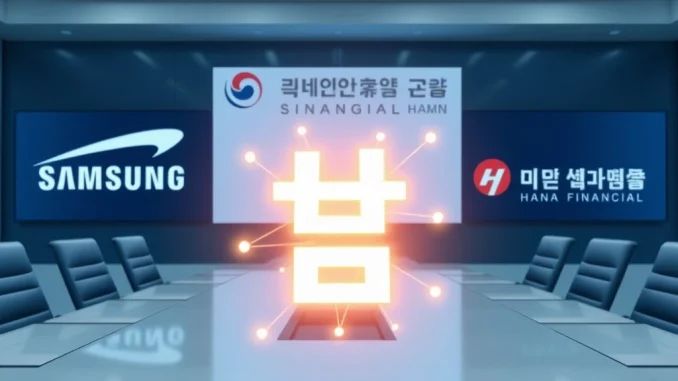
Seoul, South Korea – May 2025: In a move poised to reshape the landscape of digital finance, South Korean corporate titan Samsung has entered a landmark partnership with two of the nation’s largest financial groups, Shinhan Financial and Hana Financial. The consortium aims to establish a comprehensive framework for issuing, distributing, and utilizing a Korean won-backed stablecoin. This strategic initiative, first reported by Maeil Business Newspaper and confirmed by sources within the financial sector, represents a significant step towards creating a sovereign digital currency alternative to the dominant dollar-pegged stablecoins that currently govern the crypto economy.
Won Stablecoin Project Forges Unprecedented Consortium
The partnership formalizes an agreement between Shinhan Financial Executive Director Jin Ok-dong, Hana Financial Chairman Ham Young-joo, and Samsung’s leadership. Preparations for the initiative are now actively underway. Industry analysts view this tripartite alliance as a masterstroke, combining distinct yet complementary strengths. Shinhan and Hana Financial bring deep regulatory expertise, extensive banking infrastructure, and a profound understanding of domestic and international monetary flows. Their participation ensures the project is grounded in financial rigor and compliance from its inception.
Conversely, Samsung’s inclusion is the critical technological catalyst. Sources indicate the financial groups deemed Samsung’s participation essential for the project’s global competitiveness. The conglomerate’s prowess in semiconductors, consumer electronics, and software development provides a formidable technological foundation. Furthermore, Samsung’s vast overseas business network and strong brand recognition are seen as vital assets for distributing and legitimizing the won stablecoin beyond South Korea’s borders, directly challenging the entrenched position of dollar-based digital assets.
The Strategic Imperative Behind a Sovereign Digital Won
The drive to create a won stablecoin is not merely a technological experiment; it is a strategic financial and geopolitical maneuver. The global stablecoin market, valued in the hundreds of billions, is overwhelmingly dominated by tokens pegged to the US dollar, such as Tether (USDT) and USD Coin (USDC). This dominance extends the dollar’s influence into the burgeoning digital asset ecosystem, affecting exchange rates, liquidity, and monetary policy transmission worldwide. For a major export economy like South Korea, reliance on a foreign-denominated digital currency introduces unnecessary volatility and control risks.
A sovereign won stablecoin offers several compelling advantages:
- Reduced FX Risk: Korean businesses engaged in international trade could settle transactions in a digital won, mitigating costs and complexities associated with dollar conversion.
- Enhanced Payment Efficiency: Cross-border remittances and B2B payments could become faster and cheaper, leveraging blockchain’s inherent properties.
- Monetary Policy Tool: The Bank of Korea could gain new insights into money flow and potentially utilize the stablecoin framework for future Central Bank Digital Currency (CBDC) trials.
- Domestic Crypto Ecosystem Growth: It provides a stable, trusted on-ramp for Korean investors and developers, fostering a healthier local Web3 environment.
Navigating the Regulatory Landscape and Technical Hurdles
The consortium’s first major challenge will be navigating South Korea’s evolving and stringent regulatory framework for digital assets. The Financial Services Commission (FSC) has established clear guidelines for cryptocurrency exchanges and is progressively shaping policy for stablecoins. The involvement of Shinhan and Hana, two systemically important financial institutions, signals an intent to work within—and likely help shape—these regulations from the outset. Their credibility lends the project significant weight in regulatory dialogues.
On the technical front, critical decisions await. The partnership must choose between building on an existing public blockchain like Ethereum or Hedera (with which Shinhan has previously experimented) or developing a private, permissioned ledger. They must also engineer robust mechanisms for maintaining the won peg, involving transparent reserve audits and secure custody solutions for the underlying Korean currency reserves. Samsung’s expertise in secure hardware, such as its Knox platform, could be pivotal for safeguarding private keys and ensuring transaction integrity.
Global Context and Competitive Implications
South Korea’s move places it among a vanguard of nations actively exploring sovereign digital currency alternatives. Japan’s largest banks have launched yen-pegged stablecoin trials, while the European Union’s MiCA regulations create a pathway for euro-denominated stablecoins. This project, however, is unique due to the direct involvement of a global technology conglomerate like Samsung. It blurs the traditional lines between finance, technology, and industry in a way few other initiatives have.
The success of this won stablecoin could trigger a domino effect. Other export-driven economies may seek similar partnerships between their flagship corporations and financial institutions. For the existing dollar-pegged stablecoin issuers, the long-term threat is not immediate volume loss but the gradual erosion of their monopoly as credible national alternatives emerge. The battle for the future of digital money is increasingly becoming a battle of currencies, not just blockchains.
Conclusion
The partnership between Samsung, Shinhan Financial, and Hana Financial to develop a won stablecoin is a definitive signal that the digital asset revolution is entering a new, institutional phase. It moves beyond speculation and towards pragmatic financial infrastructure built by national champions. This initiative aims to harness blockchain technology for sovereign economic advantage, reducing dependency on dollar-based digital systems. While significant regulatory and technical hurdles remain, the combined authority, expertise, and global reach of this consortium make the prospect of a competitive Korean won stablecoin a formidable and imminent reality in the global financial landscape.
FAQs
Q1: What is a won stablecoin?
A won stablecoin is a type of cryptocurrency designed to maintain a stable value by being pegged 1:1 to the South Korean Won (KRW). It combines the programmability and transfer efficiency of digital assets with the price stability of a national fiat currency.
Q2: Why are Samsung, Shinhan, and Hana partnering on this?
Each partner brings critical strengths: Shinhan and Hana provide financial expertise, regulatory knowledge, and banking infrastructure. Samsung contributes cutting-edge technology, global business networks, and brand power, which are deemed essential for making the stablecoin competitive internationally.
Q3: How is this different from a Central Bank Digital Currency (CBDC)?
This is a privately issued stablecoin, backed by won reserves held by the consortium. A CBDC would be a digital form of cash issued directly by the Bank of Korea. This project could inform or coexist with a future Korean CBDC but is a separate, commercial initiative.
Q4: What are the main challenges for this project?
The primary challenges are regulatory compliance with South Korea’s strict digital asset laws, designing a technically secure and scalable blockchain system, and ensuring absolutely transparent and fully-backed reserves to maintain user trust in the peg.
Q5: How could this affect the average person or business in Korea?
If successful, it could lead to faster and cheaper international money transfers for individuals and businesses. It could also provide a safer, regulated gateway for Koreans to interact with the broader cryptocurrency market and potentially streamline corporate treasury and payment operations.