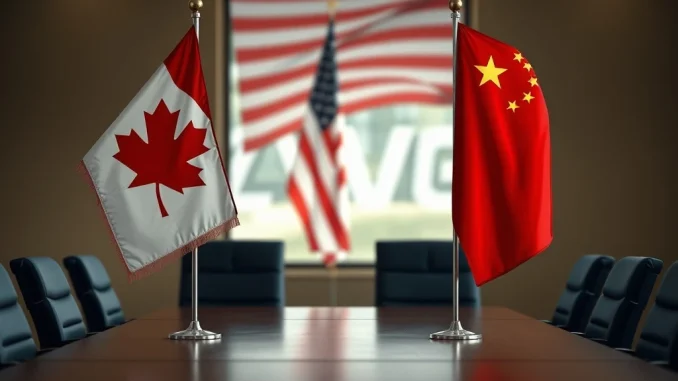
Ottawa, Canada – April 2025: In a definitive statement shaping North American trade policy, Canadian Prime Minister Mark Carney has confirmed his government has no plans to pursue a free trade agreement (FTA) with China. This crucial decision follows a stark public warning from former U.S. President Donald Trump, who threatened to impose 100% tariffs on Canadian goods if Ottawa moved forward with a China trade deal. The announcement, first reported by Solidintel, underscores the complex geopolitical and economic pressures defining Canada’s foreign trade strategy in a multipolar world.
Canada-China Free Trade Agreement: The Context of Carney’s Decision
Prime Minister Mark Carney’s rejection of a formal Canada-China free trade agreement is not an isolated policy shift. Instead, it represents the culmination of over a decade of evolving and often fraught trade relations between Ottawa and Beijing. Formal exploratory talks for a comprehensive FTA began in 2016 under Prime Minister Justin Trudeau but stalled repeatedly. Key sticking points included Chinese demands for greater access to Canada’s protected sectors, like dairy and cultural industries, and Canada’s concerns over China’s state-owned enterprises, intellectual property protections, and human rights record.
The diplomatic relationship faced severe strain following Canada’s 2018 arrest of Huawei CFO Meng Wanzhou at the behest of the United States. China’s subsequent detention of two Canadian citizens, Michael Kovrig and Michael Spavor, in what was widely viewed as retaliatory action, plunged relations into a deep freeze. Although the “Two Michaels” were released in 2021, the episode left a lasting scar on bilateral trust, making any ambitious trade pact politically sensitive within Canada.
The Trump Factor: A Direct Threat to US-Canada Trade
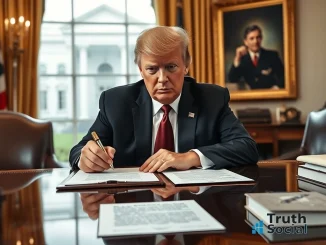
The immediate catalyst for Carney’s clear statement appears to be the intervention of Donald Trump. On his Truth Social platform, the former and potential future U.S. president issued a blunt warning. He stated that if Canada proceeded with a trade deal with China, his administration would respond by imposing 100% tariffs on all Canadian products entering the United States. Given the immense scale of the U.S.-Canada trade relationship, this threat carries significant economic weight.
- The US-Canada Trade Lifeline: The United States is Canada’s largest trading partner by an overwhelming margin. In 2024, two-way trade in goods and services exceeded $1.2 trillion CAD.
- Comparative Scale: Canada’s trade with China, while substantial, is less than one-fifth the size of its trade with the United States.
- Historical Precedent: During his first term, President Trump used tariffs as a primary tool of economic statecraft, including on Canadian steel and aluminum, causing significant market disruption.
For any Canadian government, the calculus is stark. Pursuing a potential future benefit with China cannot reasonably justify jeopardizing the foundational economic relationship with the United States, especially under a threat of total tariff warfare.
Analyzing Carney’s Strategic Calculus
Mark Carney, a former Governor of the Bank of Canada and the Bank of England, brings a deeply analytical, economics-first perspective to the Prime Minister’s office. His decision reflects a risk-management assessment of Canada’s national interests. On one side lies the theoretical promise of deeper access to the world’s second-largest economy. On the other is the concrete reality of preserving access to its largest and most integrated market. The choice, from a purely economic standpoint, is clear.
Furthermore, Carney’s statement allows his government to proactively manage a major geopolitical fault line. By taking the Canada-China free trade agreement off the table, he removes a potential point of major contention with the United States, regardless of who wins the next presidential election. This move reinforces Canada’s position within the US-led North American economic and security framework, a cornerstone of Canadian foreign policy since the Second World War.
The Broader Implications for Global Trade Dynamics
Canada’s decision is a microcosm of the larger fragmentation occurring in the global trading system. The era of hyper-globalization and multilateral consensus is giving way to an era of blocs, strategic competition, and economic security. Nations are increasingly forced to choose sides or navigate carefully between major powers. Canada’s experience highlights the pressures middle powers face when caught between the strategic rivalry of the United States and China.
This does not mean Canada will cease trading with China. Bilateral trade will continue under existing World Trade Organization (WTO) rules and the two countries’ 2014 Foreign Investment Promotion and Protection Agreement. However, the ambition for a comprehensive, next-generation FTA—one that could have set standards for digital trade, environmental goods, and labor—is now shelved indefinitely. This limits the potential for deeper economic integration and leaves numerous trade barriers in place.
Conclusion: A Pragmatic Pivot in Canadian Trade Policy
Prime Minister Mark Carney’s confirmation that there are no plans for a Canada-China free trade agreement is a decisive and pragmatic moment in Canadian economic policy. Driven by the overwhelming importance of the U.S. relationship and clarified by Donald Trump’s explicit tariff threat, the decision prioritizes economic stability and continental integration over uncertain gains in Asia. It reflects a sober understanding of Canada’s place in a world where trade is increasingly weaponized for geopolitical ends. While the door to enhanced cooperation with China is not fully closed, the path to a comprehensive free trade agreement is now clearly blocked, marking a significant realignment in Canada’s approach to global commerce and alliance management.
FAQs
Q1: What exactly did Prime Minister Mark Carney say about a Canada-China FTA?
Prime Minister Carney, through a statement reported by Solidintel, confirmed his government has “no plans to pursue a free trade agreement (FTA) with China.” This was a direct and unambiguous rejection of moving forward with formal FTA negotiations.
Q2: Why did Donald Trump threaten tariffs on Canada?
Former President Trump threatened to impose 100% tariffs on all Canadian products if Canada proceeded with a trade deal with China. This threat, made on Truth Social, is consistent with his “America First” trade philosophy and his view of China as a strategic rival, seeking to deter U.S. allies from deepening economic ties with Beijing.
Q3: Has Canada ever had a free trade agreement with China?
No, Canada and China have never had a comprehensive free trade agreement. They have a Foreign Investment Promotion and Protection Agreement (FIPA) from 2014, which governs investment rules, but not the broad elimination of tariffs on goods and services that an FTA would entail.
Q4: Does this mean Canada will stop trading with China?
Not at all. Canada and China will continue to be significant trading partners under existing WTO rules. The decision only halts the pursuit of a deeper, more integrated free trade agreement. Bilateral trade in commodities, manufactured goods, and other products will continue.
Q5: What are the main consequences of not having a Canada-China FTA?
The main consequences are missed opportunities for Canadian exporters to gain preferential, tariff-free access to the Chinese market in certain sectors, and for Chinese investors to have more predictable rules in Canada. It also means both countries will maintain higher trade barriers against each other compared to what an FTA would have dismantled, potentially putting Canadian exporters at a disadvantage versus competitors from countries that do have FTAs with China.