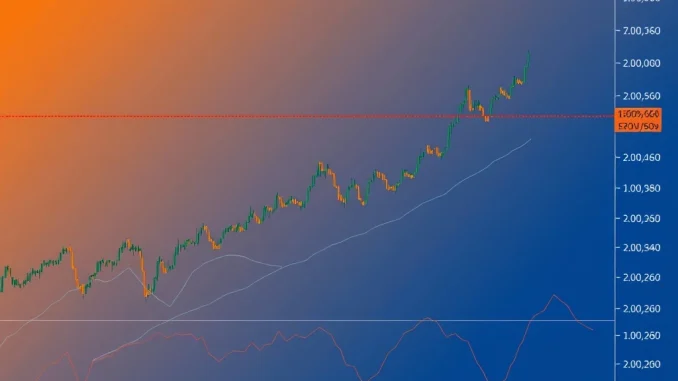
Global, May 2025: Ethereum, the world’s second-largest cryptocurrency by market capitalization, is navigating a pivotal technical juncture. On-chain data reveals the asset is approaching a historically significant support level that has remained unbroken through multiple market cycles. Concurrently, a notable increase in accumulation by large-scale investors, commonly referred to as ‘whales,’ suggests these market participants are interpreting the current price zone as a potential bottom. This convergence of technical and on-chain signals presents a critical moment for market structure analysis.
Ethereum Approaches a Historically Significant Support Line
Technical analysis of Ethereum’s price history identifies several key levels that have acted as major support and resistance. One level, in particular, has demonstrated remarkable resilience. This zone, established during previous bear market consolidations and subsequent bull market launches, has repelled significant downward pressure on multiple occasions. Market analysts track this level not merely as a price point but as a reflection of underlying network value and long-term holder conviction. The approach to this level in the current market cycle is drawing intense scrutiny because a breach could signal a fundamental shift in market structure, while a successful hold could reinforce its status as a foundational price floor.
The concept of ‘support’ in financial markets refers to a price level where buying interest is sufficiently strong to overcome selling pressure, halting a decline. For Ethereum, this specific support line is intertwined with the aggregate cost basis of long-term investors from prior cycles. When the market price trades near this aggregate cost basis, it often creates a zone of increased equilibrium, where sellers who are at breakeven become reluctant to sell at a loss, and value-oriented buyers perceive an opportunity.
Whale Wallet Activity and the Cost Basis Signal
Separate from chart-based technical analysis, on-chain analytics provide a real-time ledger of investor behavior. A key metric gaining attention is the realized price or cost basis of large Ethereum holders. Data from analytics platforms shows that the aggregate cost basis for wallets holding between 10,000 and 100,000 ETH has become a focal point. As Ethereum’s spot price has declined toward this aggregate cost basis, blockchain data indicates a measurable uptick in net inflows to these whale addresses.
This activity is significant for several reasons. First, whale wallets typically represent sophisticated entities such as investment funds, foundations, or early adopters with deep market knowledge. Their accumulation during price weakness often contrasts with retail investor sentiment, which can be more reactive to short-term volatility. Second, accumulation at or near the aggregate cost basis suggests these players view the risk-reward profile as favorable, believing the downside from this level is limited relative to long-term upside potential. Analysts monitor not just the volume of ETH moving but also the sources and destinations to distinguish between exchange transfers for potential selling and movements into cold storage for long-term holding.
- Net Position Change: Metrics show a net increase in ETH balance across cohorts of the largest non-exchange wallets over recent weeks.
- Exchange Outflows: The flow of ETH from centralized exchanges to private wallets has periodically spiked, indicating withdrawal for custody rather than immediate liquidation.
- Supply Concentration: The percentage of total ETH supply held by addresses exceeding certain thresholds has remained stable or increased slightly, suggesting consolidation.
The Mechanics of On-Chain Cost Basis Analysis
Understanding whale cost basis requires delving into on-chain methodology. Every ETH transaction is permanently recorded on the blockchain. By analyzing the price of ETH at the time each coin last moved, analysts can model the average acquisition price for any given wallet or cohort. When the market price falls below this average, the cohort is ‘out of the money’ on paper. Historically, when a large cohort like long-term whales falls into an unrealized loss position, selling pressure often diminishes, as these holders are less inclined to realize a loss. Conversely, if the price approaches their cost basis from below, it can create overhead resistance as holders break even and may choose to exit. The current scenario sees price approaching this key cohort’s cost basis from above, testing it as support.
Contextualizing the Potential Bottom Zone
Labeling any price zone a ‘potential bottom’ is an exercise in probabilistic analysis, not prediction. A confluence of factors, however, can increase the statistical likelihood of a market finding a durable low. The current situation presents such a confluence: a tested historical support level aligning with the cost basis of influential holders who are demonstrating accumulation behavior. Furthermore, macroeconomic conditions for risk assets, the evolving regulatory landscape for digital assets, and developments within the Ethereum ecosystem itself, such as network upgrade timelines and scaling solution adoption, all provide the backdrop against which this technical action is unfolding.
It is crucial to distinguish between a trading bottom and a long-term investment bottom. A trading bottom may involve a sharp, volatile reversal followed by further testing. A long-term bottom, often formed over weeks or months, is characterized by a transition from distribution (selling into rallies) to accumulation (buying into weakness), which the on-chain data currently hints at. This process ‘re-bases’ the asset at a higher cost foundation for a new cohort of investors, potentially setting the stage for the next cycle.
Historical Precedents and Market Psychology
Previous crypto market cycles offer context for the significance of whale accumulation at key levels. In late 2018 and again in mid-2022, periods of extreme bearish sentiment were accompanied by stealth accumulation by large holders, which was only clearly visible in on-chain data retrospectively. These periods preceded major trend changes. The market psychology at play involves ‘smart money’ accumulating assets when ‘weak hands’ capitulate due to fear or exhaustion. The public narrative often remains pessimistic at these junctures, creating a divergence between sentiment and the actions of the most capitalized participants.
The current market phase shares similarities with these historical moments, including negative funding rates in derivatives markets (indicating a prevalence of short bets) alongside steady or increasing coin accumulation in spot wallets. This divergence can create a coiled-spring effect if sentiment suddenly shifts, though timing such shifts remains notoriously difficult.
Conclusion
Ethereum’s approach to a historically robust support line, combined with on-chain signals of whale accumulation near their aggregate cost basis, marks a technically and behaviorally significant moment for the asset. This convergence suggests that sophisticated market participants are actively engaging with what they perceive as a high-value price zone. While no single indicator guarantees future price action, the alignment of a strong technical support level with demonstrable buying from influential holders provides a data-driven narrative for a potential bottom formation. Market participants will watch closely to see if this support line holds, which would reinforce its historical significance and likely validate the accumulation thesis, or if a breakdown occurs, necessitating a reassessment of the underlying value proposition. The coming weeks will be critical in determining the next major structural phase for Ethereum’s market.
FAQs
Q1: What is a ‘support line’ in cryptocurrency trading?
A support line is a price level where historical buying interest has been strong enough to prevent the asset’s price from falling further. It is a key concept in technical analysis, representing a zone where demand overwhelms supply.
Q2: How do analysts determine a whale’s cost basis?
Analysts use on-chain data to track when coins were last moved. By referencing the market price of ETH at the timestamp of that movement, they can estimate the acquisition price. Aggregating this data across all coins in a large wallet provides its average cost basis.
Q3: Does whale accumulation always lead to a price bottom?
No, it does not guarantee a bottom. While whale accumulation is a strong bullish signal, it is one of many factors. Macro conditions, broader market sentiment, and unforeseen events can override this signal. It indicates conviction from large players but does not ensure immediate price appreciation.
Q4: What is the difference between a trading bottom and an investment bottom?
A trading bottom is a short-term low, often V-shaped, that may be retested. An investment bottom is a longer process of consolidation and accumulation where the asset establishes a new, higher foundation of holder cost bases, which is more relevant for long-term trend changes.
Q5: Why is the aggregate cost basis of whales considered important?
It represents the average price at which a significant portion of the supply was acquired by major holders. The market price interacting with this level often triggers heightened activity, as these holders decide whether to add to positions, hold, or sell. It acts as a psychological and financial anchor for the market.