Global cryptocurrency markets entered a state of remarkable equilibrium on Thursday, March 13, 2025, as the latest BTC perpetual futures long/short ratio data from the world’s three largest derivatives exchanges revealed an almost perfect balance between bullish and bearish positions, creating what analysts describe as a ‘coiled spring’ market condition awaiting a decisive catalyst.
BTC Perpetual Futures Long/Short Ratio Analysis
The BTC perpetual futures long/short ratio represents one of the most closely watched sentiment indicators in cryptocurrency markets. This metric measures the percentage of open positions that are long (betting on price increases) versus short (betting on price decreases) across major trading platforms. The data from the past 24 hours shows an unprecedented level of balance across the three exchanges that collectively dominate Bitcoin derivatives trading volume worldwide.
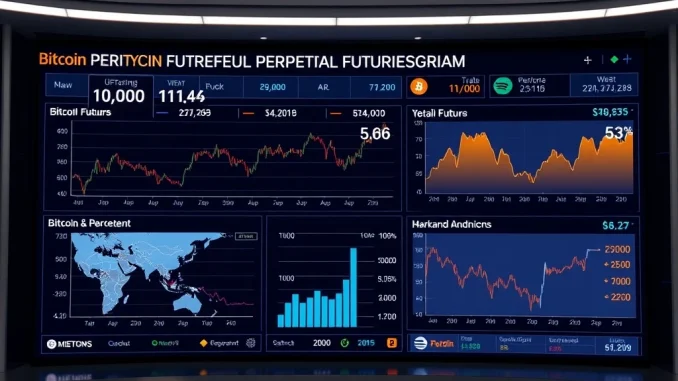
According to the latest aggregated data, the overall BTC perpetual futures long/short ratio stands at 49.74% long positions versus 50.26% short positions. This near-perfect equilibrium represents a significant departure from the extreme sentiment readings that typically characterize cryptocurrency markets. The balanced ratio suggests traders are adopting a cautious, wait-and-see approach amid several pending macroeconomic and regulatory developments.
Breaking down the data by exchange reveals subtle but important variations in trader positioning. Binance, the world’s largest cryptocurrency exchange by trading volume, shows a ratio of 50.07% long to 49.93% short. Bybit, known for its sophisticated derivatives products, reports 50.14% long versus 49.86% short. Meanwhile, OKX demonstrates the most bullish skew among the three, with 50.36% long positions against 49.64% short positions.
Understanding Perpetual Futures Market Mechanics
Perpetual futures contracts represent a cornerstone of cryptocurrency derivatives trading. Unlike traditional futures with expiration dates, perpetual contracts continue indefinitely, using a funding rate mechanism to maintain price alignment with the underlying spot market. The long/short ratio for these instruments provides crucial insight into market sentiment because it reflects the collective positioning of sophisticated traders who typically drive price discovery.
Historically, extreme readings in the BTC perpetual futures long/short ratio have often preceded significant market movements. When long positions dramatically outnumber short positions, markets become vulnerable to liquidation cascades during price declines. Conversely, when short positions dominate, markets become susceptible to short squeezes during upward price movements. The current balanced state suggests neither scenario presents an immediate risk, but the equilibrium creates conditions for explosive movement once a catalyst emerges.
Exchange-Specific Positioning and Market Implications
The subtle differences in BTC perpetual futures long/short ratios across exchanges reveal important nuances in global trader behavior. Binance’s nearly perfect balance reflects its status as the most liquid and globally accessible platform, attracting both retail and institutional participants. The exchange’s 50.07% long positioning suggests a marginal bullish bias among its diverse user base.
Bybit’s slightly more bullish ratio of 50.14% long positions aligns with its reputation for attracting more sophisticated derivatives traders who often employ complex strategies. OKX’s 50.36% long ratio, while still balanced, indicates the strongest bullish sentiment among the three major platforms, potentially reflecting regional trading patterns or platform-specific user demographics.
Market analysts note that such balanced ratios across multiple exchanges typically occur during consolidation periods or ahead of major market-moving events. The current data coincides with several pending developments, including potential regulatory clarity in major jurisdictions, upcoming Bitcoin network difficulty adjustments, and broader macroeconomic uncertainty surrounding interest rate policies.
Historical Context and Comparative Analysis
To understand the significance of the current BTC perpetual futures long/short ratio, we must examine historical patterns. During the 2021 bull market peak, long positions frequently exceeded 70% across major exchanges, creating extreme leverage vulnerability. Conversely, during the 2022 bear market trough, short positions sometimes surpassed 65%, setting the stage for dramatic short squeezes.
The current balanced state represents a maturation of cryptocurrency markets, with traders demonstrating more measured positioning. This equilibrium suggests several possibilities:
- Institutional influence has increased risk management discipline
- Market participants have learned from previous leverage-induced volatility
- Regulatory developments have encouraged more conservative positioning
- Macroeconomic uncertainty has created conflicting signals for traders
Comparative analysis with traditional financial markets reveals that such balanced sentiment readings often precede significant directional moves. In equity markets, balanced positioning between bulls and bears frequently indicates accumulation or distribution phases before trend establishment.
Technical and Fundamental Factors Influencing Positioning
Several technical and fundamental factors contribute to the current balanced BTC perpetual futures long/short ratio. From a technical perspective, Bitcoin has been trading within a well-defined range for several weeks, with neither bulls nor bears achieving decisive breakout momentum. This range-bound action naturally encourages balanced positioning as traders await clearer directional signals.
Fundamentally, conflicting narratives create uncertainty. Positive developments include increasing institutional adoption through spot Bitcoin ETF flows and growing recognition of Bitcoin as a digital store of value. Negative factors include regulatory uncertainty in key markets, environmental concerns about proof-of-work consensus, and competition from alternative digital assets.
The funding rates on perpetual futures contracts provide additional context. Currently, funding rates across major exchanges remain relatively neutral, neither excessively positive nor negative. This neutrality supports the balanced long/short ratio data, indicating that neither side is paying significant premiums to maintain their positions.
Risk Management Considerations for Traders
The balanced BTC perpetual futures long/short ratio presents both opportunities and risks for market participants. On one hand, the absence of extreme positioning reduces the immediate risk of liquidation cascades or short squeezes. On the other hand, the equilibrium suggests markets could move rapidly in either direction once a catalyst emerges, potentially catching unprepared traders off guard.
Experienced derivatives traders monitor several additional metrics alongside the long/short ratio:
- Open interest levels indicate total market exposure
- Liquidation heatmaps show potential price levels that could trigger mass liquidations
- Volume profiles reveal where trading activity concentrates
- Options skew measures the relative demand for puts versus calls
Current data shows open interest remaining elevated but stable, suggesting traders maintain significant exposure despite balanced sentiment. Liquidation heatmaps indicate clusters of potential liquidation levels both above and below current prices, creating potential volatility triggers in either direction.
Conclusion
The latest BTC perpetual futures long/short ratio data reveals a cryptocurrency market in careful balance, with traders demonstrating unprecedented equilibrium in their positioning across the world’s three largest derivatives exchanges. This balanced state reflects both market maturation and current uncertainty, creating conditions that could lead to significant volatility once a decisive catalyst emerges. Market participants should monitor this ratio alongside other derivatives metrics, as sustained deviation from current levels could signal the beginning of the next major trend in Bitcoin markets. The BTC perpetual futures long/short ratio serves as a crucial sentiment barometer, and its current balanced reading provides valuable insight into the collective mindset of the cryptocurrency trading community as it navigates an increasingly complex global financial landscape.
FAQs
Q1: What does the BTC perpetual futures long/short ratio measure?
The ratio measures the percentage of open perpetual futures positions that are long (betting on price increases) versus short (betting on price decreases) across cryptocurrency exchanges, serving as a key sentiment indicator for market participants.
Q2: Why is a balanced long/short ratio significant for Bitcoin markets?
A balanced ratio indicates neither bulls nor bears dominate market positioning, reducing immediate risks of liquidation cascades or short squeezes while potentially setting the stage for significant volatility once a catalyst breaks the equilibrium.
Q3: How do exchanges differ in their BTC perpetual futures long/short ratios?
While all three major exchanges show balanced ratios, OKX demonstrates the most bullish skew at 50.36% long, followed by Bybit at 50.14% long, with Binance showing near-perfect balance at 50.07% long.
Q4: What historical patterns are associated with extreme long/short ratios?
Historically, extreme long ratios (above 70%) have preceded liquidation cascades during price declines, while extreme short ratios (above 65%) have set up short squeezes during price rallies, making balanced ratios relatively rare and significant.
Q5: How should traders use the long/short ratio in their decision-making?
Traders should consider the ratio alongside other metrics like open interest, funding rates, and liquidation levels, using it as one component of a comprehensive market analysis rather than a standalone trading signal.