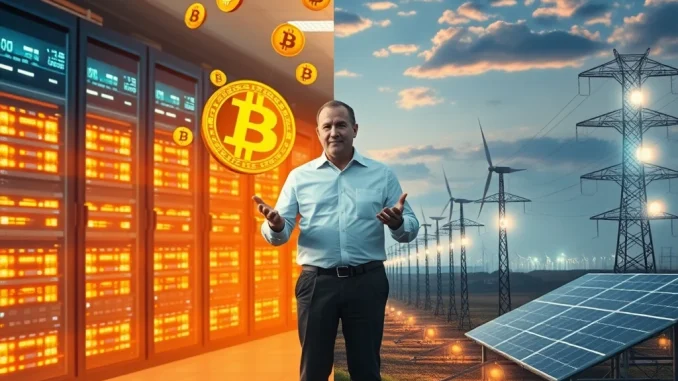
Prominent investor Kevin O’Leary has delivered a significant market analysis, suggesting a strategic pivot for 2025 portfolios. During a recent financial discussion reported by CoinDesk, the billionaire venture capitalist presented a compelling case for prioritizing energy infrastructure assets over direct Bitcoin exposure. This perspective arrives amid a complex global landscape defined by soaring computational demands from both cryptocurrency mining and artificial intelligence development. Consequently, O’Leary’s commentary provides a crucial framework for evaluating tangible infrastructure versus digital asset classes in the coming year.
Kevin O’Leary’s Bitcoin and Energy Investment Thesis
Kevin O’Leary, chairman of O’Leary Ventures, articulated a clear investment hierarchy based on current macroeconomic drivers. He identified the immense energy consumption required for Bitcoin’s proof-of-work consensus mechanism and for training advanced AI models as a primary investment theme. Therefore, he views the physical infrastructure that generates and transmits this power as a fundamentally superior asset class at present. “The picks and shovels of the digital age are energy assets,” O’Leary stated, drawing a historical analogy to the California Gold Rush. Meanwhile, he maintains a nuanced view on cryptocurrency, advocating for exposure through regulated public equities tied to its ecosystem.
The Converging Demand from Bitcoin and Artificial Intelligence
The core of O’Leary’s argument rests on an undeniable convergence of demand. Bitcoin’s network hashrate continues to reach record levels, requiring exponentially more electricity. Simultaneously, data centers powering large language models and generative AI are consuming power at an unprecedented scale. According to the International Energy Agency’s 2024 report, global electricity consumption from data centers, AI, and cryptocurrency could double by 2026. This creates a structural supply deficit. Consequently, companies involved in power generation, especially those utilizing nuclear, hydroelectric, and other stable baseload sources, are positioned for significant growth. Investors are now scrutinizing utility stocks and energy ETFs with renewed vigor.
Infrastructure Over Intangibles: A Risk-Adjusted Approach
O’Leary’s stance reflects a broader risk-assessment strategy favored by many institutional investors. Energy infrastructure represents a regulated, cash-flow-generating asset with predictable long-term contracts. In contrast, Bitcoin remains a highly volatile, speculative asset whose value is largely driven by sentiment and adoption narratives. For portfolio construction, adding stable infrastructure can provide a hedge against the volatility inherent in crypto markets. Furthermore, energy assets benefit from global electrification trends and governmental support for grid modernization, adding a layer of policy tailwinds absent in the cryptocurrency regulatory environment.
O’Leary’s Picks for Crypto Infrastructure Exposure
While cautious on direct Bitcoin ownership, Kevin O’Leary explicitly endorsed two key stocks for gaining exposure to the cryptocurrency ecosystem’s growth. He described Coinbase Global Inc. (COIN) as the likely primary beneficiary of clearer U.S. cryptocurrency regulation. Once regulatory frameworks solidify, O’Leary projects a wave of corporate and institutional clients will require custodial and trading services, potentially fueling Coinbase’s next growth phase. Additionally, he highlighted Robinhood Markets Inc. (HOOD) for its unique position as a unified platform. “Robinhood is building the best bridge for the next generation of investors who manage traditional stocks and crypto in a single interface,” he noted. This integrated approach could capture a significant segment of retail investor activity.
| Investment Avenue | O’Leary’s Assessment | Primary Catalyst |
|---|---|---|
| Energy Infrastructure | Top asset class for 2025 | Demand from Bitcoin mining & AI |
| Coinbase (COIN) | High-potential corporate gateway | Resolution of regulatory uncertainty |
| Robinhood (HOOD) | Best unified retail platform | Growth of hybrid stock/crypto users |
| Direct Bitcoin | Lower priority than energy | Speculative adoption & macro trends |
Market Context and Competing Expert Views
O’Leary’s perspective enters a lively debate among financial experts. Some analysts, particularly those from crypto-native firms, argue that Bitcoin itself is the ultimate scarce asset and a superior hedge against monetary inflation. They point to its fixed supply cap of 21 million coins. However, O’Leary’s view aligns with a more traditional value-investing philosophy that prioritizes cash-flowing assets during periods of economic uncertainty. It is also critical to note that his position is not outright bearish on Bitcoin’s long-term potential. Instead, it is a tactical allocation suggestion for the immediate term, emphasizing the foundational role of energy in enabling all future digital economies, whether they involve blockchain or AI.
The Regulatory Landscape’s Impact on Strategy
The unresolved regulatory environment in the United States significantly influences this investment thesis. The Securities and Exchange Commission’s delayed approval of spot Bitcoin ETFs and ongoing litigation with major exchanges like Coinbase creates headline risk for direct crypto assets. Conversely, energy infrastructure investments face their own regulatory hurdles, but they operate within long-established legal frameworks. This relative certainty is a key factor for risk-averse capital. O’Leary’s strategy effectively navigates this uncertainty by investing in the publicly traded companies that facilitate crypto access, which are subject to traditional securities laws, and in the energy sector that powers the entire digital transformation.
Conclusion
Kevin O’Leary’s analysis presents a pragmatic and experience-driven roadmap for 2025. By advocating for energy infrastructure over direct Bitcoin investment, he highlights a foundational truth of the digital age: computation requires immense power. His thesis leverages the convergent demand from Bitcoin mining and artificial intelligence as a durable macro trend. Furthermore, his endorsements of Coinbase and Robinhood provide a method for investors to maintain exposure to cryptocurrency’s growth narrative through regulated equities. Ultimately, this perspective underscores the importance of investing in the enabling infrastructure of technological revolutions, a strategy with a proven historical precedent. For portfolio managers and individual investors alike, balancing digital asset speculation with tangible infrastructure assets may be the shrewdest approach for the coming year.
FAQs
Q1: Is Kevin O’Leary saying Bitcoin is a bad investment?
No, O’Leary is not declaring Bitcoin a bad investment. He is making a relative value assessment for the current market environment. He believes capital allocated to energy infrastructure and related equities may offer better risk-adjusted returns in the near term compared to direct Bitcoin ownership, due to the sector’s explosive demand growth.
Q2: What specific types of energy assets is O’Leary referring to?
While not specifying individual companies, the context points to assets involved in reliable baseload power generation and transmission. This likely includes utilities with nuclear, hydroelectric, or natural gas portfolios, companies building grid-scale battery storage, and firms involved in modernizing electrical grid infrastructure to handle dense computational loads from data centers.
Q3: Why does O’Leary recommend Coinbase and Robinhood if he’s cautious on Bitcoin?
O’Leary distinguishes between the volatile cryptocurrency asset and the businesses that facilitate its trade. Coinbase and Robinhood are regulated public companies that generate revenue from transaction fees, subscriptions, and services. They offer a way to gain exposure to cryptocurrency adoption trends without holding the underlying volatile assets, and they benefit from scale as the ecosystem grows.
Q4: How does Artificial Intelligence (AI) factor into this energy demand?
Training and running advanced AI models, especially large language models, is computationally intensive and requires massive amounts of electricity in specialized data centers. This demand is growing concurrently with Bitcoin mining demand, creating competition for stable, low-cost power sources and straining existing grid capacity in many regions, thereby increasing the value of energy assets.
Q5: Has O’Leary’s view on Bitcoin changed over time?
Yes, O’Leary’s stance has evolved. He was initially a vocal skeptic of cryptocurrency. He later became a cautious advocate, allocating a small percentage of his portfolio to Bitcoin and discussing its role as an alternative asset class. His latest comments represent a further refinement, focusing on the infrastructural enablers of the crypto and digital economy rather than the speculative asset itself.