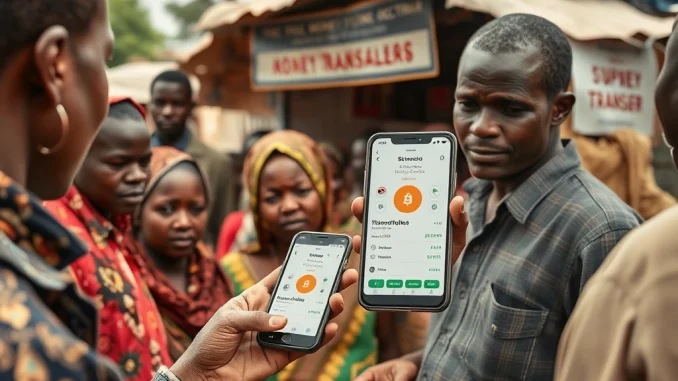
DAVOS, SWITZERLAND – January 2025. A striking declaration from a top global economist is reshaping the narrative around Africa’s financial development. Vera Songwe, a renowned economist and former UN Under-Secretary-General, asserted at the World Economic Forum that stablecoins have fundamentally shifted from a niche innovation to a cornerstone of economic resilience, now holding more practical importance for many Africans than traditional foreign aid. This pivotal statement highlights a dramatic technological and behavioral shift across the continent, where digital dollar-pegged currencies are solving long-standing problems of cost and access.
Stablecoins Redefine African Remittances and Financial Access
Vera Songwe’s analysis, reported by Cointelegraph, centers on the tangible, daily impact of blockchain-based currencies. She provided a clear comparison that underscores the transformation. Previously, sending $100 within African borders typically incurred a steep fee of around six dollars. Furthermore, the settlement process was often slow, sometimes taking several days. This created a significant burden for migrant workers and families relying on cross-border support. In contrast, Songwe detailed how stablecoins have slashed these fees to a fraction of their former cost while reducing settlement times from days to mere minutes or seconds. This efficiency is not a marginal improvement but a revolutionary change in liquidity flow.
Consequently, the volume of value transferred via these digital channels is experiencing exponential growth. Major payment corridors, such as Nigeria to Ghana or Kenya to Tanzania, are now increasingly facilitated by crypto exchanges and wallets supporting USDT or USDC. This shift is driven by pure utility. Users are adopting the technology because it demonstrably works better and cheaper than many legacy systems. The trend signals a move towards user-centric financial tools that prioritize speed and affordability over traditional institutional frameworks.
The Broader Context: Africa’s Digital Finance Revolution
This rise of stablecoins does not occur in a vacuum. It builds upon Africa’s established leadership in mobile money, with platforms like M-Pesa pioneering cashless transactions for millions. However, mobile money systems often remain siloed within national borders and can be expensive for cross-border transfers. Stablecoins, operating on global, permissionless blockchain networks, naturally bypass these geographical and institutional barriers. They act as a seamless digital bearer asset that can be sent peer-to-peer without intermediary banks.
Moreover, high inflation in several African currencies has increased demand for asset preservation. Citizens in countries with volatile local currencies are increasingly turning to dollar-pegged stablecoins as a digital safe haven. This use case extends beyond remittances into savings and commerce, providing a more predictable store of value. The technology empowers individuals to shield their wealth from local economic instability, a form of financial self-defense that traditional aid structures rarely provide directly.
Expert Insight: From Aid Dependency to Economic Agency
Songwe’s background as a UN official and development economist lends profound authority to her statement. Her perspective bridges the worlds of high-level policy and grassroots economic reality. By stating that stablecoins are “more important than aid,” she is not dismissing the critical role of humanitarian assistance during crises. Instead, she highlights a paradigm shift towards tools that foster long-term economic agency and independence. Aid is often reactive, addressing immediate needs. Stablecoins, however, are a proactive infrastructure that enables everyday earning, saving, and spending with greater efficiency.
This shift aligns with broader development goals of reducing poverty and boosting inclusive growth. When people can send and receive money cheaply, they can invest in businesses, education, and healthcare more effectively. The reduction in remittance fees alone represents billions of dollars annually staying within African families and communities rather than being lost to transaction costs. Financial experts note this retained capital has a powerful multiplier effect on local economies.
Comparative Analysis: Stablecoins vs. Traditional Systems
The advantages of stablecoin transfers become stark when placed side-by-side with conventional methods.
| Feature | Traditional Bank/Wire Transfer | Mobile Money (Cross-Border) | Stablecoin Transfer |
|---|---|---|---|
| Average Fee for $100 | $10 – $15 | $5 – $8 | <$1 |
| Settlement Time | 3-5 Business Days | 24-48 Hours | Seconds – Minutes |
| Access Requirements | Bank Account, ID | Mobile Phone, Agent Network | Smartphone, Internet |
| Geographic Reach | Limited by Corridors | Limited by Partnerships | Global/Internet-Based |
| Currency Stability | Subject to FX Rates | Subject to FX Rates | Pegged to USD/Euro |
Key challenges remain, including:
- Digital Literacy and Access: Requiring a smartphone and understanding of digital wallets.
- Regulatory Clarity: Governments are crafting policies to manage risks without stifling innovation.
- On/Off Ramps: Converting local currency to and from stablecoins easily is crucial for adoption.
Conclusion
The assertion by economist Vera Songwe that stablecoins now surpass aid in importance for Africa marks a critical moment in the continent’s financial evolution. It underscores a transition from dependency to digital empowerment. The core value proposition—dramatically lower costs and near-instant settlement for remittances—is addressing a fundamental economic pain point for millions. While regulatory and infrastructural hurdles persist, the user-driven adoption of this technology is building a more inclusive, efficient, and resilient financial landscape. The future of African finance is increasingly digital, and stablecoins are proving to be a vital component of that new architecture.
FAQs
Q1: What exactly is a stablecoin?
A stablecoin is a type of cryptocurrency designed to have a stable value, typically pegged to a reserve asset like the US dollar (e.g., USDT, USDC). This minimizes the price volatility seen in other cryptocurrencies like Bitcoin.
Q2: Why are stablecoins particularly useful in Africa?
They offer a fast, low-cost method for cross-border remittances, a digital store of value against local currency inflation, and greater financial access for those with limited banking services.
Q3: Is it legal to use stablecoins in African countries?
Regulations vary significantly by country. Some nations, like Nigeria and Kenya, have established regulatory frameworks, while others are still developing policies. Users must always check local laws.
Q4: How do stablecoins compare to mobile money like M-Pesa?
Mobile money is fantastic for domestic transactions but can be costly and slow for international transfers. Stablecoins excel at borderless, global transactions on the internet, often at a lower cost.
Q5: What are the main risks of using stablecoins?
Risks include potential regulatory changes, the technical risk of losing private keys to a digital wallet, and the need to trust the issuer of the stablecoin to properly hold the reserve assets backing it.