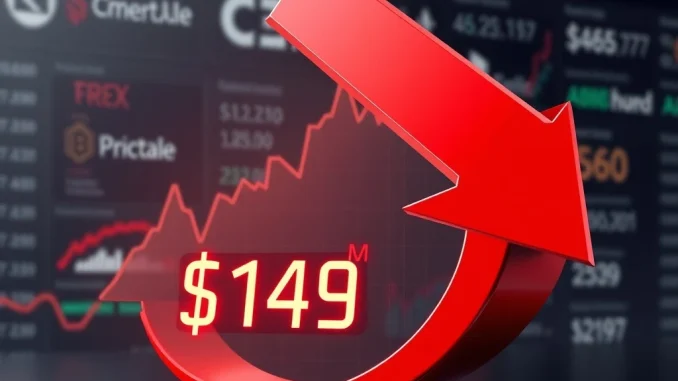
Global cryptocurrency markets experienced a severe shockwave on [Current Date], as a staggering $149 million worth of leveraged futures contracts faced forced liquidation within a single hour. This intense event, primarily concentrated across major exchanges like Binance, Bybit, and OKX, underscores the inherent volatility and amplified risks present in derivative trading. Consequently, the rapid price movements that triggered these liquidations have prompted immediate analysis from traders and risk managers worldwide.
Crypto Futures Liquidated: Anatomy of a $149 Million Hour
The $149 million liquidation figure represents positions that exchanges automatically closed due to insufficient collateral, or margin. When traders use leverage to amplify their bets, even small price swings can trigger margin calls. In this case, a sharp, coordinated price movement likely cascaded through the market. For instance, long positions betting on price increases suffered the most significant damage. Data from tracking platforms like Coinglass confirms the majority of the liquidated value came from these bullish bets. This event serves as a powerful reminder of the double-edged nature of leverage in digital asset markets.
Furthermore, the scale of this hourly event becomes clearer within a broader context. Over the preceding 24-hour period, total liquidations reached $303 million. This indicates sustained pressure rather than an isolated flash crash. Market analysts often examine the long/short ratio of liquidations to gauge sentiment. A dominance of long liquidations, as seen here, typically suggests a rapid transition from bullish optimism to forced selling. Such data provides critical, real-time insight into market leverage and potential overextension.
Understanding the Mechanics of Futures Liquidation
To comprehend the $149 million event, one must understand the mechanics of futures trading. Traders post a fraction of a contract’s total value as collateral. This practice allows for control of large positions with relatively little capital. However, if the market moves against their position and their collateral falls below a maintenance margin level, the exchange intervenes. The platform then forcibly closes the position to prevent losses exceeding the trader’s initial stake. This process is the liquidation event now visible on public data feeds.
- Leverage Multiplier: Using 10x leverage means a 10% price move against the position can trigger 100% loss.
- Liquidation Price: The specific price point where a position becomes under-collateralized and subject to automatic closure.
- Cascade Effect: Large liquidations can create selling pressure, pushing prices further and triggering more liquidations in a feedback loop.
Major exchanges employ slightly different risk engines, but the core principle remains universal. The speed of this process, especially during high volatility, often leaves traders with no opportunity to add funds. Therefore, risk management through stop-loss orders and conservative leverage is paramount.
Expert Analysis on Market Structure and Risk
Financial risk analysts point to several contributing factors behind such liquidation clusters. First, elevated levels of aggregate open interest across futures markets often precede volatility spikes. When many leveraged positions exist, the market becomes more fragile. Second, the lack of a clear, singular catalyst—like major regulatory news—can point to a technical market correction. In this environment, algorithmic trading systems may have accelerated the move. Historical data from previous cycles, such as the sell-offs in May 2021 and November 2022, show similar patterns of leveraged long positions being rapidly unwound.
Moreover, the concentration of liquidations on a few major platforms is telling. It highlights the centralized nature of crypto derivatives liquidity. A price movement on Binance Futures can quickly propagate to other venues through arbitrage bots. This interconnectedness means localized volatility can become systemic within minutes. Analysts from firms like Glassnode and CryptoQuant routinely stress monitoring estimated leverage ratios and funding rates as early warning indicators for such events.
Immediate Impacts and Broader Market Consequences
The immediate impact of the $149 million liquidation hour was a noticeable spike in market volatility indices. The Bitcoin Volatility Index (BVOL) and similar metrics for Ethereum likely recorded sharp increases. For spot traders, this resulted in wider bid-ask spreads and potential slippage on orders. Meanwhile, the forced selling from liquidations applied additional downward pressure on asset prices, potentially exacerbating the initial move.
Beyond price action, these events impact market sentiment and participant behavior. Retail traders with liquidated accounts may withdraw from the market temporarily, reducing liquidity. Conversely, institutional risk managers often tighten margin requirements after such episodes. This can lead to a short-term deleveraging of the entire market ecosystem. The table below contrasts key metrics from this event with a previous significant liquidation cluster.
| Metric | Current Event (1-Hour) | Comparable Past Event (e.g., Nov 2022) |
|---|---|---|
| Total Value Liquidated | $149 Million | $350 Million+ |
| Dominant Side | Longs | Longs |
| Primary Assets | BTC, ETH, SOL | BTC, ETH |
| 24-Hour Context | $303 Million | $1 Billion+ |
Furthermore, derivatives data reveals shifts in trader positioning post-event. Funding rates for perpetual swaps, which had been positive, often turn negative as bullish leverage is purged. This reset can create a more stable foundation for price discovery, albeit after a painful correction for over-leveraged participants.
Risk Management Lessons for Traders
Events like the $149 million liquidation hour provide critical, real-world lessons for all market participants. The foremost lesson is the absolute necessity of using risk management tools. Stop-loss orders, while not immune to gaps, provide a defined exit point. Position sizing is equally crucial; risking only a small percentage of capital on any single trade ensures survival through volatility. Additionally, understanding the relationship between leverage multiplier and liquidation price is non-negotiable for futures traders.
Many seasoned traders also monitor aggregate market data. High open interest combined with extreme funding rates often signals a crowded trade. This scenario increases the probability of a violent long or short squeeze. Tools like the estimated leverage ratio and the liquidation heatmap offered by various analytics platforms can inform more defensive positioning. Ultimately, preserving capital during such chaotic periods is more important than capturing every potential gain.
Conclusion
The liquidation of $149 million in crypto futures within one hour stands as a stark testament to the market’s volatile and unforgiving nature. This event, stemming from a rapid price move and excessive leverage, triggered a cascade of forced selling that impacted broader market dynamics. Analysis reveals it was part of a larger $303 million deleveraging over 24 hours, predominantly affecting overconfident long positions. While painful for those involved, such events serve to recalibrate market leverage, realign derivatives metrics like funding rates, and reinforce the timeless principles of prudent risk management. As the cryptocurrency market matures, the frequency and scale of these liquidations will remain a key indicator of speculative excess and systemic risk.
FAQs
Q1: What does “futures liquidated” mean in cryptocurrency?
A1: It means an exchange has forcibly closed a leveraged futures position because its value fell below the required maintenance margin. The trader loses their collateral, and the exchange sells the position to prevent further loss.
Q2: Why did $149 million get liquidated in just one hour?
A2: A sharp, rapid price movement triggered margin calls for many highly leveraged positions simultaneously. This likely created a cascade, where the initial liquidations caused more selling pressure, pushing prices further and triggering even more liquidations.
Q3: Who loses money when futures are liquidated?
A3: The traders who held the liquidated positions lose the collateral they posted to open them. The exchange does not typically lose money, as its automated system closes the position to cover the debt.
Q4: How can traders avoid being liquidated?
A4: Key strategies include using lower leverage multipliers, employing stop-loss orders, maintaining ample collateral above the maintenance margin, and actively monitoring position health, especially during high volatility.
Q5: Are large liquidations like this bad for the overall crypto market?
A5: They cause short-term pain and volatility but can have a neutralizing long-term effect. They purge excessive leverage, reset overextended derivatives metrics, and can lead to a healthier, less fragile market structure once the deleveraging is complete.