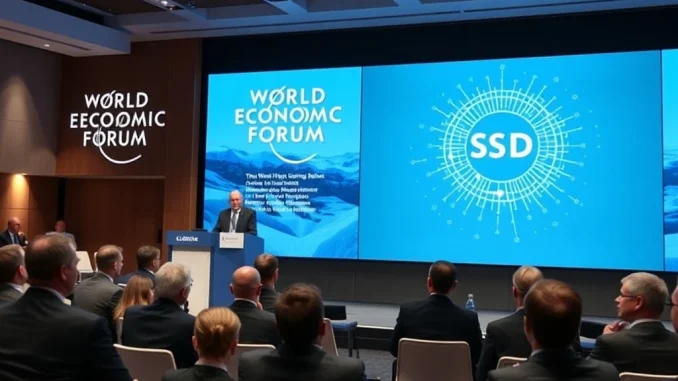
DAVOS, SWITZERLAND – January 2026. In a forceful rebuttal to mounting regulatory anxiety, Circle CEO Jeremy Allaire has labeled widespread fears about stablecoin stability as “totally absurd.” Speaking at the World Economic Forum’s high-profile crypto finance panel, Allaire positioned dollar-backed digital assets not as a systemic threat, but as an essential pillar for modernizing global financial infrastructure. His comments directly challenge warnings from major banking institutions that have circulated through regulatory circles for months.
Stablecoin Fears Meet a Reality Check in Davos
Jeremy Allaire’s Davos appearance marked a significant escalation in the ongoing dialogue between traditional finance and the cryptocurrency sector. The banking industry, represented by institutions like Bank of America, has repeatedly voiced concerns that yield-bearing stablecoins could trigger massive deposit outflows. Specifically, analysts have projected potential outflows reaching $6 trillion if such products gain widespread regulatory approval and adoption. However, Allaire countered this narrative with a compelling historical parallel.
He pointed to the coexistence of American money market funds and the traditional banking system as definitive proof that new financial instruments do not inherently destabilize established ones. “Money market funds currently hold over $7 trillion in assets,” Allaire stated. “Their existence alongside banks for decades demonstrates that financial systems can successfully integrate complementary products without triggering collapses.” This comparison forms the core of his argument against what he views as alarmist rhetoric.
The Technical Foundation Versus Political Debate
The debate, according to Allaire, has shifted from technical feasibility to political will. The technical mechanisms for ensuring stablecoin transparency and liquidity, he argues, are already well-developed. Circle’s USDC, for instance, publishes monthly attestation reports from independent accounting firms, detailing the composition and value of its reserve assets. This level of operational transparency often exceeds the public disclosure standards of many traditional financial products.
Meanwhile, U.S. legislators continue to deliberate the Clarity Act, a proposed bill designed to establish a comprehensive federal regulatory framework for payment stablecoins. The legislative process has exposed a fundamental rift: one side views stablecoins as a risky innovation requiring stringent containment, while the other, championed by Allaire, sees them as a necessary evolution. The outcome of this political struggle will likely determine the pace at which tokenized finance integrates with mainstream economies.
From Wall Street Balance Sheets to Programmable Credit
The underlying tension stems from a profound structural shift in global credit markets. For decades, commercial banks served as the primary intermediaries for credit creation, holding loans on their balance sheets. The modern trend, however, sees credit increasingly originating in capital markets through securitization and, more recently, tokenization. This transition moves risk and allocation from opaque bank ledgers to transparent, programmable blockchains.
In the United States, a substantial portion of recent economic growth has been financed through market-based debt instruments rather than traditional bank loans. Stablecoins like USDC are emerging as the critical liquidity layer for this new paradigm. They act as a neutral, digital dollar settlement asset that operates 24/7 across global borders. This functionality makes them indispensable for the real-time settlement required in tokenized markets for bonds, equities, and real-world assets.
Key distinctions between traditional and crypto-native finance include:
- Transparency: Blockchain-based reserves are verifiable in real-time, unlike traditional fractional reserve systems.
- Compliance: Leading stablecoins like USDC integrate identity verification at the protocol level.
- Liquidity: Digital assets enable instant, global settlement without intermediary banking hours.
This evolution does not render banks obsolete. Instead, it redefines their role. Banks may increasingly become custodians of blockchain-based assets and providers of specialized services, while the core mechanisms of credit allocation and payment become more open, competitive, and software-driven.
Arch Blockchain: Building for an AI-Driven Financial Future
Perhaps the most forward-looking segment of Allaire’s Davos presentation focused on artificial intelligence. He posited that the next major user base for stablecoins will not be humans, but autonomous AI agents. “Billions of AI agents will require a native, programmable, and stable means of payment,” Allaire explained. “In my view, there is currently no alternative to stablecoins to accomplish this.”
This vision anticipates a future where AI agents conduct economic activity—negotiating contracts, purchasing computational resources, or managing investment portfolios. These agents will need to transact with each other and with human-controlled entities using a currency that is both digitally native and price-stable. Traditional fiat currencies, bound to legacy banking rails, lack the programmability. Volatile cryptocurrencies like Bitcoin lack the stability. Stablecoins, therefore, emerge as the only viable candidate for a machine-readable medium of exchange.
To service this future, Circle is developing “Arch,” a new blockchain specifically architected for high-volume, low-cost transactions between autonomous AI agents and applications. Arch aims to provide the settlement layer for an internet of economically enabled AIs, with stablecoins like USDC serving as the universal monetary language. This project underscores a strategic bet that the convergence of AI and crypto will create unprecedented demand for robust digital dollar infrastructure.
Industry Consensus on an AI-Crypto Convergence
Allaire is not alone in this assessment. Other prominent figures in the crypto space, including former Binance CEO Changpeng Zhao and Galaxy Digital founder Mike Novogratz, have publicly echoed the sentiment that AI will become a primary driver of cryptocurrency utility. The logic is straightforward: AI agents operate in digital environments and require digital-native tools. This shared perspective suggests a growing industry alignment around a post-human use case that could dwarf current adoption metrics.
Davos 2026: Five Key Data Points on Finance’s Future
The discussions in Davos crystallized several critical metrics and projects that will shape the next decade of finance.
| Metric | Significance |
|---|---|
| $7 Trillion | Assets in U.S. money market funds, demonstrating non-bank financial stability. |
| $6 Trillion | Bank deposits cited as potentially at risk from stablecoin yields. |
| Arch Blockchain | Circle’s new network designed for AI-to-AI and AI-to-application transactions. |
| USDC | The regulated stablecoin acting as a bridge between traditional and crypto finance. |
| Clarity Act | The pending U.S. legislation that will define the regulatory future of stablecoins. |
The narrative of direct opposition between crypto and traditional finance is gradually fading. As noted by Silicon Valley investor David Sacks during the forum, the era of separation is ending. The emerging model is one of hybrid finance—a collaborative ecosystem where regulated entities like Circle provide the compliant digital dollar layer, while traditional banks, asset managers, and new fintech firms build innovative services on top. In this future, code enforces trust, and programmable money enables efficiency gains across every sector of the global economy.
Conclusion
Jeremy Allaire’s robust defense at Davos 2026 highlights a pivotal moment for stablecoin integration. Framing fears of bank runs as “absurd,” he anchored his argument in historical precedent, current technical capability, and a clear vision for an AI-driven future. The path forward hinges less on technological hurdles and more on regulatory clarity and political compromise. As the debate moves from hypothetical risks to practical implementation, stablecoins like USDC are poised to become the indispensable settlement layer connecting legacy finance, the crypto economy, and the autonomous digital agents of tomorrow. The stablecoin fears of today may well be remembered as the growing pains of a financial system undergoing its most significant upgrade in generations.
FAQs
Q1: What was the main argument Circle’s CEO used against stablecoin fears?
Jeremy Allaire argued that fears of stablecoins causing bank runs are “totally absurd” by pointing to the peaceful coexistence of money market funds and traditional banks. He noted that U.S. money market funds hold over $7 trillion without destabilizing the banking system, suggesting well-regulated stablecoins can integrate similarly.
Q2: What is the Clarity Act and why is it important?
The Clarity Act is proposed U.S. legislation aimed at creating a federal regulatory framework for payment stablecoins. Its importance lies in providing legal certainty, which would allow compliant stablecoin issuers like Circle to operate at scale and encourage broader institutional adoption within clear regulatory guardrails.
Q3: How do stablecoins like USDC serve as a “bridge” between finance sectors?
Stablecoins act as a bridge by providing a digital, dollar-pegged asset that is native to blockchain networks. This allows traditional financial institutions to interact with crypto markets and DeFi applications using a familiar unit of account, while also providing the crypto economy with a stable, compliant settlement asset connected to the traditional banking system.
Q4: What is Circle’s “Arch” blockchain and who is it for?
Arch is a new blockchain being developed by Circle specifically to facilitate transactions between autonomous artificial intelligence agents and applications. It is designed for a future where AI entities require a programmable, stable, and digital-native currency like a stablecoin to conduct economic activity independently.
Q5: Why do critics fear yield-bearing stablecoins?
Critics, often from traditional banking, fear that if stablecoins can offer attractive interest yields, they could incentivize massive withdrawals from bank savings accounts into these digital alternatives. This could theoretically reduce bank deposit bases, potentially affecting their lending capacity and overall financial stability, though this fear is contested by stablecoin advocates.