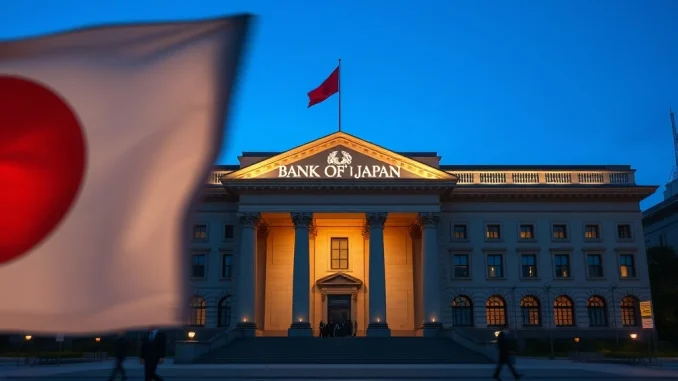
TOKYO, JAPAN – March 2025. The Bank of Japan (BOJ) has decisively held its benchmark short-term interest rate at 0.75%, a pivotal move that maintains its cautious monetary policy stance amidst swirling global economic crosscurrents and persistent domestic inflation concerns. Consequently, this decision reinforces the central bank’s commitment to a measured normalization path, directly impacting currency markets, government bond yields, and broader financial stability across Asia.
Bank of Japan Interest Rate Decision: A Detailed Analysis
The BOJ’s Policy Board concluded its two-day meeting with a unanimous vote to maintain the uncollateralized overnight call rate at 0.75%. This key rate serves as the primary lever for monetary conditions in the world’s fourth-largest economy. Moreover, the central bank also kept its yield curve control (YCC) parameters unchanged, continuing to target a 10-year Japanese Government Bond (JGB) yield around 1.0% with flexible upper and lower bounds. This dual-policy steadiness arrives after a series of incremental hikes that began in 2022, marking the end of the global era of ultra-low and negative interest rates.
Governor Kazuo Ueda, in his subsequent press conference, emphasized data-dependent forward guidance. He stated the bank would patiently continue monetary easing as it closely monitors the virtuous cycle between wages and prices. Importantly, recent data shows core inflation, which excludes fresh food, hovering at 2.8% year-on-year, still above the BOJ’s 2% target. However, the bank’s latest quarterly outlook report projects inflation to gradually moderate toward its target by mid-2026, justifying its current patient stance.
The Global Context of Monetary Policy Divergence
This BOJ decision occurs against a complex global backdrop. While other major central banks like the Federal Reserve and the European Central Bank have paused or even begun cutting rates, Japan’s path remains distinct. The BOJ’s 0.75% rate, therefore, creates a significant interest rate differential with the United States, where the Fed Funds rate sits higher. This differential fundamentally influences capital flows and currency valuations. For instance, the Japanese yen (JPY) initially weakened against the US dollar following the announcement, trading above 152 yen per dollar, a level that historically prompts verbal intervention from Japanese finance officials.
Impacts on the Japanese Economy and Financial Markets
The decision to hold rates has immediate and profound effects. Firstly, it provides stability for Japan’s massive public debt, which exceeds 250% of GDP. Higher interest rates would dramatically increase debt-servicing costs for the government. Secondly, it offers continued support for business investment and consumer spending by keeping borrowing costs relatively low. Major Japanese corporations, particularly exporters, benefit from a weaker yen that boosts overseas earnings when repatriated.
- Government Bonds: The 10-year JGB yield stabilized around 0.95%, well within the BOJ’s target band.
- Equity Markets: The Nikkei 225 index showed muted reaction, reflecting a market that had largely priced in the status quo.
- Banking Sector: Domestic banks, which profit from a steeper yield curve, welcomed the stability.
- Consumer Loans: Mortgage and lending rates for households are expected to remain steady.
Furthermore, the BOJ’s asset purchase program, though scaled back from its peak, continues to provide liquidity. The bank’s balance sheet remains the largest among major central banks as a percentage of GDP, a legacy of its aggressive quantitative and qualitative easing (QQE) program launched over a decade ago.
Expert Analysis and Forward Guidance
Leading economists and market strategists have dissected the BOJ’s communication. “The bank is clearly in a data-watching mode,” noted Dr. Akira Sato, Chief Economist at the Daiwa Institute of Research. “Their primary focus is ensuring that wage growth, which saw a 3.6% increase in this year’s Shunto spring negotiations, translates into sustainable demand-driven inflation, not just cost-push inflation from imported energy.” This analysis highlights the BOJ’s unique challenge: fostering a permanent shift in Japan’s decades-long deflationary mindset.
Market pricing, according to Bloomberg surveys, now suggests a high probability of the next rate hike occurring in the third quarter of 2025, contingent on inflation and wage data. The BOJ’s own forward guidance removed specific date-based references, instead emphasizing a commitment to accommodative financial conditions. This flexible approach allows the bank to react nimbly to unforeseen economic shocks, whether from geopolitical tensions, commodity price spikes, or sudden shifts in global demand.
| Date | Policy Action | Overnight Call Rate | Primary Context |
|---|---|---|---|
| Dec 2022 | First Hike in 17 Years | 0.00% to 0.10% | Global inflation surge |
| Jul 2023 | Policy Adjustment | 0.10% to 0.25% | YCC band widening |
| Mar 2024 | Rate Hike | 0.25% to 0.50% | Strong wage growth data |
| Oct 2024 | Rate Hike | 0.50% to 0.75% | Sustained inflation above target |
| Mar 2025 | Hold Steady | 0.75% (Unchanged) | Assessment of policy impact |
The Road Ahead: Risks and Considerations
Several risks cloud the horizon. A sharp, unanticipated appreciation of the yen could hurt exporters and dampen growth. Conversely, a disorderly depreciation could import excessive inflation and strain household budgets. Additionally, the health of the global economy, particularly slowdowns in China and Europe, poses external demand risks for Japanese exports. The BOJ must also navigate the gradual reduction of its enormous balance sheet—a process known as quantitative tightening (QT)—without disrupting market functioning. This delicate balancing act requires impeccable timing and clear communication to avoid volatility.
Conclusion
The Bank of Japan’s decision to hold its benchmark interest rate at 0.75% represents a strategic pause in its normalization journey. It underscores a patient, evidence-based approach to monetary policy aimed at securing stable, demand-driven inflation without jeopardizing fragile economic growth. This steady hand provides crucial predictability for businesses, investors, and policymakers navigating an uncertain global landscape. Ultimately, the BOJ’s future moves will hinge on the evolving data for wages, prices, and economic activity, with the 0.75% rate serving as a foundational pillar for the next phase of Japan’s monetary policy.
FAQs
Q1: Why did the Bank of Japan decide to hold interest rates steady?
The BOJ held rates to assess the cumulative impact of its previous hikes on the economy and inflation. It seeks more evidence that wage growth is fueling sustainable price increases before tightening policy further.
Q2: How does the 0.75% rate affect the Japanese yen?
The decision, maintaining a wide interest rate gap with the US, typically exerts downward pressure on the yen. A weaker yen boosts export profits but increases the cost of imported goods and energy for consumers.
Q3: What is the Bank of Japan’s current inflation target?
The BOJ maintains a clear 2% inflation target, measured by the year-on-year change in the core Consumer Price Index (CPI), which excludes fresh food prices.
Q4: When is the next Bank of Japan policy meeting?
The BOJ’s Policy Board meets regularly, approximately every six to eight weeks. The next scheduled meeting is anticipated for late April 2025, where it will review fresh economic and price data.
Q5: What is Yield Curve Control (YCC) and is it still active?
Yes, YCC remains active. It is a policy where the BOJ targets specific yields on Japanese Government Bonds (like the 10-year JGB at around 1.0%) and commits to buying unlimited bonds to defend that target, thereby controlling long-term borrowing costs.
Q6: How does this decision impact global cryptocurrency markets?
While indirect, the BOJ’s stance influences global liquidity and risk sentiment. A steady, predictable BOJ reduces volatility in traditional finance, which can foster stability in crypto markets. However, the resulting yen weakness may drive some Japanese investors to seek alternative assets, including cryptocurrencies, as a hedge.